Jeffrey McCullough - Transfusion Medicine
Здесь есть возможность читать онлайн «Jeffrey McCullough - Transfusion Medicine» — ознакомительный отрывок электронной книги совершенно бесплатно, а после прочтения отрывка купить полную версию. В некоторых случаях можно слушать аудио, скачать через торрент в формате fb2 и присутствует краткое содержание. Жанр: unrecognised, на английском языке. Описание произведения, (предисловие) а так же отзывы посетителей доступны на портале библиотеки ЛибКат.
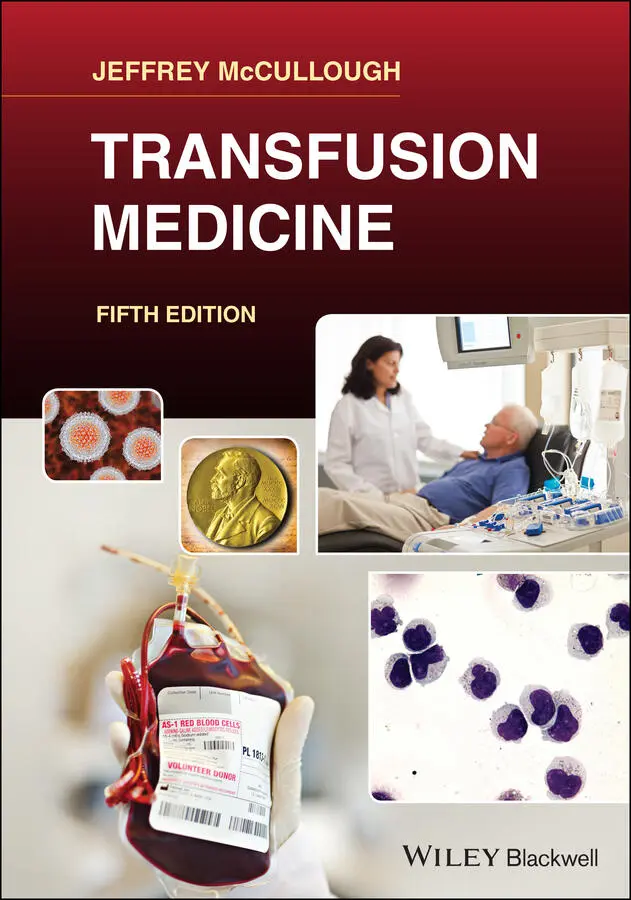
- Название:Transfusion Medicine
- Автор:
- Жанр:
- Год:неизвестен
- ISBN:нет данных
- Рейтинг книги:3 / 5. Голосов: 1
-
Избранное:Добавить в избранное
- Отзывы:
-
Ваша оценка:
Transfusion Medicine: краткое содержание, описание и аннотация
Предлагаем к чтению аннотацию, описание, краткое содержание или предисловие (зависит от того, что написал сам автор книги «Transfusion Medicine»). Если вы не нашли необходимую информацию о книге — напишите в комментариях, мы постараемся отыскать её.
The Fifth Edition of
delivers a succinct, thorough, clinically focused, practical and authoritative treatment of a full range of topics in transfusion therapy. This ranges from issues with the blood supply, recruitment of both whole blood and apheresis donors, blood collection and storage, blood testing, blood safety, and transmissible diseases. This edition has been fully updated and revised to include exciting cellular therapies for cancer, transplantation of both hematopoietic cells and solid organs, infectious diseases and regenerative medicine.
The Fifth Edition includes new authors with highly relevant content that provides a solid grounding for readers in the field. The book:
Is an approachable comprehensive guide to the field of blood banking and transfusion medicine Provides complete and timely perspective on crucial topics, including the HLA system in transfusion medicine and transplantation and quality programs in blood banking and transfusion medicine Is extensively referenced, making it simple for readers to conduct further research on the topics of interest to them Includes new chapters on pediatric transfusion medicine and pathogen reduction Has an expended chapter on patient blood management Provides extensive discussions of the clinical use of blood transfusion in a wide variety of clinical situations including recent development In the management of acute traumatic blood loss Provides updated information about blood groups and molecular testing making inroads into clinical practice along with discussions of laboratory detection of blood groups and provision of red cells Perfect for all those working in the field of blood banking, transfusion medicine and hematology or oncology and fellows in pathology, hematology, surgery and anesthesiology.
is a good introduction for technologists specializing in blood banking and non-medical personnel working in areas related to hematology and transfusion medicine. Transfusion Medicine will also earn a place in the libraries of practicing pathologists with responsibility for blood banks.
Transfusion Medicine — читать онлайн ознакомительный отрывок
Ниже представлен текст книги, разбитый по страницам. Система сохранения места последней прочитанной страницы, позволяет с удобством читать онлайн бесплатно книгу «Transfusion Medicine», без необходимости каждый раз заново искать на чём Вы остановились. Поставьте закладку, и сможете в любой момент перейти на страницу, на которой закончили чтение.
Интервал:
Закладка:
Hemoglobin can be prepared in solution by lysis of red cells. If the remaining cell stroma is removed, the stroma‐free hemoglobin is nonantigenic. However, stroma‐free hemoglobin in solution has a short intravascular life span and has a low P 50(the point at which 50% is saturated). Thus, research has focused on modifying the structure of the hemoglobin molecule (cross‐linking or polymerization) or binding hemoglobin to other molecules to overcome these two problems [161]. Outdated human red cells, bovine hemoglobulin, and recombinant DNA‐produced hemoglobin have been used as sources of hemoglobin. The potential difficulties with hemoglobin‐based oxygen carriers are rapid clearance of the hemoglobin, hypertensive effects, change in the oxygen dissociation curve, hemoglobin metabolites, immunogenicity, and bacterial sepsis [161].
Five products are or have undergone clinical trials: Polyheme (Northfield Laboratories, Evanston, IL, USA), HemAssist (Baxter Healthcare Corporation, Round Lake, IL, USA), Hemopure (Biopure Corporation, Cambridge, MA, USA), Hemolink (Hemosol, Mississauga, ON, Canada), and Sanguinate (Prolong Pharmaceuticals, LLC, South Plainfield, NJ, USA) [162, 163].
Development of HemAssist has been discontinued after randomized trials demonstrated safety problems [164, 165]. Hemopure was used successfully in a patient with severe autoimmune hemolytic anemia [166] and in a patient with sickle cell disease with acute chest syndrome who refused blood transfusion [167]. However, clinical trials of these products have come to a stop [168, 169]. Currently, the FDA has approved expanded access study for Hemopure (compassionate use) for patients with life‐threatening anemia when a transfusion is not an option [170, 171].
In a careful study, 8 patients with severe anemia (hemoglobin levels of 1.2–4.5 g/dL) who refused a blood transfusion received the perfluorocarbon product and were compared with 15 patients who did not [172]. The amount of oxygen delivered by the perfluorocarbon was not clinically significant, and the patients did not benefit. The major observation in this study was the ability of all the patients to tolerate remarkably low hemoglobin levels and the lack of the need for increased arterial oxygen content in the 15 control patients who had hemoglobin levels of approximately 7 g/dL. Fluosol products are not available, nor are they undergoing clinical trial.
Potential clinical uses and impact of hemoglobin substitutes
If a hemoglobin‐based oxygen carrier was developed, it is not likely that it will replace most red cell transfusions. The substitutes might be used for immediate restoration of oxygen delivery, such as in trauma or in other urgent situations involving massive blood loss where red cells are not available quickly, but the short intravascular half‐life of these substitutes makes them impractical for long‐term red cell replacement (for instance, in patients with chronic anemia). Because blood typing and crossmatching would not be necessary, the substitutes might be carried in emergency vehicles, stocked in emergency departments, or used by the military or civilians in situations where access to blood is limited. Other potential uses of hemoglobin substitutes include organ perfusion and preservation prior to transplantation and improving oxygen delivery to tissues that have an impaired blood supply. Unfortunately, it does not appear that a hemoglobin‐based blood substitute [24] will be available soon, and the long‐awaited “blood substitute” is not close to reality.
References
1 1. Jobes DR, Sesok‐Pizzini D, Friedman D. Reduced transfusion requirement with use of fresh whole blood in pediatric cardiac surgical procedures. Ann Thorac Surg 2015; 99(5):1706–1711.
2 2. Manno CS, Hedberg KW, Kim HC, et al. Comparison of the hemostatic effects of fresh whole blood, stored whole blood, and components after open heart surgery in children. Blood 1991; 77(5):930–936.
3 3. Mou SS, Giroir BP, Molitor‐Kirsch EA, et al. Fresh whole blood versus reconstituted blood for pump priming in heart surgery in infants. N Engl J Med 2004; 351(16):1635–1644.
4 4. Spinella PC, Perkins JG, Grathwohl KW, et al. Warm fresh whole blood is independently associated with improved survival for patients with combat‐related traumatic injuries. J Trauma Inj Infect Crit Care 2009; 66(Suppl):S69–S76.
5 5. Shackelford SA, del Junco DJ, Powell‐Dunford N, et al. Association of prehospital blood product transfusion during medical evacuation of combat casualties in Afghanistan with acute and 30‐day survival. JAMA 2017; 318(16):1581.
6 6. Guyette FX, Sperry JL, Peitzman AB, et al. Prehospital blood product and crystalloid resuscitation in the severely injured patient. Ann Surg 2019. Available from: http://dx.doi.org/10.1097/SLA.0000000000003324.
7 7. Seheult JN, Anto V, Alarcon LH, et al. Clinical outcomes among low‐titer group O whole blood recipients compared to recipients of conventional components in civilian trauma resuscitation. Transfusion 2018; 58(8):1838–1845.
8 8. Cotton BA, Podbielski J, Camp E, et al. A randomized controlled pilot trial of modified whole blood versus component therapy in severely injured patients requiring large volume transfusions. Ann Surg 2013; 258(4):527–533.
9 9. Sperry J. Pragmatic prehospital group O whole blood early resuscitation trial (PPOWER). NCT03477006. Available from: https://clinicaltrials.gov/ct2/show/NCT03477006[cited 28 October 2019].
10 10. Spinella PC, Pidcoke HF, Strandenes G, et al. Whole blood for hemostatic resuscitation of major bleeding. Transfusion 2016; 56:S190–S202.
11 11. Spinella PC, Cap AP. Whole blood. Curr Opin Hematol 2016; 23(6):536–542.
12 12. Strandenes G, Berséus O, Cap AP, et al. Low titer group O whole blood in emergency situations. Shock 2014; 41:70–75.
13 13. Becker GA, Tuccelli M, Kunicki T, et al. Studies of platelet concentrates stored at 22 C and 4 C. Transfusion 1973; 13(2):61–68.
14 14. Rous P. The preservation of living red blood cells in vitro: I. Methods of preservation. J Exp Med 1916; 23(2):219–237.
15 15. Loutit JF, Mollison PL. Disodium‐citrate–glucose mixture as a blood preservative. BMJ 1943; 2(4327):744–745.
16 16. Simon E. Red cell preservation: further studies with adenine. Blood 1962; 20:485–491.
17 17. Benesh R, Benesh R. The influence of organic phosphates on the oxygenation of hemoglobin. Fed Proc 1967; 121:96–102.
18 18. Chanutin A, Curnish RR. Effect of organic and inorganic phosphates on the oxygen equilibrium of human erythrocytes. Arch Biochem Biophys 1967; 121(1):96–102.
19 19. Benesch R, Benesch RE. Intracellular organic phosphates as regulators of oxygen release by haemoglobin. Nature 1969; 221(5181):618–622.
20 20. Högman CF, Hedlund K, Zetterström H. Clinical usefulness of red cells preserved in protein‐poor mediums. N Engl J Med 1978; 299(25):1377–1382.
21 21. Högman CF. Additive system approach in blood transfusion: birth of the SAG and Sagman systems. Vox Sang 1986; 51(4):339–340.
22 22. Moroff G, Holme S, Keegan T, Heaton A. Storage of ADSOL‐preserved red cells at 2.5 and 5.5°C: comparable retention of in vitro properties. Vox Sang 1990; 59(3):136–139.
23 23. Simon T, Marcus C, Myhre B, Nelson E. Effects of AS‐3 nutrient‐additive solution on 42 and 49 days of storage of red cells. Transfusion 1987; 27(2):178–182.
24 24. American Association of Blood Banks; Standards Program Committee. Standards for Blood Banks and Transfusion Services, 31st edn. Bethesda, MD: American Association of Blood Banks, 2018.
25 25. Kleinman S, Busch MP, Murphy EL, et al. The National Heart, Lung, and Blood Institute Recipient Epidemiology and Donor Evaluation Study (REDS‐III): a research program striving to improve blood donor and transfusion recipient outcomes. Transfusion 2014; 54(3 pt 2):942–955.
Читать дальшеИнтервал:
Закладка:
Похожие книги на «Transfusion Medicine»
Представляем Вашему вниманию похожие книги на «Transfusion Medicine» списком для выбора. Мы отобрали схожую по названию и смыслу литературу в надежде предоставить читателям больше вариантов отыскать новые, интересные, ещё непрочитанные произведения.









Обсуждение, отзывы о книге «Transfusion Medicine» и просто собственные мнения читателей. Оставьте ваши комментарии, напишите, что Вы думаете о произведении, его смысле или главных героях. Укажите что конкретно понравилось, а что нет, и почему Вы так считаете.