Jeffrey McCullough - Transfusion Medicine
Здесь есть возможность читать онлайн «Jeffrey McCullough - Transfusion Medicine» — ознакомительный отрывок электронной книги совершенно бесплатно, а после прочтения отрывка купить полную версию. В некоторых случаях можно слушать аудио, скачать через торрент в формате fb2 и присутствует краткое содержание. Жанр: unrecognised, на английском языке. Описание произведения, (предисловие) а так же отзывы посетителей доступны на портале библиотеки ЛибКат.
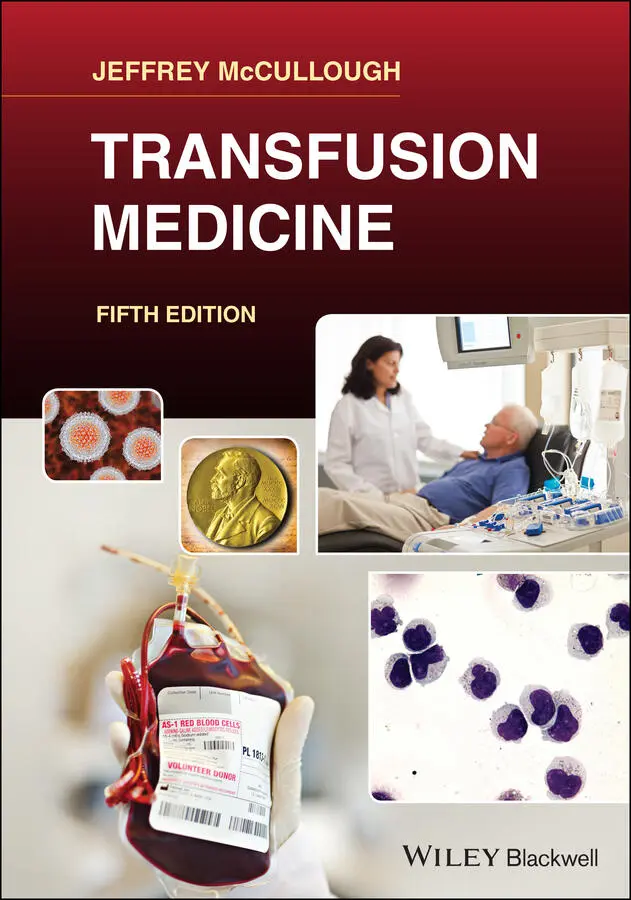
- Название:Transfusion Medicine
- Автор:
- Жанр:
- Год:неизвестен
- ISBN:нет данных
- Рейтинг книги:3 / 5. Голосов: 1
-
Избранное:Добавить в избранное
- Отзывы:
-
Ваша оценка:
Transfusion Medicine: краткое содержание, описание и аннотация
Предлагаем к чтению аннотацию, описание, краткое содержание или предисловие (зависит от того, что написал сам автор книги «Transfusion Medicine»). Если вы не нашли необходимую информацию о книге — напишите в комментариях, мы постараемся отыскать её.
The Fifth Edition of
delivers a succinct, thorough, clinically focused, practical and authoritative treatment of a full range of topics in transfusion therapy. This ranges from issues with the blood supply, recruitment of both whole blood and apheresis donors, blood collection and storage, blood testing, blood safety, and transmissible diseases. This edition has been fully updated and revised to include exciting cellular therapies for cancer, transplantation of both hematopoietic cells and solid organs, infectious diseases and regenerative medicine.
The Fifth Edition includes new authors with highly relevant content that provides a solid grounding for readers in the field. The book:
Is an approachable comprehensive guide to the field of blood banking and transfusion medicine Provides complete and timely perspective on crucial topics, including the HLA system in transfusion medicine and transplantation and quality programs in blood banking and transfusion medicine Is extensively referenced, making it simple for readers to conduct further research on the topics of interest to them Includes new chapters on pediatric transfusion medicine and pathogen reduction Has an expended chapter on patient blood management Provides extensive discussions of the clinical use of blood transfusion in a wide variety of clinical situations including recent development In the management of acute traumatic blood loss Provides updated information about blood groups and molecular testing making inroads into clinical practice along with discussions of laboratory detection of blood groups and provision of red cells Perfect for all those working in the field of blood banking, transfusion medicine and hematology or oncology and fellows in pathology, hematology, surgery and anesthesiology.
is a good introduction for technologists specializing in blood banking and non-medical personnel working in areas related to hematology and transfusion medicine. Transfusion Medicine will also earn a place in the libraries of practicing pathologists with responsibility for blood banks.
Transfusion Medicine — читать онлайн ознакомительный отрывок
Ниже представлен текст книги, разбитый по страницам. Система сохранения места последней прочитанной страницы, позволяет с удобством читать онлайн бесплатно книгу «Transfusion Medicine», без необходимости каждый раз заново искать на чём Вы остановились. Поставьте закладку, и сможете в любой момент перейти на страницу, на которой закончили чтение.
Интервал:
Закладка:
Fresh frozen plasma
Three pathogen‐inactivated FFP products are in use in Europe. Methylene blue can be added to plasma, and subsequent exposure to visible light inactivates most viruses and bacteria [129, 130]. The plasma can then be frozen as an FFP product. Three other pathogen inactivation methods are used for both plasma and platelets [118–122]. One uses a psoralen compound and ultraviolet A (UV‐A) light [131], one uses riboflavin and ultraviolet B (UV‐B) light [132], and a third method uses ultraviolet C (UV‐C) light [133]. The psoralen compound followed by UV light results in intercalation into DNA or RNA with cross‐links. Riboflavin damages DNA upon exposure to UV light. Both methods prevent nucleic acid replication. Thus, contaminating pathogens are inactivated, but platelets are not damaged. Extensive toxicity, mutagenicity, and pharmacologic studies have given satisfactory results. The psoralen product has satisfactory coagulation factor levels and provides posttransfusion increases in coagulation factors similar to ordinary FFP [131]. The riboflavin‐treated FFP also has satisfactory levels of coagulation factors [132]. Because these products are relatively new, there is little clinical experience reported, but the psoralen product is effective in patients with bleeding due to liver disease [134] and for replacement in patients with thrombotic thrombocytopenic purpura [135]. Plasma treated with the psoralen method is now FDA approved for use in the United States.
Table 5.11 Coagulation factor and inhibitor levels in 12 lots of Octaplas.
Source : Adapted from Solheim BG, Hellstern P. Composition, efficacy, and safety of S/D‐treated plasma. Transfusion 2003; 43:1176–1178.
| Measure | Reference range | Octaplas ( n = 12) a |
| PT (s) | 12.5–16.1 | 13.3 (12.9–13.8) |
| aPTT (s) | 28–40 | 35 (34–37) |
| Fibrinogen (g/L) | 1.45–3.85 | 2.5 (2.4–2.6) |
| Prothrombin | 65–154 | 83 (79–86) |
| Factor V (U/100 mL) | 54–145 | 78 (75–84) |
| Factor VII (U/100 mL) | 62–165 | 108 (90–117) |
| Factor X (U/100 mL) | 68–148 | 78 (75–80) |
| Factor VIIa (mU/mL) | 25–170 | 166 (134–209) |
| Protein C activity (U/100 mL) | 58–164 | 85 (81–87) |
| Protein S activity (U/100 mL) | 56–168 | 64 (55–71) |
| PI (U/100 mL) | 72–132 | 23 (20–27) |
| Plasminogen (U/100 mL) | 68–144 | 96 (92–101) |
| Citrate (mM) | 17.5 (14.2–20.9) |
aPTT, activated partial thromboplastin time; PT, prothrombin time.
aData are reported as mean (range).
Platelets
Three methods used for pathogen inactivation of FFP are also being used to treat platelets [118–121, 136–138]. Initial studies in healthy research subjects and studies in patients with thrombocytopenia indicate satisfactory platelet function for both the psoralen and riboflavin methods [138–140]. Successful clinical trials in Europe using psoralen‐treated platelets prepared by the buffy coat method [141] and in the United States using apheresis platelets [142, 143] have been reported, and those platelets are widely used in Europe [144]. Riboflavin‐treated platelets also appear to be clinically effective [145]. Follow‐up of large numbers of patients do not indicate any unexpected adverse consequences from use of the psoralen‐treated platelets [146].
Red cells
Two different approaches are under development for inactivation of transfusion‐transmissible pathogens in RBC components. These involve riboflavin [147] and an alkylating agent [148]. The methods involve selective damage to nucleic acid strands, thus inactivating contaminating pathogens while sparing red cells [122]. The methods are effective against most common bacteria, viruses, and protozoa that would be of concern in blood transfusion [122].
Red cells treated with S303 for pathogen inactivation had in vitro properties similar to paired untreated controls for hemolysis, glucose consumption and potassium release, lower lactate levels and pH, and higher ATP, with significant loss of 2,3‐DPG. Thus, in vitro studies of S303 red cells are essentially not significantly different from untreated red cells [148–151].
A clinical trial in cardiovascular surgery was successful, except that two patients developed clinically nonsignificant antibodies to the treated red cells [152]. That method has been revised, and the clinical trial of the revised method in chronically transfused patients with thalassemia reported no difference in efficacy and safety between the control and study groups [153, 154]. The riboflavin method also results in satisfactory red cells [155], and a clinical trial of that WB product prevented transfusion‐transmitted malaria [156].
Inactivation of viruses and bacteria in cellular components, a strategy almost unthinkable a decade ago, is also showing exciting promise with a platelet and two plasma products now FDA approved in the United States. If a WB/red cell technology becomes available, there will certainly be a major impact on the blood supply system and the nature of blood centers producing these components. See Chapter 16for more details on pathogen inactivation technology.
5.10 Universal red cells
Two approaches have been attempted to convert A or B red cells to type O. If such a process became practical and widely adopted, it could have a huge impact on blood banking by eliminating most inventory management issues and making more blood available by eliminating outdating of type A and B units. Development of these technologies has been difficult, and neither is near clinical use.
Enzymatic cleavage of ABO and Rh antigen
Enzymes can cleave the sugars that confer A and B specificities [157, 158]. The enzymes for this cleavage have been cloned and are available on a scale sufficient to allow for the production of clinical doses of red cells from which the A and B antigens have been removed. Most of the experience involves successful conversion of group B to group O [157]. Although A‐to‐O conversion is possible, some A determinants remained on the carbohydrate, and this work was halted. Clinical trials of enzymatically converted B type RBCs on healthy volunteers reported no signs of hemolysis [157].
Masking ABO antigens
A different approach to altering the RBC membrane to convert group A or B red cells into group O red cells is to mask the antigens to produce “stealth” red cells. Polyethylene glycol has been used to covalently bond to red cells to mask blood group antigens, such as ABO, Rh, Kell, and Kidd [159]. Small studies in animals suggest that there is little in vitro damage to the red cells and that they have a normal survival, although such studies have not yet been carried out in humans. It is not clear whether development of this process will continue.
5.11 Blood substitutes
The functions of blood can be grouped generally as maintenance of intravascular volume, delivery of oxygen to tissues, provision of coagulation factors, provision of some defense mechanisms, and transportation of metabolic waste products. Considerable effort has been made to develop blood substitutes or artificial blood, but these products deal only with the oxygen‐delivery function. Thus, more appropriate terms are hemoglobin or red cell substitutes [160].
The ideal acellular red cell substitute would not require crossmatching or blood typing, could be stored preferably at room temperature for a long period, would have a reasonable intravascular life span and thereafter be excreted promptly, and would be free of toxicity or disease transmission. Two approaches have been used: perfluorocarbons, compounds in which oxygen is highly soluble, and free hemoglobin solutions using either human or animal hemoglobin [161]. Hemoglobin chemically binds oxygen, whereas perfluorocarbons have a carbon backbone with fluorine substitutions that have solubility for oxygen 20 times greater than water. The physiologic benefit of this high solubility for oxygen has been demonstrated dramatically by the survival of mice completely immersed in a solution of well‐oxygenated perfluorocarbons.
Читать дальшеИнтервал:
Закладка:
Похожие книги на «Transfusion Medicine»
Представляем Вашему вниманию похожие книги на «Transfusion Medicine» списком для выбора. Мы отобрали схожую по названию и смыслу литературу в надежде предоставить читателям больше вариантов отыскать новые, интересные, ещё непрочитанные произведения.








Обсуждение, отзывы о книге «Transfusion Medicine» и просто собственные мнения читателей. Оставьте ваши комментарии, напишите, что Вы думаете о произведении, его смысле или главных героях. Укажите что конкретно понравилось, а что нет, и почему Вы так считаете.