Jeffrey McCullough - Transfusion Medicine
Здесь есть возможность читать онлайн «Jeffrey McCullough - Transfusion Medicine» — ознакомительный отрывок электронной книги совершенно бесплатно, а после прочтения отрывка купить полную версию. В некоторых случаях можно слушать аудио, скачать через торрент в формате fb2 и присутствует краткое содержание. Жанр: unrecognised, на английском языке. Описание произведения, (предисловие) а так же отзывы посетителей доступны на портале библиотеки ЛибКат.
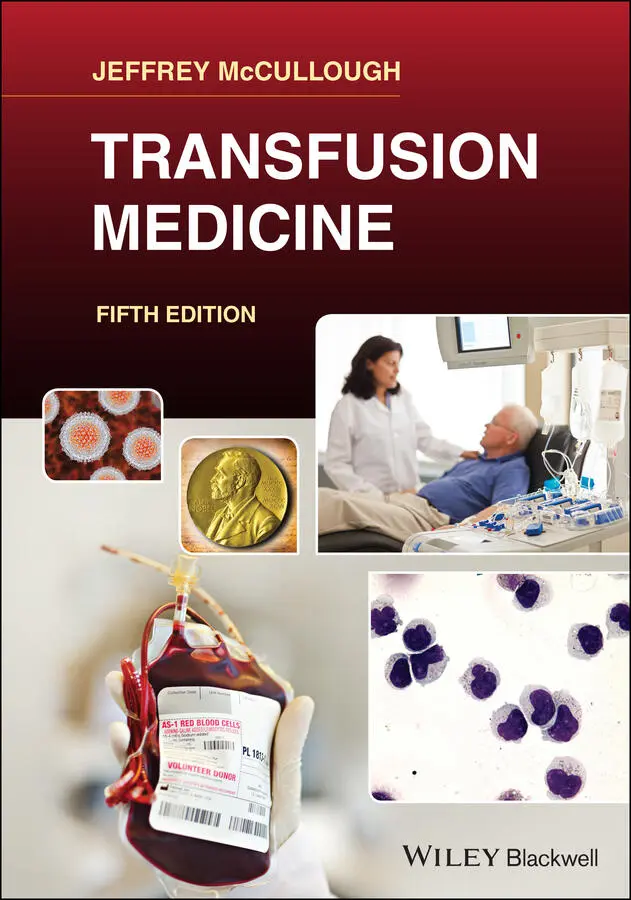
- Название:Transfusion Medicine
- Автор:
- Жанр:
- Год:неизвестен
- ISBN:нет данных
- Рейтинг книги:3 / 5. Голосов: 1
-
Избранное:Добавить в избранное
- Отзывы:
-
Ваша оценка:
Transfusion Medicine: краткое содержание, описание и аннотация
Предлагаем к чтению аннотацию, описание, краткое содержание или предисловие (зависит от того, что написал сам автор книги «Transfusion Medicine»). Если вы не нашли необходимую информацию о книге — напишите в комментариях, мы постараемся отыскать её.
The Fifth Edition of
delivers a succinct, thorough, clinically focused, practical and authoritative treatment of a full range of topics in transfusion therapy. This ranges from issues with the blood supply, recruitment of both whole blood and apheresis donors, blood collection and storage, blood testing, blood safety, and transmissible diseases. This edition has been fully updated and revised to include exciting cellular therapies for cancer, transplantation of both hematopoietic cells and solid organs, infectious diseases and regenerative medicine.
The Fifth Edition includes new authors with highly relevant content that provides a solid grounding for readers in the field. The book:
Is an approachable comprehensive guide to the field of blood banking and transfusion medicine Provides complete and timely perspective on crucial topics, including the HLA system in transfusion medicine and transplantation and quality programs in blood banking and transfusion medicine Is extensively referenced, making it simple for readers to conduct further research on the topics of interest to them Includes new chapters on pediatric transfusion medicine and pathogen reduction Has an expended chapter on patient blood management Provides extensive discussions of the clinical use of blood transfusion in a wide variety of clinical situations including recent development In the management of acute traumatic blood loss Provides updated information about blood groups and molecular testing making inroads into clinical practice along with discussions of laboratory detection of blood groups and provision of red cells Perfect for all those working in the field of blood banking, transfusion medicine and hematology or oncology and fellows in pathology, hematology, surgery and anesthesiology.
is a good introduction for technologists specializing in blood banking and non-medical personnel working in areas related to hematology and transfusion medicine. Transfusion Medicine will also earn a place in the libraries of practicing pathologists with responsibility for blood banks.
Transfusion Medicine — читать онлайн ознакомительный отрывок
Ниже представлен текст книги, разбитый по страницам. Система сохранения места последней прочитанной страницы, позволяет с удобством читать онлайн бесплатно книгу «Transfusion Medicine», без необходимости каждый раз заново искать на чём Вы остановились. Поставьте закладку, и сможете в любой момент перейти на страницу, на которой закончили чтение.
Интервал:
Закладка:
A disconnect exists between blood supply shortages and demographic reports that there are actually more eligible blood donors in the United States [33]. Simply put, it should be easier to meet the blood unit demands of the US medical system. However, experiences have shown that 12 million units in 2017 were donated by 9 million donors, representing 4.8% of the of the population eligible to donate. For many reasons, from demographics to logistics, many potential donors do not present to donate [33].
Donors are also more time conscious and desire a shorter (or more efficient) donor experience. Long wait times and screening may deter some from many blood drives. Blood collectors are looking at more self‐directed donor screening and additional software changes to decrease donor wait times.
Perhaps the most contentious area affecting continued donation may be iron depletion of blood donors. This is a widely debated area, with some medical directors arguing for more stringent monitoring of donor iron loss and others suggesting that we maintain the status quo. A review by Zalpuri et al. [34] addresses existing literature from 12 studies, regarding whole blood donors and health consequences from iron deficiency. The authors did note a high prevalence of iron deficiency among whole blood donors. The studies were much more conflicting as to what symptoms or conclusions could be drawn.
One confounding factor was that there is a lack of universally representative iron parameters for iron deficiency. Another confounding issue is that replenishment of hemoglobin and ferritin levels across the population of whole blood donors is widely varied, making comparisons between studies difficult. Ultimately, the effect of blood donation and subsequent iron deficiency (or transient deficiency) on overall quality of life could not be found [34].
Social influences on blood donation and social media
Because blood donation is not done in private, it is by definition a “social” act [4]. It is not surprising that social factors and issues have a strong influence on blood donation. Social norms of the community affect donation behavior. For example, general publicity about blood donation in the community creates the perception that blood donation is an active part of the community, thus setting the stage for positive decisions by individuals to donate. This, together with “intrinsic” motivational appeals, builds a community norm for blood donation.
Volunteerism plays a major role in blood donation. A sense of social connection is gained, a feeling of helping others, and a history of volunteerism in the family or during their school years characterize blood donors [10].
The differing factors of social media’s influence on blood donation cannot be understated [35]. Most blood collection centers now have a dedicated strategy for social media representation and recruitment. Many centers turn to these media in times of inventory crisis, to contact engaged donors to turn out to drives and fixed sites. Because centers are doing with less financially, they can get messages out to donors in large numbers, many times at no cost. This is especially useful in expanding drive hours, or in the event of adverse conditions closing or canceling a drive or closing a center (early).
Family history of donation or blood use
Blood donors are more likely to have had family members who were blood donors [4]. It is not clear whether blood use by a relative or close friend influences the likelihood that one will be a blood donor [6].
The donation situation
Blood is collected in both fixed and mobile sites. Fixed sites are facilities that are permanently outfitted to serve as a blood donation center. These sites are usually within the blood center or hospital but may be in freestanding locations, such as office buildings or shopping malls. The proportion of blood that is collected in fixed sites is not known and may vary greatly based on different blood centers’ collection strategies. In the Southern parts of the United States, mobile collections operations may predominate based on favorable logistic and climate conditions. A very large portion of the US blood supply is collected in mobile sites. A mobile site is a location that usually serves a purpose other than blood donation. Examples are offices, high schools, social clubs, churches, colleges, manufacturing companies, public buildings, or shopping malls. At the mobile site, or “bloodmobile,” all of the equipment and supplies necessary for blood collection are portable and are brought in for a few hours or days for the blood collection activity, or is a bus specially outfitted for blood donation. Donors at mobile sites are more likely to be first‐time donors, giving under social pressure, and thus with less internal motivation to donate, and they are more likely to experience a reaction or less‐than‐optimal experience [4]. However, the influence that these settings have on the likelihood that an individual will donate or will have a good experience and be willing to donate again is not well understood. There are differences between those who donate at fixed sites and those who donate at mobile locations [4]. Donors at fixed sites report more internal motivation, whereas those at mobile sites report more external motivation. This would be consistent with the structure of mobile sites, which are usually arranged around a blood “drive” of some sort involving a community group or a particular need, thus providing the “external” motivation. At fixed sites, the donor is usually called by blood center staff and the donation scheduled as part of the general ongoing blood collection activity, but there is no relation to a particular community or social group or patient.
Organizational influences
Different types of organization are involved in collecting blood and providing the nation’s blood supply (see Chapter 2), and these may influence people’s willingness to donate. Such preferences could be because of the nature of the organization or the individual donor’s motivation. One major difference among organizations is hospital‐based donor programs versus community‐based freestanding blood centers. Because the community‐based blood center serves multiple hospitals, the organization (and, by extension, a donation made to it) carries an image of service to the general medical community, along with a feeling of community pride and allegiance. The nature of the community organization may also influence the individual’s willingness to donate. About half of the blood collection in community centers is carried out by the American Red Cross. The other half of blood collection is performed by freestanding organizations whose mission is the provision of blood services. In contrast, a hospital‐based program is associated with a specific medical center and can take advantage of the image of that center and its physicians, programs, and patients. Although there are no definitive studies, it seems likely that these factors influence the types of donor and their motivation for donating to different organizations. The differences between organizations involved may also affect the setting in which the blood is collected, and thus may indirectly influence the donors or their motivation. For instance, hospital‐based donor programs are more likely to use fixed sites for blood collection. Although community‐based blood centers use some fixed sites, they use mobile sites more extensively than hospital programs.
Role of incentives
A variety of incentives, ranging from small trinkets, such as key chains, coffee mugs, or T‐shirts, to tickets to events to cash, have been offered to donors in hopes of motivating them to continue to donate. In almost every study worldwide, paying donors results in donors with a higher likelihood of transmitting disease [32, 36]. Thus, organizations such as the American Association of Blood Banks, the American Red Cross, the International Society for Blood Transfusion, the World Health Organization, and most countries that have a national blood policy stipulate that blood for transfusion be obtained from volunteer donors. The definition of volunteerism in blood donation is whether the incentive is transferable, refundable, or redeemable, or whether a market for it exists [37]. If none of these applies, it is presumed that the incentive could not be converted into cash.
Читать дальшеИнтервал:
Закладка:
Похожие книги на «Transfusion Medicine»
Представляем Вашему вниманию похожие книги на «Transfusion Medicine» списком для выбора. Мы отобрали схожую по названию и смыслу литературу в надежде предоставить читателям больше вариантов отыскать новые, интересные, ещё непрочитанные произведения.








Обсуждение, отзывы о книге «Transfusion Medicine» и просто собственные мнения читателей. Оставьте ваши комментарии, напишите, что Вы думаете о произведении, его смысле или главных героях. Укажите что конкретно понравилось, а что нет, и почему Вы так считаете.