Jeffrey McCullough - Transfusion Medicine
Здесь есть возможность читать онлайн «Jeffrey McCullough - Transfusion Medicine» — ознакомительный отрывок электронной книги совершенно бесплатно, а после прочтения отрывка купить полную версию. В некоторых случаях можно слушать аудио, скачать через торрент в формате fb2 и присутствует краткое содержание. Жанр: unrecognised, на английском языке. Описание произведения, (предисловие) а так же отзывы посетителей доступны на портале библиотеки ЛибКат.
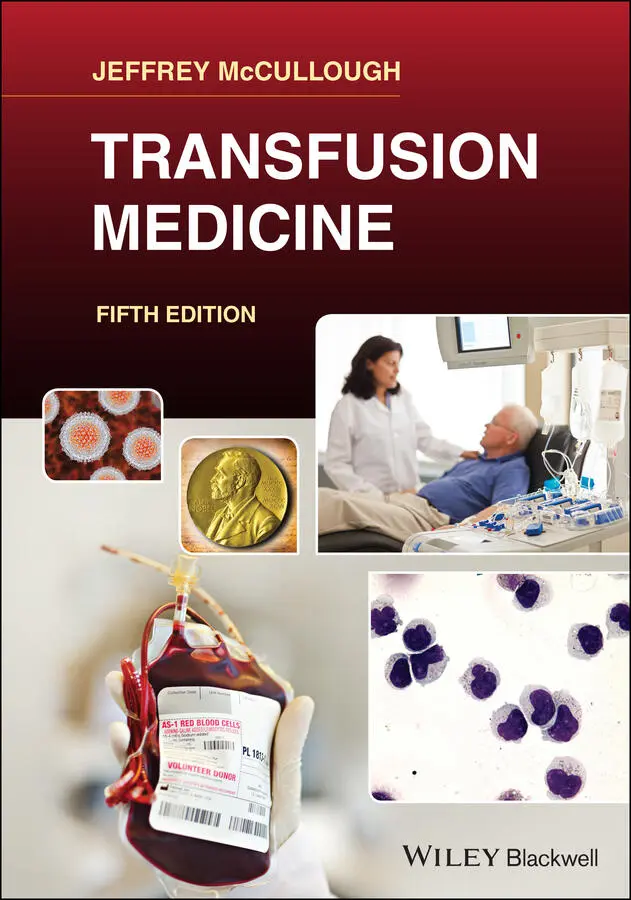
- Название:Transfusion Medicine
- Автор:
- Жанр:
- Год:неизвестен
- ISBN:нет данных
- Рейтинг книги:3 / 5. Голосов: 1
-
Избранное:Добавить в избранное
- Отзывы:
-
Ваша оценка:
Transfusion Medicine: краткое содержание, описание и аннотация
Предлагаем к чтению аннотацию, описание, краткое содержание или предисловие (зависит от того, что написал сам автор книги «Transfusion Medicine»). Если вы не нашли необходимую информацию о книге — напишите в комментариях, мы постараемся отыскать её.
The Fifth Edition of
delivers a succinct, thorough, clinically focused, practical and authoritative treatment of a full range of topics in transfusion therapy. This ranges from issues with the blood supply, recruitment of both whole blood and apheresis donors, blood collection and storage, blood testing, blood safety, and transmissible diseases. This edition has been fully updated and revised to include exciting cellular therapies for cancer, transplantation of both hematopoietic cells and solid organs, infectious diseases and regenerative medicine.
The Fifth Edition includes new authors with highly relevant content that provides a solid grounding for readers in the field. The book:
Is an approachable comprehensive guide to the field of blood banking and transfusion medicine Provides complete and timely perspective on crucial topics, including the HLA system in transfusion medicine and transplantation and quality programs in blood banking and transfusion medicine Is extensively referenced, making it simple for readers to conduct further research on the topics of interest to them Includes new chapters on pediatric transfusion medicine and pathogen reduction Has an expended chapter on patient blood management Provides extensive discussions of the clinical use of blood transfusion in a wide variety of clinical situations including recent development In the management of acute traumatic blood loss Provides updated information about blood groups and molecular testing making inroads into clinical practice along with discussions of laboratory detection of blood groups and provision of red cells Perfect for all those working in the field of blood banking, transfusion medicine and hematology or oncology and fellows in pathology, hematology, surgery and anesthesiology.
is a good introduction for technologists specializing in blood banking and non-medical personnel working in areas related to hematology and transfusion medicine. Transfusion Medicine will also earn a place in the libraries of practicing pathologists with responsibility for blood banks.
Transfusion Medicine — читать онлайн ознакомительный отрывок
Ниже представлен текст книги, разбитый по страницам. Система сохранения места последней прочитанной страницы, позволяет с удобством читать онлайн бесплатно книгу «Transfusion Medicine», без необходимости каждый раз заново искать на чём Вы остановились. Поставьте закладку, и сможете в любой момент перейти на страницу, на которой закончили чтение.
Интервал:
Закладка:
30 30. Joseph BG, Hendry C, Walsh TS. Red blood cell use outside the operating theater: a prospective observational study with modeling of potential blood conservation during severe blood shortages. Transfusion 2009; 49:2060–2069.
31 31. Bowman R, Clay M, Therkelsen D, et al. Donor attitudes about exporting and importing blood. Transfusion. 1997; 37:913–930.
32 32. Cohn EJ, Oncley JL, Strong LE, et al. Chemical, clinical, and immunological studies on the products of human plasma fractionation. J Clin Invest 1944; 23:417–606.
33 33. Lamb M. Source plasma: future outlook. Transfusion 2009; 49:1520–1526.
34 34. Burnouf T. Modern fractionation. Transfus Med Rev 2007; 21:101–117.
35 35. Plasma Protein Therapeutics Association. Available from: https://www.pptaglobal.org/.
36 36. Code of Federal Regulations, Subchapter F, 640.60; 1992.
37 37. Plasma Protein Therapeutics Association. Plasma Collection. Available from: https://www.pptaglobal.org/plasma(accessed August 2020).
3 Recruitment of Blood Donors
Thomas Watkins DO, PhD
The recruitment of donors has undergone several changes over the last few years. Regulatory agencies have allowed for a 1‐year deferral for males having sex with males (MSM), and societal acceptance toward nonbinary/gender fluid donors has had an effect on who presents to donate blood. Further research has raised awareness of iron depletion among donors, and emerging viral and parasitic infections have affected some travel deferrals and are likely to continue to evolve. As traditional print/radio/television media outlets are becoming somewhat less effective in reaching a more diverse donor population, blood providers have needed to become more adept at social media and targeted messaging to different groups. Patient blood management programs and aggressive cost control in hospital supply chain management have increased overall focus on cost savings, driving the process of donor recruitment toward maximum operational efficiency at blood centers from small to large. Health care reform has led hospitals to increasing their focus on cost savings, which has led to blood providers experiencing significant cost constraints. The commoditization of blood and decreasing contract prices for blood products have negatively affected operating margins for many blood centers. Blood collectors are having to do more specific recruiting with less financial resources. In the effort to decrease costs, there have been significant collaborations and mergers between formerly independent blood centers affecting the local identity and community relationships between blood collections and the donor base.
3.1 Demographic characteristics of blood donors
Although most Americans will require a blood transfusion at some time in their lives, it is said that less than 5% of the total population or less than 10% of those eligible to donate have ever done so, although there are no data to directly support this. A surprisingly limited portion of the US population is eligible [1–3]. Many donors give once or infrequently, and much of the nation’s blood supply comes from a small number of dedicated and frequent donors. Blood donors differ from the general population. The demographic characteristics or other factors related to the likelihood of an individual being a blood donor are age, marital status, gender, educational experience, occupation, peer pressure, humanitarianism, fear of the unknown, apathy, self‐esteem, race, social pressure, altruism, volunteerism, convenience, and community service [4–10]. These characteristics are described in more detail in the following subsections.
Gender
There is a preponderance of females among first‐time donors [4], but with subsequent donations the ratio shifts to a male preponderance of 60–80% [6, 9], with an overall average of 52% of donors being males [11]. Deferral has a more pronounced effect on first‐time compared with repeat blood donors, and because women are more likely to have a reaction during donation and reactions reduce the likelihood of a donor returning, the gender distribution shifts with advancing age to an increasing percentage of men compared with women. The greatest loss of female donors apparently occurs at about the fourth to eighth donation. In general, the larger the number of lifetime donations the greater is the male preponderance [9]. It seems likely that the shift from female to male donors with increasing numbers of donations is a result of deferral of women in the childbearing age who become iron deficient from menstrual blood loss.
As demographics have changed, there has been an increase in nonbinary gender donors, leading to changes in screening. Further complicating the process are programs of preexposure prophylaxis medication for individuals at risk for acquiring HIV.
Age
Most donors are 30–50 years old, with an average age between 33 and 38 years [4, 9, 11]. The age range of donors shifted during the 1980s and 1990s from only about 2–3% of donors older than 60 years in the 1970s to 10% of donors older than 60 years and 4% older than 65 years in the 1990s [9]. This apparent “aging” of the donor population could reflect a shift in the population age in general; however, during the past few years, blood bank professionals have recognized that blood donation is safe for older individuals, and donor age limits have therefore been extended to attract older donors (see Chapter 4). During the past few years, recruitment of college and high school students has been emphasized, and they now account for about 8% of donations [12]. Younger donors are more likely than repeat donors to experience a reaction [12, 13]. Because donors who experience a reaction are less likely to return [12–15], strategies to minimize reactions in young and first‐time donors are being developed (see Chapter 4). Donors most likely to return are those aged 16 and 17 years and older than 50 years, males, blood group O donors (probably because they are sought by the blood centers), and those without any initial adverse reaction [15, 16].
Race/Ethnicity
There are differences in the rate of donation by different ethnic groups. In 1975, whites were 48% more likely to have donated blood during the previous year than non‐whites [17]. By 1989, this figure had increased to 56%. Minority and Latin America–born donors are younger and more likely first time compared with white US‐born donors, but the annual donation frequency of these minority donors is only slightly lower than white US‐born donors [17].
Education and socioeconomic characteristics
Blood donors tend to have more education and higher incomes than the general population, with incomes as much as 30% higher than those of nondonors. Donors with some college education are the most overrepresented group compared with nondonors. Lightman [18] found that 60% of blood donors in Toronto, Canada, had some post–high school education, compared with 20% for the entire city. Bowman et al. [11] found that 77% of their donors had some post–high school education, with a range of 60–80% in the different blood centers participating in the study. In a separate study, 69% of all donors and 79% of multigallon donors had more than a high school education.
Employment
In Bowman et al.’s study [11], 80% of donors were employed full time and another 9% part time. Seven percent were retired, which is consistent with the 10% of donors who were 60 years or older.
Other social characteristics
It is important to understand donors’ behavior that might increase their likelihood of transmitting disease. Compared with the general population, it appears that donors have fewer sex partners, less frequent sexual experiences, fewer homosexual experiences in males, and are less likely to engage in behavior that puts them at risk for transfusion‐transmissible diseases, although about 1.5% report some kind of risk behavior [19]. In one study, 8% of young “potential” donors tested positive for drugs of abuse [20], but because these were not actual donors, it is not clear whether this experience would apply to blood donors.
Читать дальшеИнтервал:
Закладка:
Похожие книги на «Transfusion Medicine»
Представляем Вашему вниманию похожие книги на «Transfusion Medicine» списком для выбора. Мы отобрали схожую по названию и смыслу литературу в надежде предоставить читателям больше вариантов отыскать новые, интересные, ещё непрочитанные произведения.










Обсуждение, отзывы о книге «Transfusion Medicine» и просто собственные мнения читателей. Оставьте ваши комментарии, напишите, что Вы думаете о произведении, его смысле или главных героях. Укажите что конкретно понравилось, а что нет, и почему Вы так считаете.