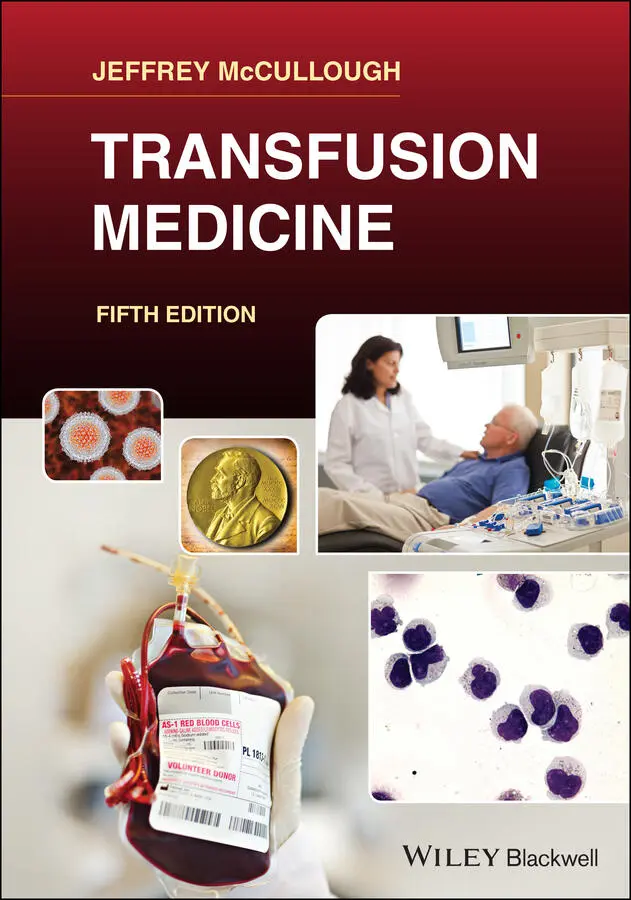
Jeffrey McCullough - Transfusion Medicine
Здесь есть возможность читать онлайн «Jeffrey McCullough - Transfusion Medicine» — ознакомительный отрывок электронной книги совершенно бесплатно, а после прочтения отрывка купить полную версию. В некоторых случаях можно слушать аудио, скачать через торрент в формате fb2 и присутствует краткое содержание. Жанр: unrecognised, на английском языке. Описание произведения, (предисловие) а так же отзывы посетителей доступны на портале библиотеки ЛибКат.
- Название:Transfusion Medicine
- Автор:
- Жанр:
- Год:неизвестен
- ISBN:нет данных
- Рейтинг книги:3 / 5. Голосов: 1
-
Избранное:Добавить в избранное
- Отзывы:
-
Ваша оценка:
Transfusion Medicine: краткое содержание, описание и аннотация
Предлагаем к чтению аннотацию, описание, краткое содержание или предисловие (зависит от того, что написал сам автор книги «Transfusion Medicine»). Если вы не нашли необходимую информацию о книге — напишите в комментариях, мы постараемся отыскать её.
The Fifth Edition of
delivers a succinct, thorough, clinically focused, practical and authoritative treatment of a full range of topics in transfusion therapy. This ranges from issues with the blood supply, recruitment of both whole blood and apheresis donors, blood collection and storage, blood testing, blood safety, and transmissible diseases. This edition has been fully updated and revised to include exciting cellular therapies for cancer, transplantation of both hematopoietic cells and solid organs, infectious diseases and regenerative medicine.
The Fifth Edition includes new authors with highly relevant content that provides a solid grounding for readers in the field. The book:
Is an approachable comprehensive guide to the field of blood banking and transfusion medicine Provides complete and timely perspective on crucial topics, including the HLA system in transfusion medicine and transplantation and quality programs in blood banking and transfusion medicine Is extensively referenced, making it simple for readers to conduct further research on the topics of interest to them Includes new chapters on pediatric transfusion medicine and pathogen reduction Has an expended chapter on patient blood management Provides extensive discussions of the clinical use of blood transfusion in a wide variety of clinical situations including recent development In the management of acute traumatic blood loss Provides updated information about blood groups and molecular testing making inroads into clinical practice along with discussions of laboratory detection of blood groups and provision of red cells Perfect for all those working in the field of blood banking, transfusion medicine and hematology or oncology and fellows in pathology, hematology, surgery and anesthesiology.
is a good introduction for technologists specializing in blood banking and non-medical personnel working in areas related to hematology and transfusion medicine. Transfusion Medicine will also earn a place in the libraries of practicing pathologists with responsibility for blood banks.
Transfusion Medicine — читать онлайн ознакомительный отрывок
Ниже представлен текст книги, разбитый по страницам. Система сохранения места последней прочитанной страницы, позволяет с удобством читать онлайн бесплатно книгу «Transfusion Medicine», без необходимости каждый раз заново искать на чём Вы остановились. Поставьте закладку, и сможете в любой момент перейти на страницу, на которой закончили чтение.
Интервал:
Закладка:
2.8 Federation of Red Cross and Red Crescent Societies
The Federation of Red Cross and Red Crescent Societies, located in Geneva, Switzerland, is the central coordinating organization for all individual country Red Cross or Red Crescent Societies. Although most of the Federation’s activities involve humanitarian assistance in times of war or disaster, there is a small blood program office. Approximately 180 National Red Cross or Red Crescent Societies are involved in blood programs. Because of the wide variety of Red Cross involvement and the diverse nature of these Red Cross blood programs, the focus of the blood program at the Federation is on blood donor recruitment. When appropriate, the Federation collaborates with the Global Blood Safety unit at WHO, which is made all the more convenient by their close proximity.
2.9 International Society for Blood Transfusion
The International Society for Blood Transfusion, founded in 1935, is composed of almost 1,400 medical, scientific, technical, or managerial individuals involved with blood transfusion. Members represent more than 100 countries. The mission of the International Society for Blood Transfusion is to establish close and mutually beneficial working relationships with international and national professional societies, together with intergovernmental and nongovernmental organizations. By this means, it is possible to disseminate knowledge of how blood transfusion medicine and science may best serve the patient; to create global and regional opportunities for the presentation of research, new developments, and changing concepts in blood transfusion medicine and science and related disciplines; to make provision for the exchange of views and information among members; to promote and to maintain a high level of ethical, medical, and scientific standards in blood transfusion medicine and science throughout the world; and to encourage the development of collaborative programs of good manufacturing and laboratory and user practices in all countries, particularly those with less well‐developed blood transfusion services. The Society publishes Vox Sanguinis , a scientific journal on blood transfusion, transfusion medicine, and blood banking, and a newsletter, Transfusion Today . It also sponsors world and regional congresses, which provide an excellent forum for discussion of not only highly technical subjects and innovations but also issues important to less developed blood transfusion situations.
2.10 Regulation of the blood supply system
US Federal Regulation
Blood is considered a drug and is regulated by the FDA. The legal basis for this regulation of blood, blood components, and plasma derivatives is provided by two separate but overlapping statutes, one governing “biologics” and one governing “drugs.” The biologics law requires that any “virus, therapeutic serum, toxin, anti‐toxin, or analogous product” be prepared in a facility holding an FDA license [36]. A separate law, the Pure Food and Drugs Act, covers drugs intended for the “cure, mitigation, or prevention of disease,” and thus includes biologics such as blood and blood components or plasma derivatives. Thus, blood banks are subject to the biologics and the drug regulatory process. The federal requirements for blood banks are specified in the Code of Federal Regulations. In addition, the FDA publishes “guidelines” that specify the agency’s recommendations of specific policies, procedures, or actions regarding any aspect of the acquisition of blood.
FDA law requires that all organizations involved in “collection, preparation, processing, or compatibility testing … of any blood product” [36] register with the FDA. This registration allows the organization to collect blood and prepare blood components for its own use. If the organization wishes to ship the components across state lines or engage in commerce by selling the products to other organizations, the organization must obtain an FDA license for this purpose. Thus, for practical purposes, most hospitals that collect blood or prepare blood components for their own use are registered, but not licensed, because they do not ship blood in interstate commerce. Most blood centers are licensed, because they supply multiple hospitals, some of which may be in other states. In addition, blood centers may wish to participate in blood resource sharing with blood centers in other states, and thus need to be licensed for interstate shipment of blood.
Federal licensure is intended to ensure that the facility in which the biologic is produced will provide products with high purity and quality. In addition to licensing the facility or establishment, this law requires that each biologic product itself be licensed by the FDA. Thus, to produce a licensed biologic, an organization must have an establishment license describing the facility in which the product is produced and a product license describing the specific product being produced. Over the years, this law has been specifically amended to include the terms blood and blood component or derivative to make it clear that blood is subject to the biologics’ regulation. Blood banks and plasma derivative manufacturers are inspected every other year by the FDA, and they must submit a report annually to the FDA indicating which products are collected, tested, prepared, and distributed.
When an organization applies for an FDA license to produce blood components or plasma derivatives, it must provide the credentials of the person in charge (responsible head) and of those responsible for determining donor suitability, blood collection, and laboratory processing and testing. In addition, it must provide blueprints and floor plans of the facility; descriptions of all equipment; indications of any other activities occurring in the facility; provisions for housekeeping, pest control, ventilation, lighting, and water systems; other occupants of the building; activity in adjacent buildings; record maintenance systems; validation of all systems; quality‐control/assurance programs; procedures for receipt and handling of raw materials; source of starting materials; methods and facilities for any chemical purification; inactivation or transfer steps; formulation and final product preparation; computer systems; and other miscellaneous information.
Along with the establishment license, the organization must file a product license application for each product it plans to produce in the facility. For whole blood and components, the product application involves basic information about the manufacturer (organization), facility, product, standard operating procedures, blood donor screening tests, frequency of donation, donor medical history, presence of a physician, phlebotomy supplies, venipuncture technique, collection technique, allowable storage period, storage conditions, disposal of contaminated units, supplies and reagents, label control processes, procedures for reissue of blood, and a brief summary of experience testing 500 samples. For the manufacture of plasma derivatives, the product license application involves the manufacturer’s (organization’s) name; the establishment name; procedures for determining donor suitability, including medical history, examination by physician, laboratory testing, and methods of preparing the venipuncture site and collecting the plasma; methods to prevent circulatory embolism and to ensure return of red cells to the proper donor; minimum intervals between donation and maximum frequency of donation; techniques for immunizing donors; laboratory tests of collected plasma; techniques of preparing source plasma and storing it; methods to ensure proper storage conditions and identification of units; and label control systems and shipping conditions and procedures.
Читать дальшеИнтервал:
Закладка:
Похожие книги на «Transfusion Medicine»
Представляем Вашему вниманию похожие книги на «Transfusion Medicine» списком для выбора. Мы отобрали схожую по названию и смыслу литературу в надежде предоставить читателям больше вариантов отыскать новые, интересные, ещё непрочитанные произведения.










Обсуждение, отзывы о книге «Transfusion Medicine» и просто собственные мнения читателей. Оставьте ваши комментарии, напишите, что Вы думаете о произведении, его смысле или главных героях. Укажите что конкретно понравилось, а что нет, и почему Вы так считаете.