Jeffrey McCullough - Transfusion Medicine
Здесь есть возможность читать онлайн «Jeffrey McCullough - Transfusion Medicine» — ознакомительный отрывок электронной книги совершенно бесплатно, а после прочтения отрывка купить полную версию. В некоторых случаях можно слушать аудио, скачать через торрент в формате fb2 и присутствует краткое содержание. Жанр: unrecognised, на английском языке. Описание произведения, (предисловие) а так же отзывы посетителей доступны на портале библиотеки ЛибКат.
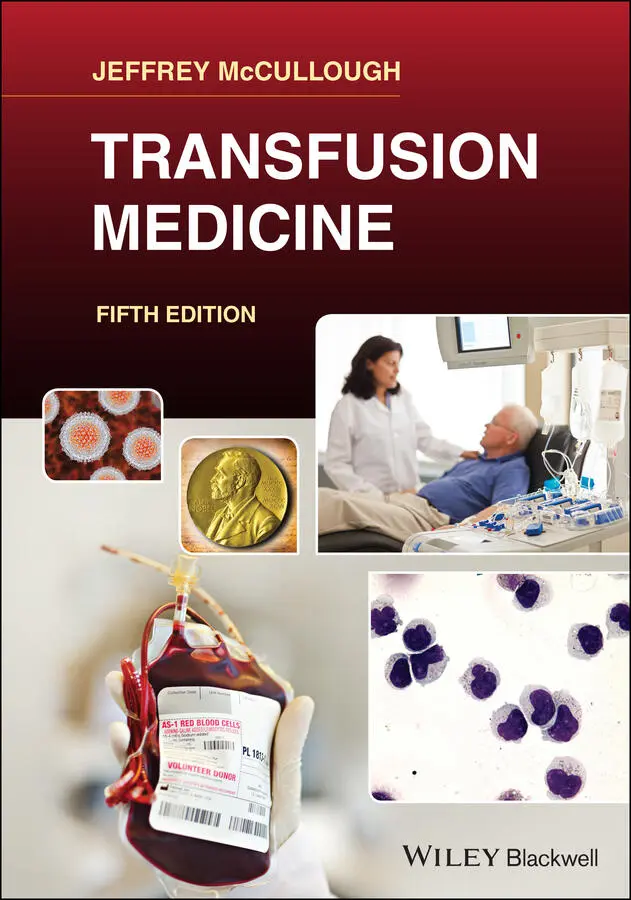
- Название:Transfusion Medicine
- Автор:
- Жанр:
- Год:неизвестен
- ISBN:нет данных
- Рейтинг книги:3 / 5. Голосов: 1
-
Избранное:Добавить в избранное
- Отзывы:
-
Ваша оценка:
Transfusion Medicine: краткое содержание, описание и аннотация
Предлагаем к чтению аннотацию, описание, краткое содержание или предисловие (зависит от того, что написал сам автор книги «Transfusion Medicine»). Если вы не нашли необходимую информацию о книге — напишите в комментариях, мы постараемся отыскать её.
The Fifth Edition of
delivers a succinct, thorough, clinically focused, practical and authoritative treatment of a full range of topics in transfusion therapy. This ranges from issues with the blood supply, recruitment of both whole blood and apheresis donors, blood collection and storage, blood testing, blood safety, and transmissible diseases. This edition has been fully updated and revised to include exciting cellular therapies for cancer, transplantation of both hematopoietic cells and solid organs, infectious diseases and regenerative medicine.
The Fifth Edition includes new authors with highly relevant content that provides a solid grounding for readers in the field. The book:
Is an approachable comprehensive guide to the field of blood banking and transfusion medicine Provides complete and timely perspective on crucial topics, including the HLA system in transfusion medicine and transplantation and quality programs in blood banking and transfusion medicine Is extensively referenced, making it simple for readers to conduct further research on the topics of interest to them Includes new chapters on pediatric transfusion medicine and pathogen reduction Has an expended chapter on patient blood management Provides extensive discussions of the clinical use of blood transfusion in a wide variety of clinical situations including recent development In the management of acute traumatic blood loss Provides updated information about blood groups and molecular testing making inroads into clinical practice along with discussions of laboratory detection of blood groups and provision of red cells Perfect for all those working in the field of blood banking, transfusion medicine and hematology or oncology and fellows in pathology, hematology, surgery and anesthesiology.
is a good introduction for technologists specializing in blood banking and non-medical personnel working in areas related to hematology and transfusion medicine. Transfusion Medicine will also earn a place in the libraries of practicing pathologists with responsibility for blood banks.
Transfusion Medicine — читать онлайн ознакомительный отрывок
Ниже представлен текст книги, разбитый по страницам. Система сохранения места последней прочитанной страницы, позволяет с удобством читать онлайн бесплатно книгу «Transfusion Medicine», без необходимости каждый раз заново искать на чём Вы остановились. Поставьте закладку, и сможете в любой момент перейти на страницу, на которой закончили чтение.
Интервал:
Закладка:
As the prevalence of tattooing and other body modifications has increased, a study in the Netherlands by Prinsze et al. [21] reviewed the risks of transfusion‐transmitted infection after tattooing and other needle‐related events. These donors (if deferred) often show low return rates to donation. The authors also demonstrated that donors who reported a tattoo, body piercing, or acupuncture showed no higher risks for transfusion‐transmitted infections [21].
3.2 Motivation of whole blood donors
Psychosocial theories applicable to blood donation
Piliavin and Callero [4] discuss five psychosocial theories that might apply to blood donor motivation: (a) Becker’s model of commitment, (b) the opponent process theory, (c) the attribution/self‐perception framework, (d) the identity theory, and (e) the theory of reasoned action. These can be described briefly as summarized from Piliavin and Callero [4].
In Becker’s theory of commitment, the action or decision is based on background factors or preconceptions. These factors influence whether the person takes the initial action and then the person is subsequently influenced by the first few experiences. In the opponent process theory, the stronger the negative feelings before the action, the stronger are the positive feelings after successfully completing the action. Thus, despite initial fears or negative feelings, a good experience with donation could lead to a strongly positive attitude about continued donation. This theory attempts to account for the continuation of activities that were initially associated with negative feelings. The attribution theory postulates that if an individual believes that there is an external reason for the action, the action is attributed to that external force. In the identity theory, the sense of self is developed from the variety of social roles in which the individual engages. In the theory of reasoned action, the critical factor leading to an act is the development of an intention to carry out the act.
Integrated model
Piliavin and Callero [4] believe that all five of the theories outlined earlier have some relevance to blood donation. The identity theory is thought to be “overarching,” and that the “sense of self as donor is clearly the central factor among the personal determinants of donation” [4]. Becker’s model applies to making the commitment to donate, the opponent process and attribution theories relate to the development of a sense of the individual as a blood donor, and the theory of reasoned action is involved in translating the person’s idea of himself or herself as a blood donor into action to donate. In integrating these theories, Piliavin and Callero [4] believe that the decision to donate is based on “childhood experience factors” negatively influenced by “pain and inconvenience” and positively influenced by “social pressures.”
Experienced donors increasingly internalize the expectations and the role of being a blood donor. Donor identity correlates with the donation intention. Self‐determination theory indicates that people persist with behaviors that are internally versus externally motivated. This theory of self‐determination has been at the basis of thinking about blood donor recruitment [22].
Theory of planned behavior
This model is based on attitude, subjective norm, and perceived behavioral control [23]. These influence the intention to carry out behaviors. Although this model has a different name than those of Piliavin and Callero [4], theory of planned behavior really involves attitudes about the behavior, social pressure about the behavior, and control over performing the behavior. Thus, it is not surprising that several studies (reviewed by Masser et al. [23]) indicate that theory of planned behavior predicts a substantial portion of blood donation intention and behavior [24].
Giving and not giving
The reasons for donating are summarized generally [4] as: (a) extrinsic rewards and incentives, (b) intrinsic rewards and incentives, (c) perceived community needs, (d) perceived community support, (e) social pressure, and (f) addiction to donation. The reasons for not donating include: (a) medical ineligibility, (b) fear, (c) reactions and deferral (poor experiences), and (d) inconvenience and time requirements. Oswalt [6], in reviewing 60 English‐language reports regarding motivation for blood donation, concluded that the following factors were motivations to donate: (a) altruism and humanitarianism, (b) personal or family credit, (c) social pressure, (d) replacement, and (e) reward. Reasons for not donating included: (a) fear, (b) medical excuses, (c) reactions, (d) apathy, and (e) inconvenience. Rados [24] also found that fear, inconvenience, and never being asked were the most common reasons given for not donating. In general, the issues described earlier have seemed to appear rather consistently in these and other studies [25] of donor motivation or nondonation. Because they have been consistent over time, most recruitment strategies attempt to take these factors into consideration. Most blood donors have a rationale way of thinking about blood donation, but some think and make decisions about blood donation based on emotional, personal, or stereotype manner in continuing to donate blood, and the convenience of donation is a stronger factor than helping others [26]. In general, donors give blood out of altruism and in response to a general appeal or a specific request.
3.3 The donation experience and factors that influence continued donation
About 28% of blood is collected from first‐time donors, about half of whom return within the first year [27]. Those who return tend to be white, US born, and college educated [28]. Experience with the first donation has a major effect on their willingness to return for subsequent donations [4, 14, 16]. Although the first blood donation is anxiety producing, it is usually accompanied by good interactions with the donor staff and good feelings about the donation and oneself [28]. Thus, most donors realize that they are reasonably able to give and plan to do so again. With continued donation, the experience becomes easier and the reasons for continuing to donate become more “internal” [3]. Ferguson et al. [29] propose that the “warm glow” associated with donating supports a general benevolence hypothesis.
About 70–80% of donors are repeat donors, although this percentage is decreasing [16, 30]. Repeat donors tend to be 16 and 17 years or older than 50 years, male, Rh negative, type O, without a reaction during donation, and have a college degree [16, 31]. A shorter interval between the first two donations also predicts more continued donations [28]. Over time a “blood donor role” develops in repeat donors, and this strengthens self‐commitment to blood donation, including “friendships contingent on donating, a self‐description as a regular donor, an increase in the ranking of the blood donor role, greater expectations from others, and even more donations” [4].
Donors who are deferred are less likely to return to donate after the reason for the temporary deferral has passed [4, 16]. This is not surprising because deferral breaks the good feelings that might have developed about donation and makes future donation more difficult. Experiencing a reaction also reduces the likelihood of a donor returning [4, 14, 15]. This is because the donor begins to see himself or herself as someone who has trouble donating, and the reaction experience modifies any previous positive feelings about donation. Surprisingly, most multigallon donors report that they do not receive recognition for their donation, and the knowledge that a friend or relative was a blood donor did not make them more likely to donate [9]. These observations are consistent with the general view that the initial donation is motivated primarily by external factors and continued donation primarily by internal factors [32].
Читать дальшеИнтервал:
Закладка:
Похожие книги на «Transfusion Medicine»
Представляем Вашему вниманию похожие книги на «Transfusion Medicine» списком для выбора. Мы отобрали схожую по названию и смыслу литературу в надежде предоставить читателям больше вариантов отыскать новые, интересные, ещё непрочитанные произведения.









Обсуждение, отзывы о книге «Transfusion Medicine» и просто собственные мнения читателей. Оставьте ваши комментарии, напишите, что Вы думаете о произведении, его смысле или главных героях. Укажите что конкретно понравилось, а что нет, и почему Вы так считаете.