John E. Boylan - Intermittent Demand Forecasting
Здесь есть возможность читать онлайн «John E. Boylan - Intermittent Demand Forecasting» — ознакомительный отрывок электронной книги совершенно бесплатно, а после прочтения отрывка купить полную версию. В некоторых случаях можно слушать аудио, скачать через торрент в формате fb2 и присутствует краткое содержание. Жанр: unrecognised, на английском языке. Описание произведения, (предисловие) а так же отзывы посетителей доступны на портале библиотеки ЛибКат.
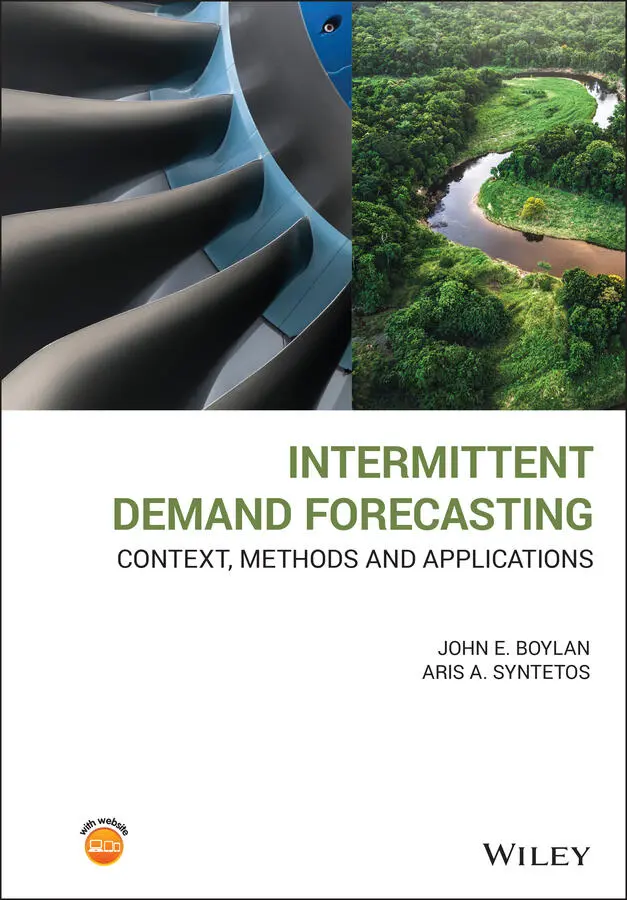
- Название:Intermittent Demand Forecasting
- Автор:
- Жанр:
- Год:неизвестен
- ISBN:нет данных
- Рейтинг книги:5 / 5. Голосов: 1
-
Избранное:Добавить в избранное
- Отзывы:
-
Ваша оценка:
Intermittent Demand Forecasting: краткое содержание, описание и аннотация
Предлагаем к чтению аннотацию, описание, краткое содержание или предисловие (зависит от того, что написал сам автор книги «Intermittent Demand Forecasting»). Если вы не нашли необходимую информацию о книге — напишите в комментариях, мы постараемся отыскать её.
The first text to focus on the methods and approaches of intermittent, rather than fast, demand forecasting
Intermittent Demand Forecasting No prior knowledge of intermittent demand forecasting or inventory management is assumed in this book. The key formulae are accompanied by worked examples to show how they can be implemented in practice. For those wishing to understand the theory in more depth, technical notes are provided at the end of each chapter, as well as an extensive and up-to-date collection of references for further study. Software developments are reviewed, to give an appreciation of the current state of the art in commercial and open source software.
“Intermittent demand forecasting may seem like a specialized area but actually is at the center of sustainability efforts to consume less and to waste less. Boylan and Syntetos have done a superb job in showing how improvements in inventory management are pivotal in achieving this. Their book covers both the theory and practice of intermittent demand forecasting and my prediction is that it will fast become the bible of the field.” —
, Professor, University of Nicosia, and Director, Institute for the Future and the Makridakis Open Forecasting Center (MOFC).
“We have been able to support our clients by adopting many of the ideas discussed in this excellent book, and implementing them in our software. I am sure that these ideas will be equally helpful for other supply chain software vendors and for companies wanting to update and upgrade their capabilities in forecasting and inventory management.”—
, VP, Research and Development, Blue Yonder.
“As product variants proliferate and the pace of business quickens, more and more items have intermittent demand. Boylan and Syntetos have long been leaders in extending forecasting and inventory methods to accommodate this new reality. Their book gathers and clarifies decades of research in this area, and explains how practitioners can exploit this knowledge to make their operations more efficient and effective.”—
, Professor Emeritus, Rensselaer Polytechnic Institute.
Intermittent Demand Forecasting — читать онлайн ознакомительный отрывок
Ниже представлен текст книги, разбитый по страницам. Система сохранения места последней прочитанной страницы, позволяет с удобством читать онлайн бесплатно книгу «Intermittent Demand Forecasting», без необходимости каждый раз заново искать на чём Вы остановились. Поставьте закладку, и сможете в любой момент перейти на страницу, на которой закончили чтение.
Интервал:
Закладка:
3.6.3 Fill Rates: Sobel's Formula
Johnson et al. (1995) pointed out that the traditional fill rate calculation can suffer from double counting. This arises from the same shortage being counted in two separate periods. To appreciate how this happens, we continue with our example in Table 3.8.
Let us look again at the results corresponding to a demand of 12 (over three weeks), shown in the bottom row of the middle section of Table 3.8. For  , the traditional formula gives a shortage of five units at the end of the third week. However, this is not accurate. A total demand of 12 can have arisen only from a demand of four in each of the three weeks because the distribution in Table 3.7shows that four is the maximum weekly demand. Therefore, the demand in the first two weeks must have been for eight units, giving a shortage (and backorder) of one unit at the end of the second week if
  . The shortage of five units at the end of the third week is actually the sum of one unit backordered in the second week and a further four units backordered in the third week. To count this as five would be to double count the unit that was short in the second week and is still short in the third week.
More generally, the traditional fill rate formula is appropriate if there are no backorders at the end of  periods (still assuming that
  ). However, if there are some backorders, then these should not be added on to any further backorders that may arise in the next period. This motivated the development of a revised formula, proposed by Sobel (2004), for calculating the fill rate when the review interval is of one period:
(3.4) 
where  is the demand over the lead time,
  is the demand in the single period just after the completion of the lead time, and the other notation is unchanged. This formula overcomes the problem of double counting if demand is always non‐negative, and is independent and identically distributed. To show how the formula works in practice, we recalculate the fill rate for
  using Sobel's formula, keeping the lead time as two weeks, as shown in Table 3.9.
Table 3.9 Sobel's fill rate calculation (  ,
,  ,
,  ).
).
Demand,   |
SOH  |
Demand,   |
Not satisfied  |
Probability  ) ) |
Probability  ) ) |
Expected not satisfied |
|---|---|---|---|---|---|---|
| 0 | 7 | 1 | 0 | 0.25 | 0.3 | 0.000 |
| 0 | 7 | 4 | 0 | 0.25 | 0.2 | 0.000 |
| 1 | 6 | 1 | 0 | 0.30 | 0.3 | 0.000 |
| 1 | 6 | 4 | 0 | 0.30 | 0.2 | 0.000 |
| 2 | 5 | 1 | 0 | 0.09 | 0.3 | 0.000 |
| 2 | 5 | 4 | 0 | 0.09 | 0.2 | 0.000 |
| 4 | 3 | 1 | 0 | 0.20 | 0.3 | 0.000 |
| 4 | 3 | 4 | 1 | 0.20 | 0.2 | 0.040 |
| 5 | 2 | 1 | 0 | 0.12 | 0.3 | 0.000 |
| 5 | 2 | 4 | 2 | 0.12 | 0.2 | 0.048 |
| 8 | 0 | 1 | 1 | 0.04 | 0.3 | 0.012 |
| 8 | 0 | 4 | 4 | 0.04 | 0.2 | 0.032 |
| Total | 0.132 | |||||
Fill rate (  ) ) |
88.0% |
In Table 3.9, the first and third columns give all the potential combinations of demands during the lead time (two periods) and the review interval (one period), excluding the possibility of zero demand in the review interval, as this cannot yield unsatisfied demand in that period. The second column shows the stock on hand (SOH) for  , after depletion of the lead time demand (zero if the lead time demand is for eight units).
The fourth column shows the unsatisfied demand, given the stock on hand in the second column and the review interval demand in the third column. Let us return to the case of a demand of eight units in the first two weeks and four units in the third week, shown in the bottom row of the middle section of the table. Now, the unsatisfied demand in the third period is shown as four units, avoiding double counting of the one unit of unsatisfied demand in the second week.
The probabilities in the fifth and sixth columns are multiplied together to give the chance of the combination of demand values in the lead time and the review interval (assuming independence of demands over time). This is then multiplied by the unsatisfied demand, in the fourth column, to give the expected unsatisfied demand. (The probabilities of demand over two weeks, shown in the fifth column, are calculated in the same way as for Table 3.3. The probabilities in the sixth column are taken directly from Table 3.7.) Finally, the overall expected unsatisfied demand per period of 0.132 and the mean demand of 1.1 per single time period are substituted into Eq. (3.4)to give a fill rate of 88.0%. As anticipated, Sobel's formula gives a higher fill rate than the traditional formula (84.4%) because it avoids the problem of double counting of backorders.
Читать дальшеИнтервал:
Закладка:
Похожие книги на «Intermittent Demand Forecasting»
Представляем Вашему вниманию похожие книги на «Intermittent Demand Forecasting» списком для выбора. Мы отобрали схожую по названию и смыслу литературу в надежде предоставить читателям больше вариантов отыскать новые, интересные, ещё непрочитанные произведения.










Обсуждение, отзывы о книге «Intermittent Demand Forecasting» и просто собственные мнения читателей. Оставьте ваши комментарии, напишите, что Вы думаете о произведении, его смысле или главных героях. Укажите что конкретно понравилось, а что нет, и почему Вы так считаете.