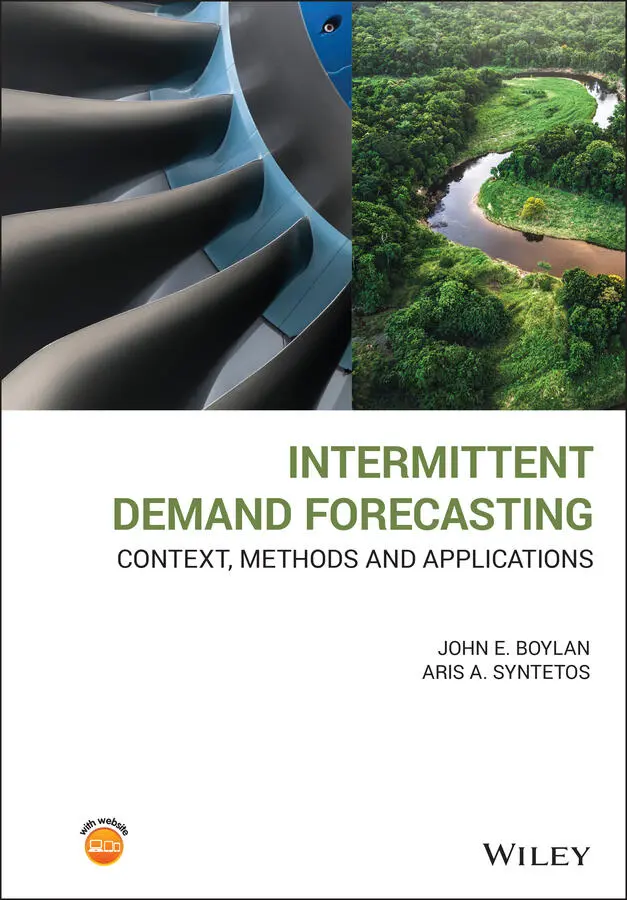
John E. Boylan - Intermittent Demand Forecasting
Здесь есть возможность читать онлайн «John E. Boylan - Intermittent Demand Forecasting» — ознакомительный отрывок электронной книги совершенно бесплатно, а после прочтения отрывка купить полную версию. В некоторых случаях можно слушать аудио, скачать через торрент в формате fb2 и присутствует краткое содержание. Жанр: unrecognised, на английском языке. Описание произведения, (предисловие) а так же отзывы посетителей доступны на портале библиотеки ЛибКат.
- Название:Intermittent Demand Forecasting
- Автор:
- Жанр:
- Год:неизвестен
- ISBN:нет данных
- Рейтинг книги:5 / 5. Голосов: 1
-
Избранное:Добавить в избранное
- Отзывы:
-
Ваша оценка:
Intermittent Demand Forecasting: краткое содержание, описание и аннотация
Предлагаем к чтению аннотацию, описание, краткое содержание или предисловие (зависит от того, что написал сам автор книги «Intermittent Demand Forecasting»). Если вы не нашли необходимую информацию о книге — напишите в комментариях, мы постараемся отыскать её.
The first text to focus on the methods and approaches of intermittent, rather than fast, demand forecasting
Intermittent Demand Forecasting No prior knowledge of intermittent demand forecasting or inventory management is assumed in this book. The key formulae are accompanied by worked examples to show how they can be implemented in practice. For those wishing to understand the theory in more depth, technical notes are provided at the end of each chapter, as well as an extensive and up-to-date collection of references for further study. Software developments are reviewed, to give an appreciation of the current state of the art in commercial and open source software.
“Intermittent demand forecasting may seem like a specialized area but actually is at the center of sustainability efforts to consume less and to waste less. Boylan and Syntetos have done a superb job in showing how improvements in inventory management are pivotal in achieving this. Their book covers both the theory and practice of intermittent demand forecasting and my prediction is that it will fast become the bible of the field.” —
, Professor, University of Nicosia, and Director, Institute for the Future and the Makridakis Open Forecasting Center (MOFC).
“We have been able to support our clients by adopting many of the ideas discussed in this excellent book, and implementing them in our software. I am sure that these ideas will be equally helpful for other supply chain software vendors and for companies wanting to update and upgrade their capabilities in forecasting and inventory management.”—
, VP, Research and Development, Blue Yonder.
“As product variants proliferate and the pace of business quickens, more and more items have intermittent demand. Boylan and Syntetos have long been leaders in extending forecasting and inventory methods to accommodate this new reality. Their book gathers and clarifies decades of research in this area, and explains how practitioners can exploit this knowledge to make their operations more efficient and effective.”—
, Professor Emeritus, Rensselaer Polytechnic Institute.
Intermittent Demand Forecasting — читать онлайн ознакомительный отрывок
Ниже представлен текст книги, разбитый по страницам. Система сохранения места последней прочитанной страницы, позволяет с удобством читать онлайн бесплатно книгу «Intermittent Demand Forecasting», без необходимости каждый раз заново искать на чём Вы остановились. Поставьте закладку, и сможете в любой момент перейти на страницу, на которой закончили чтение.
Интервал:
Закладка:
In summary, both the  and the
  measures are measurable at wholesalers, where intermittent demand items are more common. In retail, intermittent SKUs are less common. Where they do occur, the
  measure can often be approximated by
  , which is measurable. In the remainder of this chapter, we focus on the
  and
and  measures, with some discussion on the variety of ways in which these measures may be calculated in practice.
3.4.4 Choice of Service Level Measure
The choice between the  and
and  measures depends on the immediate consequences of a stockout and the financial impacts of these consequences. If the customer is prepared to wait for the SKU to come into stock (as is common in wholesaling), then a backorder will be generated and there are two possible courses of action for the organisation:
1 Place an emergency order on the supplier for all the units of the item that have not been satisfied. The supplier is requested to satisfy this order in a shorter lead time than normal, to mitigate the poor service provided to the client(s).
2 Advise the client(s) to wait until the next replenishment order is due to arrive, after the usual lead time has elapsed. When the order arrives, the backorders will be released, subject to sufficient stock having arrived.
On the other hand, if the customer is not prepared to wait for the SKU to come back into stock (as is common in retailing), then there are two possible outcomes:
1 Sales of a substitute product.
2 A complete lost sale, with no substitute items sold.
In the backorder case, for the first course of action, there will usually be an additional price to be paid to the supplier for expediting the goods in a shorter time than normal. If this additional price is fixed, and not proportional to the number of units short, then the  service measure may be appropriate. This is because it is based on the proportion of replenishment cycles for which expediting is necessary, rather than on the proportion of items not satisfied from stock.
For the second course of action in the backorder case, there is no expediting cost for the organisation, but there is a potential cost in terms of loss of goodwill. This also applies if the customer is not prepared to wait, although the loss may be mitigated if the customer is prepared to buy a substitute product. It was mentioned earlier that loss of goodwill is very difficult to quantify. However, a fixed cost does not seem appropriate. It is surely worse to be short by four units, with two client orders for two units not being satisfied, than to be short by one unit for one client. Instead, a cost that is proportional to the fraction of unsatisfied demand seems more suitable, as reflected by the  measure.
If the customer is not prepared to wait and does not purchase a substitute product then, in addition to the indirect cost of loss of goodwill, there is also a direct cost of loss of profit to take into consideration. Again, a cost that is proportional to the fraction of unfilled demand seems appropriate, making the  measure suitable.
3.4.5 Summary
In this section, we have seen that, although there may be real costs associated with inventory holdings and shortages, they can be very difficult to measure reliably. For this reason, we have advocated a service level measure approach at the SKU level.
We have found that both the cycle service level (  ) and fill rate (
  ) are measurable in a wholesaling environment, and the fill rate may be approximated by the ready rate (
  ) for non‐lumpy intermittent items in a retail environment.
There is a link between the cost‐driven approach and the service‐driven approach. If the main costs are in expediting orders, then the cycle service level is a better reflection of the costs. On the other hand, if the main costs are in loss of immediate profit or loss of goodwill, then the fill rate is a more appropriate measure.
3.5 Calculating Cycle Service Levels
If we decide to proceed with a cycle service level (CSL) measure at SKU level, then we need to be able to assess the CSL implications of alternative OUT levels. The calculation of CSLs depends on the probabilities of demand over the protection interval and so, before going further, we start this section with a discussion on demand probabilities.
Table 3.2 Distribution of demand over one week.
| Demand | Probability |
|---|---|
| 0 | 0.5 |
| 1 | 0.3 |
| 2 | 0.2 |
| 3 or more | 0.0 |
3.5.1 Distribution of Demand Over One Time Period
A ‘demand distribution’ assigns a probability to each of the possible values of demand over a specified period of time. An example of a distribution of demand for an SKU over one week is shown in Table 3.2. The distribution assigns a probability of 0.5 to 0, indicating that the SKU is intermittent and we expect 50% of future weeks to contain no demand, and similarly assigns probabilities of 0.3 and 0.2 to demands of one and two units, respectively. According to this distribution, there will never be demand for three or more units over a period of one week, as the probability of this eventuality is zero.
The distribution in Table 3.2may be represented physically by an icosahedral die of 20 faces, with the numbers on the faces representing the possible demand values. The values should be shared out amongst the 20 faces in direct proportion to the probabilities shown in Table 3.2. So, there would be 10 faces showing zero, six faces showing one, and four faces showing two.
The icosahedral die is a convenient way to visualise probabilities but suffers from the limitation that a 20‐sided die can represent only those chances that are multiples of 0.05, because each side represents a chance of 1/20. Probabilities such as 0.02 cannot be represented. In practice, we can replace a physical die with a virtual one, and use software to generate random numbers to the required level of resolution.
Читать дальшеИнтервал:
Закладка:
Похожие книги на «Intermittent Demand Forecasting»
Представляем Вашему вниманию похожие книги на «Intermittent Demand Forecasting» списком для выбора. Мы отобрали схожую по названию и смыслу литературу в надежде предоставить читателям больше вариантов отыскать новые, интересные, ещё непрочитанные произведения.










Обсуждение, отзывы о книге «Intermittent Demand Forecasting» и просто собственные мнения читателей. Оставьте ваши комментарии, напишите, что Вы думаете о произведении, его смысле или главных героях. Укажите что конкретно понравилось, а что нет, и почему Вы так считаете.