John E. Boylan - Intermittent Demand Forecasting
Здесь есть возможность читать онлайн «John E. Boylan - Intermittent Demand Forecasting» — ознакомительный отрывок электронной книги совершенно бесплатно, а после прочтения отрывка купить полную версию. В некоторых случаях можно слушать аудио, скачать через торрент в формате fb2 и присутствует краткое содержание. Жанр: unrecognised, на английском языке. Описание произведения, (предисловие) а так же отзывы посетителей доступны на портале библиотеки ЛибКат.
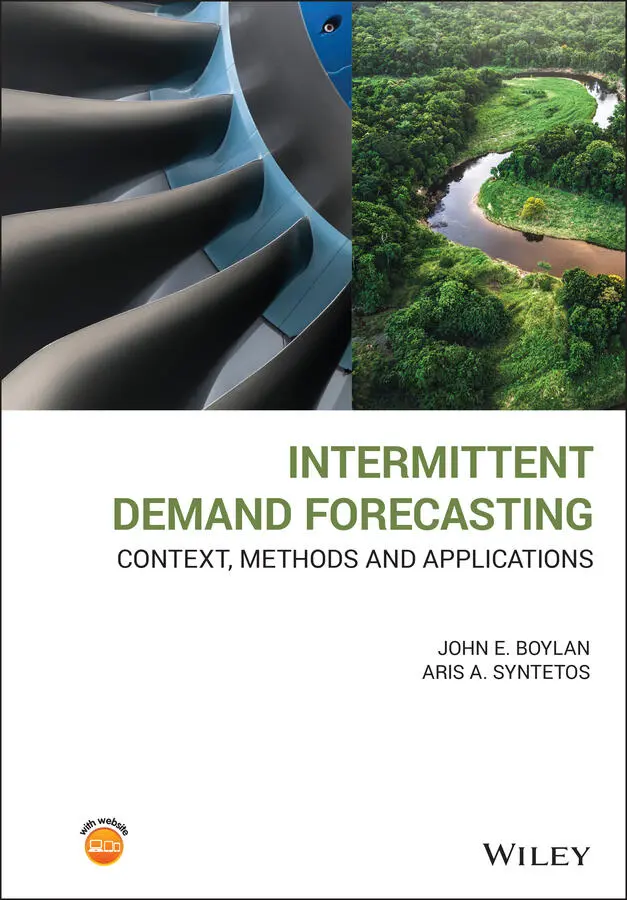
- Название:Intermittent Demand Forecasting
- Автор:
- Жанр:
- Год:неизвестен
- ISBN:нет данных
- Рейтинг книги:5 / 5. Голосов: 1
-
Избранное:Добавить в избранное
- Отзывы:
-
Ваша оценка:
Intermittent Demand Forecasting: краткое содержание, описание и аннотация
Предлагаем к чтению аннотацию, описание, краткое содержание или предисловие (зависит от того, что написал сам автор книги «Intermittent Demand Forecasting»). Если вы не нашли необходимую информацию о книге — напишите в комментариях, мы постараемся отыскать её.
The first text to focus on the methods and approaches of intermittent, rather than fast, demand forecasting
Intermittent Demand Forecasting No prior knowledge of intermittent demand forecasting or inventory management is assumed in this book. The key formulae are accompanied by worked examples to show how they can be implemented in practice. For those wishing to understand the theory in more depth, technical notes are provided at the end of each chapter, as well as an extensive and up-to-date collection of references for further study. Software developments are reviewed, to give an appreciation of the current state of the art in commercial and open source software.
“Intermittent demand forecasting may seem like a specialized area but actually is at the center of sustainability efforts to consume less and to waste less. Boylan and Syntetos have done a superb job in showing how improvements in inventory management are pivotal in achieving this. Their book covers both the theory and practice of intermittent demand forecasting and my prediction is that it will fast become the bible of the field.” —
, Professor, University of Nicosia, and Director, Institute for the Future and the Makridakis Open Forecasting Center (MOFC).
“We have been able to support our clients by adopting many of the ideas discussed in this excellent book, and implementing them in our software. I am sure that these ideas will be equally helpful for other supply chain software vendors and for companies wanting to update and upgrade their capabilities in forecasting and inventory management.”—
, VP, Research and Development, Blue Yonder.
“As product variants proliferate and the pace of business quickens, more and more items have intermittent demand. Boylan and Syntetos have long been leaders in extending forecasting and inventory methods to accommodate this new reality. Their book gathers and clarifies decades of research in this area, and explains how practitioners can exploit this knowledge to make their operations more efficient and effective.”—
, Professor Emeritus, Rensselaer Polytechnic Institute.
Intermittent Demand Forecasting — читать онлайн ознакомительный отрывок
Ниже представлен текст книги, разбитый по страницам. Система сохранения места последней прочитанной страницы, позволяет с удобством читать онлайн бесплатно книгу «Intermittent Demand Forecasting», без необходимости каждый раз заново искать на чём Вы остановились. Поставьте закладку, и сможете в любой момент перейти на страницу, на которой закончили чтение.
Интервал:
Закладка:
3.2.2 Judgemental Adjustment of Orders
Some demand planners exercise judgement by adjusting stock orders directly, whilst others do so by adjusting demand forecasts. Judgemental ordering has been the subject of some research, mainly through studies of behaviour in simulated environments. An early study of a simulated inventory distribution system (known as the ‘beer game’) showed that participants in the game often misperceived the feedback they received in multiple‐stage supply chains. This leads to ordering decisions that can be far from optimal (Sterman 1989) and can cause amplification of order variability throughout the supply chain, known as the ‘bullwhip effect’. In a different setting, based on a single‐stage supply chain, Tokar et al. (2014) found that participants tended to over‐order in anticipation of a spike of demand, relative to the optimal orders that would minimise the total inventory costs.
Although the experimental evidence on judgemental ordering is not encouraging, there are situations when it can be beneficial. A prime example is to take advantage of discounts from suppliers that are available only for a limited period of time. In making a judgemental adjustment to the order, the demand forecast should be left untouched if no change in demand from end‐customers is anticipated. In other circumstances, it may be appropriate to adjust the forecasts themselves. We shall return to forecast adjustments in Chapter 10, where there is a detailed discussion of the subject.
To summarise, judgemental adjustment of orders may have positive effects in gaining price discounts but can also contribute to the bullwhip effect, leading to additional inventory holdings. The effect of order adjustment may not be as great as the impact of forecast adjustment, as shown by a system dynamics investigation (Syntetos et al. 2011b) and a further empirical study (Syntetos et al. 2016b). Nevertheless, any price benefits should be weighed against increased inventory costs. If order adjustments are frequent, it would be good practice to keep records of the original recommended orders, as well as the adjusted orders. In this way, an organisation can monitor the effect of judgemental adjustments and evaluate whether they are beneficial or, more specifically, the circumstances under which they are beneficial.
3.2.3 Summary
Order‐up‐to (OUT) levels are sometimes set by using a rule of thumb of multiplying the forecasted demand (per period) by a set number of periods. This ignores the degree of demand uncertainty, leading to a misdirection of inventory investment. Consequently, rules of thumb like this are not recommended.
Judgemental adjustment of orders may be worthwhile in some situations. These adjustments should be continually monitored, to evaluate their effects on price benefits and inventory costs.
3.3 Aggregate Financial and Service Targets
Organisations should assess their inventory performance with respect to financial and service targets. While service targets are needed at SKU level, assessment of service targets at higher levels of aggregation elevates an operational task to a strategic issue. A strategic view of service and costs is essential because there is often a trade‐off between these two aspects of performance and looking at just one aspect may lead to poor decisions.
3.3.1 Aggregate Financial Targets
A financial target can be set in a variety of ways. One way to express it is in terms of the average inventory valuation, obtained by recording the financial value of inventories at a number of times during the year and averaging them. Sufficient times during the year should be included to obtain a reliable average, especially if inventories are seasonal. The exact method of valuation depends on the accounting rules employed; for further discussion see, for example, Muller (2019).
An important issue to be addressed is the ‘write off’ of obsolescent stock if it has no residual value or its ‘write down’ if it still has some value, for example as scrap. Once stock becomes so slow moving that it is unlikely to be ever sold, then these adjustments to the balance sheet are necessary. The record of inventory written off, or written down, is useful in two ways. Firstly, it can be used to assess the additional percentage inventory holding cost to allow for the potential obsolescence of slow moving SKUs, as discussed in Chapter 2. Secondly, the write‐off and write‐down values can be monitored to assess the effectiveness of measures to prevent the build‐up of obsolete inventory.
Inventory turnover is another useful financial measure. It is calculated as the ratio of the cost of goods sold (COGS) to the average inventory valuation. For example, if the annual COGS is £8 million and the average inventory valuation is £2 million, then the inventory turns four times a year. This measure is useful because it takes into account the growth or decline of sales. If COGS rises by 20% but inventory value increases by only 10%, then the inventory turnover will improve. It is possible to benchmark a company's performance on inventory turnover against competitors, but care is needed in drawing conclusions from the comparison. Inventory turnover is strongly influenced by the breadth of products in the stock range. If it is necessary to include slower‐moving stocks, because of contractual obligations, then the inventory turnover will necessarily be lower. If required, inventory turnover can be assessed for categories of SKUs (e.g. by volume of sales) or at the level of an individual SKU. It is most commonly measured at the aggregate level and provides a useful headline figure. It should be monitored over time, so that the effect of any changes in policies or practices can be assessed.
A full financial assessment of the impact of stockouts can be difficult to achieve. If stockouts lead to backorders, then it may be possible to estimate the costs of expediting orders to minimise the delay in satisfying the order. It is more challenging to assess the costs of lost goodwill from clients. For this reason, aggregate financial targets are usually complemented by aggregate service level targets, to which we now turn.
3.3.2 Service Level Measures
Johnson et al. (1995, p. 57) observed, ‘The rhetoric on customer service has grown from a quiet whisper to a deafening roar’. Twenty‐five years later, customer service is still a prominent issue in supply chain management and is likely to remain so. There are many aspects of service relating to customer orders, including user‐friendly ordering systems, availability of accurate order status information, delivery of the correct goods at the promised time, and the prompt and courteous response to customer queries or complaints. In this book, we are concerned with just one aspect of customer service, namely the availability of stock to satisfy customer demand. We refer to this as the ‘service level’, whilst recognising that there are many other aspects of customer service.
Some organisations have formal service level agreements (SLAs) with their major suppliers. These usually specify target service levels and may include financial penalties for missing these targets. This highlights the importance of using appropriate forecasting and inventory management methods. Otherwise, as Willemain (2018) emphasised, suppliers will incur financial penalties much more frequently than they were expecting. An SLA will specify either lump‐sum penalties or penalties proportional to underperformance. This choice needs careful consideration as it can influence ‘gaming’ behaviour by the supplier (Liang and Atkins 2013).
It is essential that the service level measure is clearly specified in an SLA, and that performance is regularly monitored against target. Indeed, even if an SLA is not in place, it is vital that there is a common understanding of how service is measured, and that the measure is appropriate for the business. A number of measures have been proposed and we now proceed to review how these measures are calculated and how they should be used.
Читать дальшеИнтервал:
Закладка:
Похожие книги на «Intermittent Demand Forecasting»
Представляем Вашему вниманию похожие книги на «Intermittent Demand Forecasting» списком для выбора. Мы отобрали схожую по названию и смыслу литературу в надежде предоставить читателям больше вариантов отыскать новые, интересные, ещё непрочитанные произведения.










Обсуждение, отзывы о книге «Intermittent Demand Forecasting» и просто собственные мнения читателей. Оставьте ваши комментарии, напишите, что Вы думаете о произведении, его смысле или главных героях. Укажите что конкретно понравилось, а что нет, и почему Вы так считаете.