John E. Boylan - Intermittent Demand Forecasting
Здесь есть возможность читать онлайн «John E. Boylan - Intermittent Demand Forecasting» — ознакомительный отрывок электронной книги совершенно бесплатно, а после прочтения отрывка купить полную версию. В некоторых случаях можно слушать аудио, скачать через торрент в формате fb2 и присутствует краткое содержание. Жанр: unrecognised, на английском языке. Описание произведения, (предисловие) а так же отзывы посетителей доступны на портале библиотеки ЛибКат.
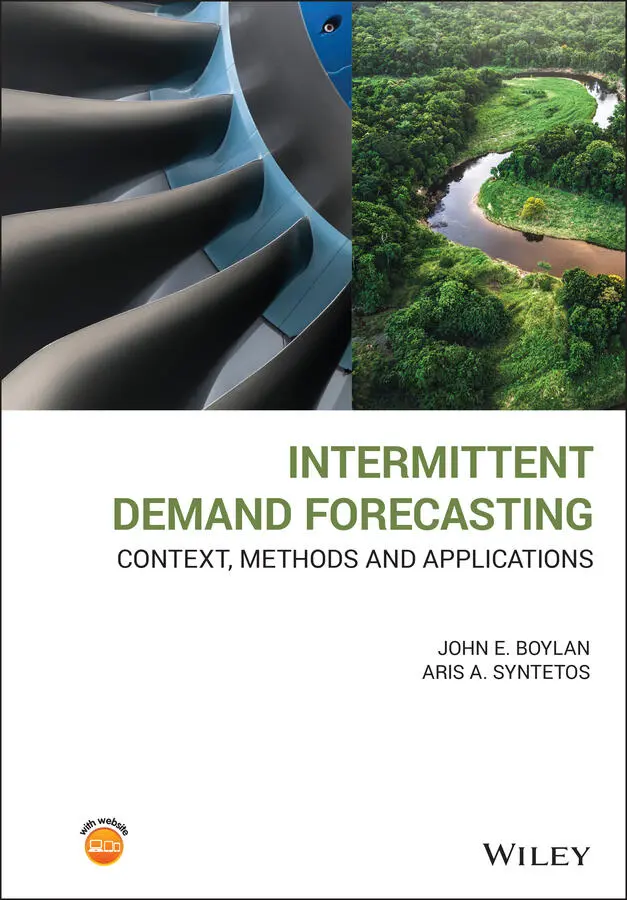
- Название:Intermittent Demand Forecasting
- Автор:
- Жанр:
- Год:неизвестен
- ISBN:нет данных
- Рейтинг книги:5 / 5. Голосов: 1
-
Избранное:Добавить в избранное
- Отзывы:
-
Ваша оценка:
Intermittent Demand Forecasting: краткое содержание, описание и аннотация
Предлагаем к чтению аннотацию, описание, краткое содержание или предисловие (зависит от того, что написал сам автор книги «Intermittent Demand Forecasting»). Если вы не нашли необходимую информацию о книге — напишите в комментариях, мы постараемся отыскать её.
The first text to focus on the methods and approaches of intermittent, rather than fast, demand forecasting
Intermittent Demand Forecasting No prior knowledge of intermittent demand forecasting or inventory management is assumed in this book. The key formulae are accompanied by worked examples to show how they can be implemented in practice. For those wishing to understand the theory in more depth, technical notes are provided at the end of each chapter, as well as an extensive and up-to-date collection of references for further study. Software developments are reviewed, to give an appreciation of the current state of the art in commercial and open source software.
“Intermittent demand forecasting may seem like a specialized area but actually is at the center of sustainability efforts to consume less and to waste less. Boylan and Syntetos have done a superb job in showing how improvements in inventory management are pivotal in achieving this. Their book covers both the theory and practice of intermittent demand forecasting and my prediction is that it will fast become the bible of the field.” —
, Professor, University of Nicosia, and Director, Institute for the Future and the Makridakis Open Forecasting Center (MOFC).
“We have been able to support our clients by adopting many of the ideas discussed in this excellent book, and implementing them in our software. I am sure that these ideas will be equally helpful for other supply chain software vendors and for companies wanting to update and upgrade their capabilities in forecasting and inventory management.”—
, VP, Research and Development, Blue Yonder.
“As product variants proliferate and the pace of business quickens, more and more items have intermittent demand. Boylan and Syntetos have long been leaders in extending forecasting and inventory methods to accommodate this new reality. Their book gathers and clarifies decades of research in this area, and explains how practitioners can exploit this knowledge to make their operations more efficient and effective.”—
, Professor Emeritus, Rensselaer Polytechnic Institute.
Intermittent Demand Forecasting — читать онлайн ознакомительный отрывок
Ниже представлен текст книги, разбитый по страницам. Система сохранения места последней прочитанной страницы, позволяет с удобством читать онлайн бесплатно книгу «Intermittent Demand Forecasting», без необходимости каждый раз заново искать на чём Вы остановились. Поставьте закладку, и сможете в любой момент перейти на страницу, на которой закончили чтение.
Интервал:
Закладка:
Schultz's proposition covers the inventory system against the possibility that one demand will occur during the lead time plus review interval. Necessary assumptions in this model's implementation are the following: (i) lead times are small, as compared to the average inter‐demand interval and (ii) the cost of reordering is small relative to the cost of holding sufficient inventory to meet more than one order.
The first assumption is clearly very restrictive. However, some work has been conducted to exploit the fact that the lead time (plus review interval) may indeed sometimes be less than the average inter‐demand interval. Syntetos et al. (2009a) developed a modified  policy that was shown empirically to perform very well for such cases. The database used for experimentation contained demand histories and lead times for 5000 SKUs from the Royal Air Force. About 50% of the sample met the qualifying condition for inclusion in the experiment (i.e. that the lead time plus review interval is less than the average inter‐demand interval) showing that models exploiting this information may be very useful in practice. However, the fact remains that they cannot be used for all intermittent demand SKUs and we do not consider them further in this book.
2.5.5 Summary
From a practitioner's standpoint, robust and not overly complicated inventory control models are required for intermittent demand items. In this section, we first provided an overview of stock control policies, arguing for the consideration of periodic (as opposed to continuous) formulations for the management of intermittent demand items. Not all such policies are easy to implement and some of them are based on very restrictive assumptions. We view the  policies as being consistent with practical needs and we further consider their implementation in later chapters.
2.6 Chapter Summary
Intermittent demand items dominate the stock bases in many industries, and in their capacity as service parts constitute a major opportunity for financial gains in the after‐sales market. In this book, we treat service parts as independent demand items and discuss estimating their future requirements and appropriately replenishing their inventories.
Owing to their inherent slow movement, an important decision relates to whether intermittent demand items should be kept in stock at all. Simple rules that rely upon a forecast of the mean demand may be employed to reach such decisions.
Assuming that an item is stocked, an appropriate policy is needed to decide when to replenish its inventory and by how much. We have argued for the relevance of periodic stock control policies, including the use of the periodic  policy (also known as the order‐up‐to (OUT) level rule) to manage intermittent demand items. The operation of this policy depends on the service measure employed and the distribution of demand, to be discussed in detail in the next three chapters. We return to the question of forecasting in Chapters 6and 7.
Technical Notes
Note 2.1 Order Overplanning
Bartezzaghi and Verganti (1995) (see also the work by Verganti 1997; Bartezzaghi et al. 1999) proposed the order overplanning forecasting method to assist MTO manufacturers in dealing with intermittent demand. The method aims at fully exploiting early information that the prospective and regular customers generate during their purchasing process. It uses as forecasting unit each single customer order instead of the overall demand for the master production schedule (MPS) unit. So, the forecast unit is distinguished from the MPS planning unit. The expected requirements for a module (that belongs to a particular order) are overestimated. This is to take into account the sources of uncertainty within the planning horizon, namely order acquisition, actual due date, system configuration (number and types of apparatus), and apparatus configuration (modules) by implicitly incorporating in them the slack necessary to handle those uncertainties. This is done by introducing redundant configurations, so as to satisfy any request that may actually be received. The demand forecast for the MPS unit is obtained by adding up the requirements included in the individual forecast orders.
In order overplanning, forecasting is not the numerical result of an algorithm for analysing historical data but rather an organisational process, closely linked to the purchasing practices of the customer. In fact the method relies upon the capabilities of Sales to anticipate future requirements by continuously gathering information from customers and to exchange this subjective information with Manufacturing. The benefits associated with the use of this method can be realised only in an industrial MTO context, when (i) there is a certain amount of information available on customers' anticipated future requests and (ii) the information provided by the customers, during their purchasing process, has some predictive power.
Note 2.2 Cessation of Replenishment and Stock Write Off
The inventory decision of ceasing to replenish an item does not necessarily imply an immediate action from the accountancy department in terms of writing the item off the assets, which is needed for financial reporting. Rather, there will typically be some time elapsing between ceasing to replenish an item and (officially) writing the item off. Further, writing off an item does not necessarily imply an immediate disposal of any remaining stock for that item. Again, there may be some time elapsing between writing an item off and committing to the disposal of any remaining stock. Although the processes of writing an item off and disposing of any remaining stock are very important, any reference in the book to not stocking an item relates only to the inventory decision to cease replenishment.
Note 2.3 External and Internal Lead Times
An implicit assumption often made in inventory theory is that there is no time elapsing between receiving an order from the supplier(s) and making that order available for customers. The reality, though, is different as there are many situations when that time difference not only exists but is quite significant too. Unloading goods upon receipt, incoming goods inspection, moving the received items to their allocated space (especially in large warehouses), and updating the information system to reflect the receipts, are not necessarily trivial exercises, time‐wise, and this should be taken into account when calculating lead times.
In summary, lead times consist of two time components: (i) external supply lead time (time difference between placing an order and receiving it); (ii) internal lead time (time difference between receiving an order and making it available for customers). However, the latter is usually ignored and the terms ‘lead time’ and ‘supply lead time’ are (wrongly) used interchangeably.
Note 2.4 Renewal Processes
In continuous review inventory control, it is only necessary to consider making replenishment decisions just after a demand has occurred. This is true for Poisson and Bernoulli processes, where the time between demands is exponentially and geometrically distributed, respectively, and hence the demand process is memoryless (see Chapter 4). However, for renewal demand processes, including Erlang arrival processes that are not memoryless, this is no longer true in general (see Chapter 5). Rather, for these processes the passage of time itself may carry information about the demand process. Thus, it may be optimal that a certain time span should trigger a replenishment order, even if a demand has not occurred. Therefore, an order may not only be triggered by a change in the inventory position (defined in the usual way). Heuristically, and for practical purposes, replenishment orders may, of course, be allowed only at the time instances just after a demand has occurred (or at predetermined time intervals, as in a periodic review system). This issue has implications for the kind of information that is useful for inventory control purposes but is not discussed further in this book.
Читать дальшеИнтервал:
Закладка:
Похожие книги на «Intermittent Demand Forecasting»
Представляем Вашему вниманию похожие книги на «Intermittent Demand Forecasting» списком для выбора. Мы отобрали схожую по названию и смыслу литературу в надежде предоставить читателям больше вариантов отыскать новые, интересные, ещё непрочитанные произведения.










Обсуждение, отзывы о книге «Intermittent Demand Forecasting» и просто собственные мнения читателей. Оставьте ваши комментарии, напишите, что Вы думаете о произведении, его смысле или главных героях. Укажите что конкретно понравилось, а что нет, и почему Вы так считаете.