Alessandro Massaro - Electronics in Advanced Research Industries
Здесь есть возможность читать онлайн «Alessandro Massaro - Electronics in Advanced Research Industries» — ознакомительный отрывок электронной книги совершенно бесплатно, а после прочтения отрывка купить полную версию. В некоторых случаях можно слушать аудио, скачать через торрент в формате fb2 и присутствует краткое содержание. Жанр: unrecognised, на английском языке. Описание произведения, (предисловие) а так же отзывы посетителей доступны на портале библиотеки ЛибКат.

- Название:Electronics in Advanced Research Industries
- Автор:
- Жанр:
- Год:неизвестен
- ISBN:нет данных
- Рейтинг книги:4 / 5. Голосов: 1
-
Избранное:Добавить в избранное
- Отзывы:
-
Ваша оценка:
Electronics in Advanced Research Industries: краткое содержание, описание и аннотация
Предлагаем к чтению аннотацию, описание, краткое содержание или предисловие (зависит от того, что написал сам автор книги «Electronics in Advanced Research Industries»). Если вы не нашли необходимую информацию о книге — напишите в комментариях, мы постараемся отыскать её.
In
, accomplished electronics researcher and engineer Alessandro Massaro delivers a comprehensive exploration of the latest ways in which people have achieved machine control, including automated vision technologies, advanced electronic and micro-nano sensors, advanced robotics, and more.
The book is composed of nine chapters, each containing examples and diagrams designed to assist the reader in applying the concepts discussed within to common issues and problems in the real-world. Combining electronics and mechatronics to show how they can each be implemented in production line systems, the book presents insightful new ways to use artificial intelligence in production line machines. The author explains how facilities can upgrade their systems to an Industry 5.0 environment.
Electronics in Advanced Research Industries: Industry 4.0 to Industry 5.0 Advances A thorough introduction to the state-of-the-art in a variety of technological areas, including flexible technologies, scientific approaches, and intelligent automatic systems Comprehensive explorations of information technology infrastructures that support Industry 5.0 facilities, including production process simulation Practical discussions of human-machine interfaces, including mechatronic machine interface architectures integrating sensor systems and machine-to-machine (M2M) interfaces In-depth examinations of internet of things (IoT) solutions in industry, including cloud computing IoT Perfect for professionals working in electrical industry sectors in manufacturing, production line manufacturers, engineers, and members of R&D industry teams,
will also earn a place in libraries of technicians working in the process industry.
Electronics in Advanced Research Industries — читать онлайн ознакомительный отрывок
Ниже представлен текст книги, разбитый по страницам. Система сохранения места последней прочитанной страницы, позволяет с удобством читать онлайн бесплатно книгу «Electronics in Advanced Research Industries», без необходимости каждый раз заново искать на чём Вы остановились. Поставьте закладку, и сможете в любой момент перейти на страницу, на которой закончили чтение.
Интервал:
Закладка:
1.2.1 Architectures Integrating AI
The software and the hardware, in a modern information system oriented on Industry 5.0, must be integrated into a flexible information system infrastructure structured as illustrated in the model of Figure 1.4, where the first layer is represented by the hardware layer constituted by sensors and in general by IoT devices. The firmware layer is programmed in an operating system (OS) framework to provide a defined application including control and actuation processes. The AI interface is the intelligent core of the system, able to update machine setting, by considering prediction of failure conditions, and by automatically adjusting machine and robot working conditions. This automatism is a fundamental aspect of Industry 5.0 systems, where processing functions are managed in auto‐adaptive modality. The AI algorithms can be executed directly in the application layer by executing a code (python, java, visual basic, etc.), or by using objects of GUIs. In the architecture model of Figure 1.4, the processor, operates in multitasking and multiuser modality, where the central processing unit (CPU) time is divided for all the programs that work simultaneously. The AI engine and the OS manage the database management system (DBMS) able to collect digital information of the whole supply chain. Furthermore, AI is suitable to exchange data and digital commands to electronic boards, interfacing machines or robots as for intelligent actuators.
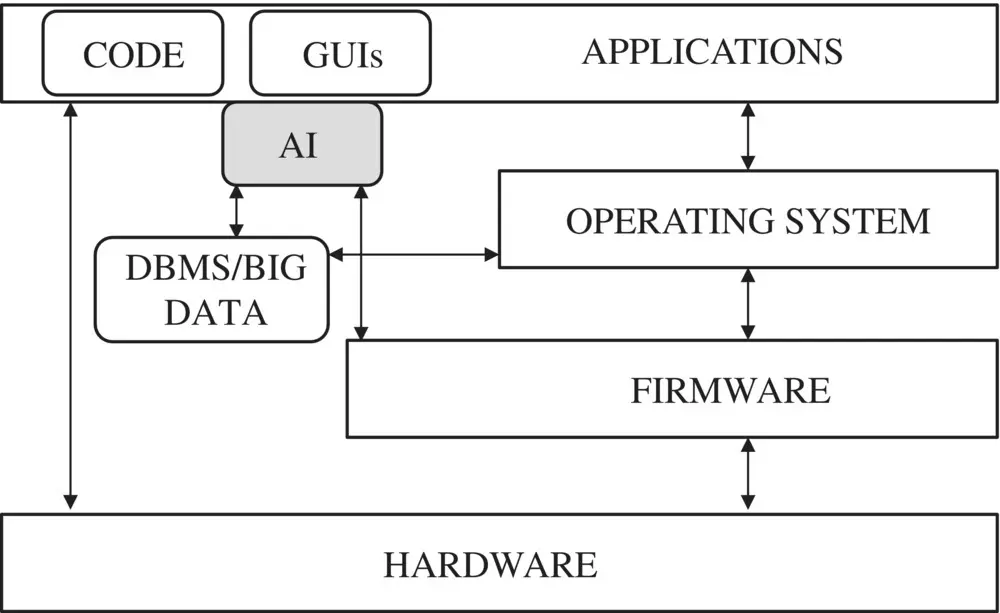
Figure 1.4 Hierarchical scheme of the software in Industry 5.0.
Another important element for Industry 4.0 and Industry 5.0 implementations are the PLC systems enabling the actuation. The block scheme of Figure 1.5represents a variation of the classic Von Neumann microprocessor scheme including the AI capability in the PLC system. The PLC system is constituted by:
A random access memory (RAM).
A microprocessor.
Input and output (I/O) ports.
An AI engine interfaced with a Programming Unit interface.
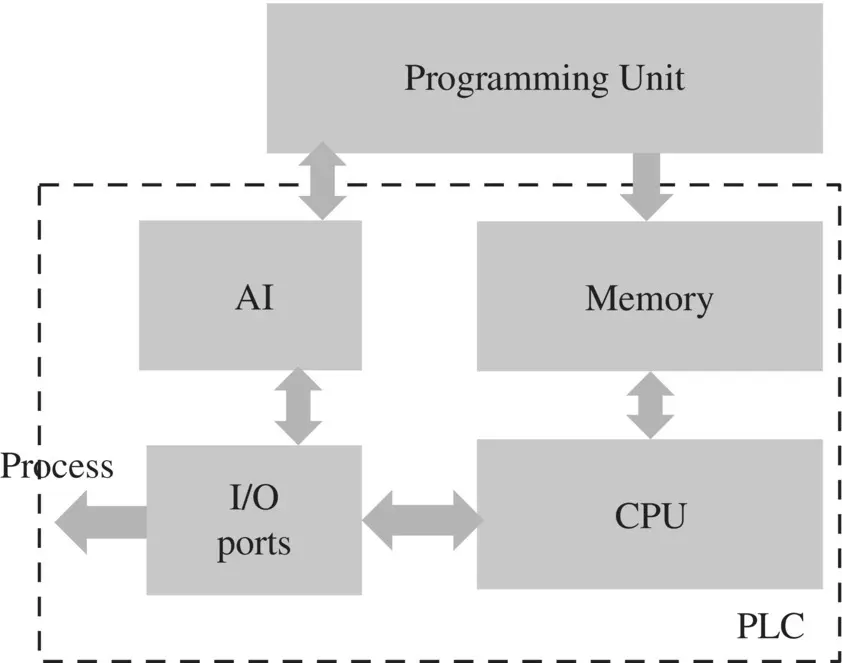
Figure 1.5 Advanced PLC architecture in Industry 5.0: central processing unit (CPU), memory, I/O ports, Program Unit module, and AI upgrading industrial processes.
1.2.2 AI Supervised and Unsupersived Algorithms
Different technologies can be integrated to improve Industry 4.0 production processes and in general digitalization. In industrial cases, supervised and unsupervised AI image vision tools detecting defects can be adopted. In this way, image vision and 3D image reconstruction methods play an important role as for assembling processes in the tire industry [41]. The image processing of raw images requires usually a high computational cost and is applied in post‐processing modality. Concerning real‐time processing, image segmentation techniques detect most relevant defects but more information about probable defects is hidden and is not easily visible in standard industrial environments. The hidden defects are “extracted” by more accurate inspections and by the application of specific intelligent image processing algorithms enhancing anomalous features. Intelligent algorithms are usually named machine learning (ML). In Table 1.6the main ML unsupervised and supervised algorithms are classified [42]. The supervised learning algorithm processes a known input dataset and data outputs to learn the regression/classification model. In supervised learning approaches, the training is performed by “labelled” data, selecting specific variables to focus the analysis: some data are already tagged with the requested answer, and the labeled data are adopted for the self‐learning of the algorithms predicting outcomes of the labeled variables. Unsupervised learning is the training modality of the algorithm which processes a dataset that is not classified/labeled. In the unsupervised learning approaches the model does not need to be supervised: the models discover information and common features of the variables (attributes) and find all kinds of unknown patterns in the data. The learning phase is structured in the following sequential steps:
Training dataset construction.
Features vector extraction.
Algorithm application setting data processing parameters.
Training model construction.
Table 1.6 Classification of machine learning algorithms.
| Machine learning algorithm class | Unsupervised | Supervised |
|---|---|---|
| Continuous | Clustering:K‐meansMean shift clusteringDensity‐based spatial clustering of applications with noiseExpectation maximization Clustering using gaussian mixture modelsAgglomerative hierarchical clusteringDimensionality reduction:Principal component analysisSingular value decomposition | Linear regressionPolynomial regressionArtificial neural networkRandom forestsDecision trees |
| Categorical | Association analysis:AprioriFP‐growthHidden Markov model | Classification:k‐nearest neighborsDecision treesLogistic regressionNaïve BayesArtificial neural networkSupport vector machine |
Both classes of supervised and unsupervised algorithms are typically applied for data processing applications of image processing for feature classification.
A typical class of unsupervised algorithms are the clustering ones. Clustering methods are able to group objects into homogeneous classes. A cluster is a set of objects that have similarities to each other, but which have dissimilarities with objects in other clusters. The input of a clustering algorithm consists of elements, while the output are clusters where the elements are divided according to a similarity measure. Clustering algorithms also provide a description of the characteristics of each cluster, which is essential for decision‐making processes. Concerning the continuous class of unsupervised algorithms, the K‐means algorithm is the classical approach estimating the centroid of the clustered data named clusters. The mean shift clustering (MSC) is a sliding‐window‐based algorithm executed to find dense areas of data points defining the centroids. The density‐based spatial clustering of applications with noise (DBSCAN) has the main characteristic to find arbitrarily sized and arbitrarily shaped clusters. The expectation maximization (EM) clustering uses the gaussian mixture model () approach assuming data points distributed as a Gaussian function and characterized by mean and standard deviation. Agglomerative hierarchical clustering (AHC) group clusters follow a hierarchy represented by a tree or by a dendrogram: the root of the tree is the main cluster grouping all the samples, and the leaves are clusters with only one sample. Principal component analysis (PCA) is able to reduce the dimensionality of a dataset made up of many more or less correlated variables. The single value deposition (SVD) technique is a particular factorization of a matrix based on the use of eigenvalues and eigenvectors. Concerning the categorical class of unsupervised algorithms, the Apriori algorithm is adopted for association rules for frequent item set mining. The algorithm of FP‐growth is able to complete a set of frequent patterns by pattern fragment growth, using frequent patterns. The hidden Markov model is a statistical Markov model with hidden states. Concerning the continuous class of supervised algorithms, the regression is a statistical process that tries to establish a relationship between two or more variables. If a regression model is given an x value, this returns the corresponding y value generated by the processing of x . The linear regression differs from the classification, since the latter is limited to discriminating the elements in a given number of classes (label), while for the linear regression approach the input is data and the system gives a real output (unlike the classification method which receives as input data and returns as output a label dataset). Polynomial regression uses the same method as linear regression, but assumes that the function that better describes the data trend is not a straight line, but a polynomial. Artificial neural networks (ANNs) are able to classify and predict data. Specifically, ANNs are made by three types of layer: the input layer, the hidden layers, and the output layer. In the input layer, the neural network receives the data in the form of inputs, activates and processes them according to the classification capacity for which it is trained, and passes the information obtained to the next layer as in neuron propagation. At each step, the starting information takes on an increasingly refined meaning due to the interpretations of the different nodes. Finally, the processed data arrive at the output layer, which collects the results. Concerning ANNs, the network is structured to learn automatically in self‐learning modality. Each perceptron has the task of categorizing objects by referring to common characteristics, following a score system calculated on each analyzed element. In AI, the perceptron represents a binary classifier selecting data input, and provides a features vector. The classifier makes its predictions based on a linear predictor function combining a set of weights with the feature vector. In AI machine learning algorithms, the perceptrons are important for their self‐learning capacity, thus addressing these tools for auto‐adaptive production solutions. A multilayered perceptron (MLP) is a particular class of feedforward ANN characterized by multiple layers of perceptrons having a threshold activation. The MLP consists of at least three layers of nodes: an input layer, a hidden layer, and an output layer. Except for the input nodes, each node is constituted by a neuron implementing an activation function. MLP utilizes a supervised learning technique called backpropagation for model training. In the class of categorical supervised algorithms, the random forest (RFo) represents a type of ensemble model, which uses bagging (the bagging aims to create a set of classifiers of equal importance) as an ensemble method and the decision tree (DT) as an individual model algorithm. Also DTs are a supervised learning tool, mainly solving classification or regression issues, capable of learning nonlinear associations and very easy to interpret and apply. DT algorithms work on both numeric and categorical data, and are categorized with respect to the output variable as categorical DT, and continuous DT. In the categorical class of a supervised algorithm, the k‐nearest neighbors (KNN) algorithm is an algorithm used for pattern recognition and for classification based on the characteristics of the objects close to the one considered. The logistic regression algorithm allows to generate a result representing a probability that a given input value belongs to a certain class. In binomial logistic regression problems, the probability that the output belongs to one class is P , while that it belongs to the other class is 1 ‐ P (where P is a number between 0 and 1 because it expresses a probability). Naïve Bayes is a supervised learning algorithm suitable for solving binary and multi‐class classification problems ant it is based on Bayes’ theorem defining the conditional probability: let A and B be two events, and let B be a possible event having a probability of occurrence P ( B ) ≠ 0, if A ∩ B indicates the intersection of the two events (both occurred events), it is defined the conditional probability P ( A | B ) (probability of A conditioned by B ) as:
Интервал:
Закладка:
Похожие книги на «Electronics in Advanced Research Industries»
Представляем Вашему вниманию похожие книги на «Electronics in Advanced Research Industries» списком для выбора. Мы отобрали схожую по названию и смыслу литературу в надежде предоставить читателям больше вариантов отыскать новые, интересные, ещё непрочитанные произведения.









Обсуждение, отзывы о книге «Electronics in Advanced Research Industries» и просто собственные мнения читателей. Оставьте ваши комментарии, напишите, что Вы думаете о произведении, его смысле или главных героях. Укажите что конкретно понравилось, а что нет, и почему Вы так считаете.