George Ritzer - Globalization
Здесь есть возможность читать онлайн «George Ritzer - Globalization» — ознакомительный отрывок электронной книги совершенно бесплатно, а после прочтения отрывка купить полную версию. В некоторых случаях можно слушать аудио, скачать через торрент в формате fb2 и присутствует краткое содержание. Жанр: unrecognised, на английском языке. Описание произведения, (предисловие) а так же отзывы посетителей доступны на портале библиотеки ЛибКат.
- Название:Globalization
- Автор:
- Жанр:
- Год:неизвестен
- ISBN:нет данных
- Рейтинг книги:3 / 5. Голосов: 1
-
Избранное:Добавить в избранное
- Отзывы:
-
Ваша оценка:
Globalization: краткое содержание, описание и аннотация
Предлагаем к чтению аннотацию, описание, краткое содержание или предисловие (зависит от того, что написал сам автор книги «Globalization»). Если вы не нашли необходимую информацию о книге — напишите в комментариях, мы постараемся отыскать её.
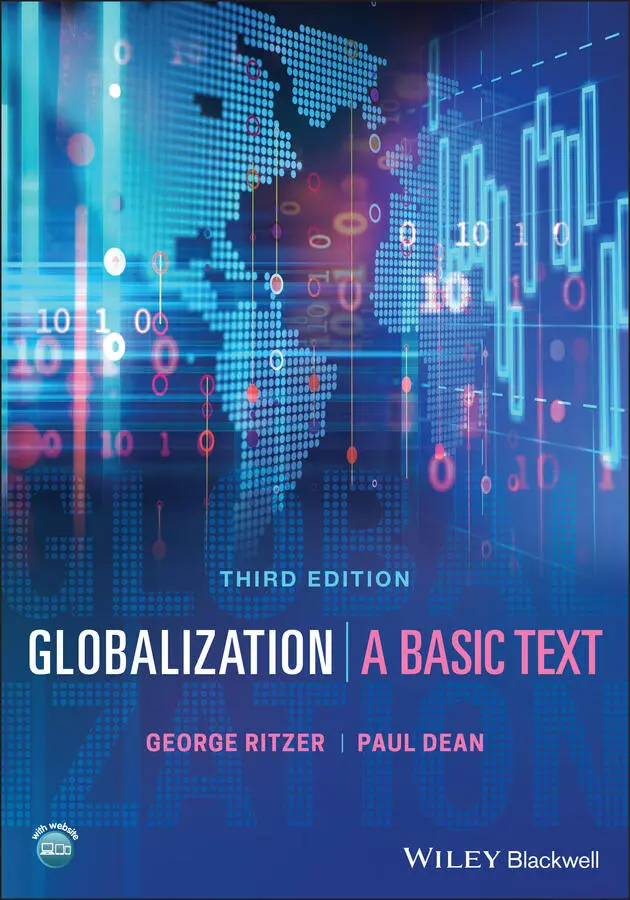
, distinguished researchers and authors George Ritzer and Paul Dean deliver an up-to-date introduction to major trends and topics related to the study of globalization. The book includes accessible and rigorous material on the key theories and major topics in globalization, as well as modern developments like the rise of populism and far-right political groups, Brexit, migration and backlash to it, trade negotiations, social media and the spread of misinformation, climate change, social justice issues, and COVID-19.
The new edition includes a greater focus on the structures of inequality that encourage or discourage global flows. Additionally, new examples and sources from Central and South America, Africa, and Asia are used to illustrate key concepts, and round out the international coverage of book. Throughout, the authors use clear and helpful metaphors including solids, liquids, gases, and flows to introduce and explain the complex nature of globalization in an engaging and understandable way.
Readers will also benefit from the inclusion of:
A thorough introduction to globalization and related processes, including imperialism, colonialism, development, and westernization An exploration of neoliberalism, including its roots, principles, criticisms, and Neo-Marxist alternatives A practical discussion of global political structures and processes, as well as global economic flows of production and consumption A concise treatment of negative global flows and processes, including dangerous imports, diseases, crime, terrorism, and war Analysis of the changing nature of globalization and de-globalization, and the social movements and technological developments driving these changes More images, charts, and graphs to help illustrate and highlight the concepts contained in the book Perfect for advanced undergraduates studying globalization across sociology, political science, geography, anthropology, and economics,
will also be essential reading for students taking courses in culture, economy and inequality, and migration taught from a global perspective.
Globalization — читать онлайн ознакомительный отрывок
Ниже представлен текст книги, разбитый по страницам. Система сохранения места последней прочитанной страницы, позволяет с удобством читать онлайн бесплатно книгу «Globalization», без необходимости каждый раз заново искать на чём Вы остановились. Поставьте закладку, и сможете в любой момент перейти на страницу, на которой закончили чтение.
Интервал:
Закладка:
The term imperialism came into widespread use in the late nineteenth century as a number of nations (Germany, Italy, Belgium, Great Britain, France, United States) competed for control over previously undeveloped geographic areas, especially in Africa. (Before that, Spain, Portugal, and the Netherlands had been other leading imperialist nations.) While used mainly descriptively at first, imperialism came to have a negative connotation beginning, perhaps, with the Boer War (1899–1902). Questions were being raised about the need for political control by the imperial powers. Also being questioned was the longstanding rationale that the “superior” cultures associated with imperial powers were necessary and beneficial to the “inferior” cultures they controlled. While it is true that much culture flowed from the imperial nations to the areas they controlled, culture flowed in the other direction, as well. Imperial nations exercised great, albeit variable, political, economic, and cultural control over vast portions of the world.
In terms of political power, Great Britain exercised great control over a vast empire well into the twentieth century (that included the United States until the end of the Revolutionary War [also called the “War of Independence” from Great Britain] and the Treaty of Paris in 1783; India until its independence in 1947, and so on). The Soviet Union created a great political empire in the early part of the twentieth century by integrating various nations into it (e.g. the Ukraine), as well as exercising great control over other Soviet bloc nations (e.g. Poland, East Germany). The United States has also been an important, perhaps the most important, imperialistic nation, but its political control has generally (but certainly not always) been more subtle and less direct than that exercised by Great Britain and the Soviet Union in their heyday.
Political imperialism declined dramatically after WW II as most imperial nations withdrew, often reluctantly, from the domains they controlled. The imperial power of the Soviet Union continued longer, but it disappeared with the demise of the Soviet Union in 1991. While there is little, if any political imperialism today (i.e. the representatives of an imperial nation ruling a controlled area), other forms of imperialism persist.
In terms of imperialism in an economic sense, the actions of the British were most notable. For example, the British East India Company (the Dutch, French, and Swedish also had East India Companies) exercised great economic (as well as political and military) power on behalf of Great Britain in India. Also important was Britain’s Hudson’s Bay Company which, from its base in Canada, exercised great control over the fur trade, and later other forms of commerce, in North America. However, it is the United States that dominated the world economy, especially throughout the latter half of the twentieth century, as an imperialistic power, at least in an economic sense.
Vladimir Lenin (1917/1939), the first leader of the Soviet Union, was an important early theorist of imperialism, especially in his book, Imperialism: The Highest Stage of Capitalism . Lenin was influenced by J. A. Hobson’s (1902/1905/1938) even earlier 1902 book, Imperialism . The title of Lenin’s work well expresses his view that the economic nature of capitalism leads capitalistic economies, and the nation-states that are dominated by such an economic system, to seek out and control distant geographic areas. This was also Hobson’s (1902/1905/1938: 85) view: “Thus we reach the conclusion that Imperialism is the endeavour of the great controllers of industry to broaden the channel for the flow of their surplus wealth by seeking foreign markets and foreign investments to take off the goods and capital they cannot sell or use at home.” Control over those areas was needed to provide resources for capitalist industries and also to create new markets for those industries. In other words, a capitalist economic system tended to expand imperialistically throughout the world.
While he recognizes that there are other dimensions to imperialism, Lenin sees “purely economic factors” as the most basic, as the essence of imperialism. His definition of imperialism encompasses five dimensions, all of which highlight economic factors:
1 The concentration of production and capital developed to such a high stage that it created monopolies 1which play a decisive role in economic life.
2 The merging of bank capital with industrial capital, and the creation, on the basis of this “finance capital,” 2of a “financial oligarchy.”
3 The export of capital, which has become extremely important, as distinguished from the export of commodities.
4 The formation of international capitalist monopolies which share the world among themselves.
5 The territorial division of the whole world among the greatest capitalist powers is completed (Lenin 1917/1939: 89).
The (mainly European) capitalist nations and firms are seen as having expanded throughout the world and as having carved up that world among themselves. From a revolutionary point of view, Lenin sees imperialism as a parasitic system and one that is part, and reflects the decay, of capitalism. Thus, it is an(other) indication of the rottenness of capitalism and the fact that capitalism is either in danger of collapse or that its decayed carcass will eventually prove easy to discard.
Ironically, although it was not capitalistic, it was Lenin’s Soviet Union that became an important imperial power, especially politically, but also through the economic exploitation of the countries in the Soviet bloc. While political imperialism has all but disappeared, economic imperialism remains quite powerful, if for no other reason than the fact that capitalism remains preeminent in the global economic system.
The continuing importance of the idea of imperialism has been challenged in an important book in the study of globalization, Michael Hardt and Antonio Negri’s Empire (2000). In their view, the often heavy-handed, nation-based forms of imperialism described above have been replaced by a far more subtle and complex network of global political/economic/cultural processes that are exercising a new form of control that is better captured, in their view, by the idea of empire rather than imperialism.
Related to Hardt and Negri’s argument is the idea that the decline of the importance of the nation-state makes it difficult to continue to talk in terms of imperialism which, at its base, is a view that a given nation (or elements of it, e.g. in the case of media imperialism, the US’s Voice of America ) exercises control over other nations (or geographic areas) around the world. It is this decline that leads to Hardt and Negri’s more “decentered” view of globalization. That is, imperialism was a modern process and perspective that was “centered” on the nation-state (Great Britain, the Soviet Union, the US), but the declining importance of the nation-state requires a very different view of control exercised on a global scale. To Hardt and Negri it is the power exercised by a decentered empire that has replaced that exercised by imperialism and practiced by nation-states.
THE NEW IMPERIALISM
Several theorists have argued that new twenty-first century forms of imperialism are what drive changes in our world (Ghosh 2019; Harvey 2003). David Harvey (2003) has articulated the idea that a “new imperialism” has arisen with the United States as its prime (if not only) representative. He calls this “capitalist imperialism” and sees it as a contradictory fusion of economics and politics. Thus, Harvey offers a more integrated view of imperialism than did Lenin or Hobson. More specifically, it involves a fusion of the political – “imperialism as a distinctively political project on the part of actors whose power is based in command of a territory and a capacity to mobilize its human and natural resources towards political, economic, and military ends” and the economic – “imperialism as a diffuse political-economic process in space and time in which command over and use of capital takes primacy” (Harvey 2003: 26). There are fundamental differences between the two (political interest in territory and capitalist interest in command, and use, of capital), but the “two logics intertwine in complex and sometimes contradictory ways” (Harvey 2003: 29). For example, to the American government the Vietnam War made sense from a political point of view, but it hardly made sense from an economic perspective and may even have adversely affected the American economy. More generally, Harvey wonders whether we are now seeing an increase in US political imperialism (e.g. Iraq and Afghanistan) while it is declining in importance from the perspective of economic imperialism (e.g. the rise in economic power of China, the EU, India, etc.).
Читать дальшеИнтервал:
Закладка:
Похожие книги на «Globalization»
Представляем Вашему вниманию похожие книги на «Globalization» списком для выбора. Мы отобрали схожую по названию и смыслу литературу в надежде предоставить читателям больше вариантов отыскать новые, интересные, ещё непрочитанные произведения.









Обсуждение, отзывы о книге «Globalization» и просто собственные мнения читателей. Оставьте ваши комментарии, напишите, что Вы думаете о произведении, его смысле или главных героях. Укажите что конкретно понравилось, а что нет, и почему Вы так считаете.