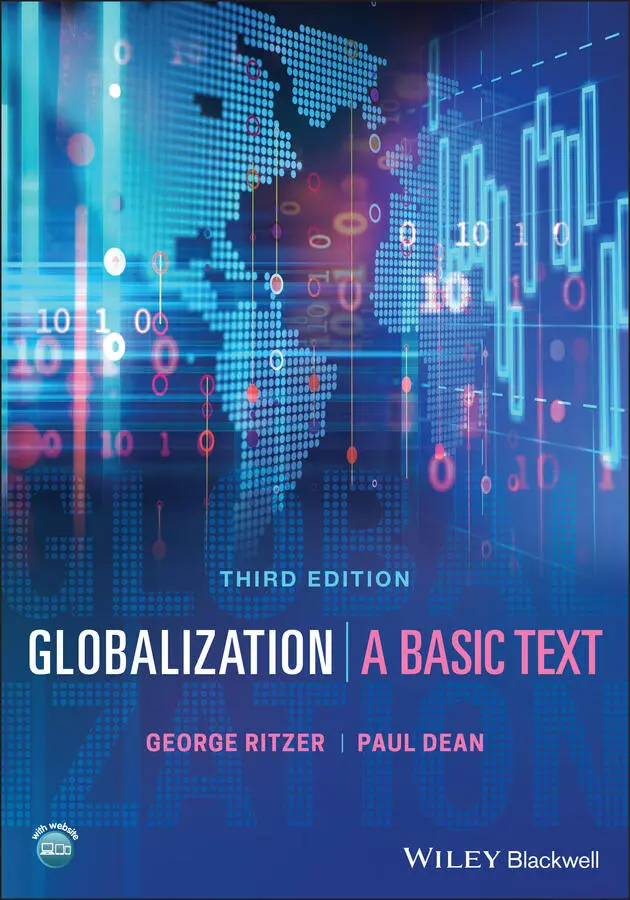
George Ritzer - Globalization
Здесь есть возможность читать онлайн «George Ritzer - Globalization» — ознакомительный отрывок электронной книги совершенно бесплатно, а после прочтения отрывка купить полную версию. В некоторых случаях можно слушать аудио, скачать через торрент в формате fb2 и присутствует краткое содержание. Жанр: unrecognised, на английском языке. Описание произведения, (предисловие) а так же отзывы посетителей доступны на портале библиотеки ЛибКат.
- Название:Globalization
- Автор:
- Жанр:
- Год:неизвестен
- ISBN:нет данных
- Рейтинг книги:3 / 5. Голосов: 1
-
Избранное:Добавить в избранное
- Отзывы:
-
Ваша оценка:
Globalization: краткое содержание, описание и аннотация
Предлагаем к чтению аннотацию, описание, краткое содержание или предисловие (зависит от того, что написал сам автор книги «Globalization»). Если вы не нашли необходимую информацию о книге — напишите в комментариях, мы постараемся отыскать её.
, distinguished researchers and authors George Ritzer and Paul Dean deliver an up-to-date introduction to major trends and topics related to the study of globalization. The book includes accessible and rigorous material on the key theories and major topics in globalization, as well as modern developments like the rise of populism and far-right political groups, Brexit, migration and backlash to it, trade negotiations, social media and the spread of misinformation, climate change, social justice issues, and COVID-19.
The new edition includes a greater focus on the structures of inequality that encourage or discourage global flows. Additionally, new examples and sources from Central and South America, Africa, and Asia are used to illustrate key concepts, and round out the international coverage of book. Throughout, the authors use clear and helpful metaphors including solids, liquids, gases, and flows to introduce and explain the complex nature of globalization in an engaging and understandable way.
Readers will also benefit from the inclusion of:
A thorough introduction to globalization and related processes, including imperialism, colonialism, development, and westernization An exploration of neoliberalism, including its roots, principles, criticisms, and Neo-Marxist alternatives A practical discussion of global political structures and processes, as well as global economic flows of production and consumption A concise treatment of negative global flows and processes, including dangerous imports, diseases, crime, terrorism, and war Analysis of the changing nature of globalization and de-globalization, and the social movements and technological developments driving these changes More images, charts, and graphs to help illustrate and highlight the concepts contained in the book Perfect for advanced undergraduates studying globalization across sociology, political science, geography, anthropology, and economics,
will also be essential reading for students taking courses in culture, economy and inequality, and migration taught from a global perspective.
Globalization — читать онлайн ознакомительный отрывок
Ниже представлен текст книги, разбитый по страницам. Система сохранения места последней прочитанной страницы, позволяет с удобством читать онлайн бесплатно книгу «Globalization», без необходимости каждый раз заново искать на чём Вы остановились. Поставьте закладку, и сможете в любой момент перейти на страницу, на которой закончили чтение.
Интервал:
Закладка:
Some scholars have noted that in spite of greater liquidity and ever-more flows of various types, flows do not necessarily go everywhere. Even when they do, they affect different places with varying degrees of intensity. Using another metaphor, it could be argued that globalization “hops” from one locale to another, rather than flowing evenly through all locales. While globalization flows more easily through the developed world, it bypasses many locales in the less developed world.
Disputes exist regarding the future development and expansion of globalization. Some view globalization as an inexorable process. But with a growing backlash to globalization today, and the effects of COVID-19, fewer see it as inevitable. Here, it is important to distinguish between globalization from above and globalization from below. Globalization from above is a process that is created and controlled by centralized and powerful actors, such as wealthy elites or MNCs (especially in the North). Globalization from below, which involves marginalized groups and social movements that struggle to make globalization benefit more people and for global processes to be more democratic, can serve to make the process less inevitable.
A difference of opinion exists between globaphiliacs and globaphobics. Globaphiliacs emphasize the positive aspects of globalization. They argue that globalization leads to great economic growth and a contingent spread of democratization and civil society. Globaphiliacs tend to deemphasize its negative aspects, particularly the people who have not been beneficiaries of the process. The globaphobics’ critiques of globalization are diverse, emerging not only from left and liberal quarters, but also from the conservative right. These critics emphasize the negative impact of globalization on the less well-off portions of the world’s population, or fear the threat to national culture and identity. Some scholars adopt a middle ground in these debates.
Large groups of people feel disadvantaged by various aspects of globalization. Some are of the opinion that globalization is an inexorable process. Others argue that not only can the process be slowed down, it can be stopped completely. Another view is that the problems existing in globalization are being addressed by major players as well as International Non-Governmental Organizations (INGOs). However, many activists feel that much more needs to be done to deal with the most problematic aspects of globalization.
DISCUSSION QUESTIONS
1 Is the current era unique in terms of globalization? What factors contribute to or detract from this uniqueness?
2 In what ways is globalization a homogenizing process?
3 Define globalization from below. Is it capable of offering adequate resistance to the pressures created by globalization from above?
4 Discuss the different drivers of globalization. Are materialist factors more influential than ideational factors?
5 Is globalization an inexorable process? Should it be?
6 Does globalization lead to a “flat world”? Discuss.
REFERENCES
1 Abrutyn, Seth. 2012. “Religions, Global.” In George Ritzer, ed., Wiley-Blackwell Encyclopedia of Globalization. Oxford: Wiley-Blackwell.
2 Adams, Vincanne, Dominique Behague, Carlo Caduff, Ilana Löwy, and Francisco Ortega. 2019. Re-imagining Global Health through Social Medicine.” Global Public Health 14 (10): 1383–1400.
3 Altbach, Philip, Liz Reisberg, and Laura E. Rumbley. 2019. Trends in Global Higher Education: Tracking an Academic Revolution. Leiden, The Netherlands: Brill.
4 Altman, Daniel. 2007. Connected: 24 Hours in the Global Economy. New York: Farrar, Straus and Giroux.
5 Andrews, David, and Ron Mower. 2012. “Sport.” In George Ritzer, ed., Wiley-Blackwell Encyclopedia of Globalization. Oxford: Wiley-Blackwell.
6 Basch, Linda Green, Nina Glick Schiller, and Cristina Blanc-Szanton. 1994. Nations Unbound: Transnational Projects, Post-Colonial Predicaments, and Deterritorialized Nation-States. Langhorne, PA: Gordon and Breach.
7 Beck, Ulrich. 2016. The Metamorphosis of the World: How Climate Change Is Transforming Our Concept of the World. Malden, MA: Polity Press.
8 Berger, Peter, and Thomas Luckmann. 1967. The Social Construction of Reality. Garden City, NY: Anchor Books.
9 Bhagwati, Jagdish. 2004. In Defense of Globalization. New York: Oxford University Press.
10 Bonanno, Alessandro, and Robert Antonio. 2012. “Multinational Corporations.” In George Ritzer, ed., Wiley-Blackwell Encyclopedia of Globalization. Oxford: Wiley-Blackwell.
11 Brulle, Robert, Jason Carmichael, and J. Craig Jenkins. 2012. “Shifting Public Opinion on Climate Change: An Empirical Assessment of Factors Influencing Concern over Climate Change in the U.S., 2002–2010.” Climate Change 114 (2): 169–188.
12 Chanda, Nayan. 2007. Bound Together: How Traders, Preachers, Adventurers, and Warriors Shaped Globalization. New Haven, CT: Yale University Press.
13 Chomsky, Noam. 2003. Hegemony or Survival: America’s Quest for Global Dominance. New York: Metropolitan Books.
14 Chomsky, Noam. 2013. Power Systems: Conversations on Global Democratic Uprisings and the New Challenges to U.S. Empire. New York: Metropolitan Books.
15 Clegg, Stewart, and Chris Carter. 2007. “The Sociology of Global Organizations.” In George Ritzer, ed., Blackwell Companion to Globalization. Oxford: Blackwell, pp. 272–290.
16 Dasgupta, Rana. 2018. “The Demise of the Nation State.” The Guardian April 5.
17 de la Dehesa, Guillermo. 2006. Winners and Losers in Globalization. Oxford: Blackwell.
18 de la Dehesa, Guillermo. 2007. What Do We Know about Globalization? Issues of Poverty and Income Distribution. Oxford: Blackwell.
19 de Sousa Santos, Boaventura. 2006. “Globalizations.” Theory, Culture, & Society 2–3 (23): 393–399.
20 Dean, Paul, and George Ritzer. 2012. “Globalization.” In George Ritzer, ed., Wiley-Blackwell Encyclopedia of Globalization. Oxford: Wiley-Blackwell.
21 Drori, Gili S.2012. “Science.” In George Ritzer, ed., Wiley-Blackwell Encyclopedia of Globalization. Oxford: Wiley-Blackwell.
22 Ferguson, James. 2006. Global Shadows: Africa in the Neoliberal World. Durham: Duke University Press.
23 Flores, Joaquin. 2020. ““Coronavirus Shutdown: The End of Globalization and Planned Obsolescence—Enter Multipolarity.” Strategic Culture Foundation April 12.
24 Friedman, Milton. 2002. Capitalism and Freedom. Chicago, IL: University of Chicago Press.
25 Friedman, Thomas. 1999. The Lexus and the Olive Tree. New York: Farrar, Straus and Giroux.
26 Friedman, Thomas. 2005. The World Is Flat: A Brief History of the Twenty-first Century. New York: Farrar, Strauss and Giroux.
27 Friedman, Thomas. 2012. The Lexus and the Olive Tree: Understanding Globalization, Revised and updated ed. New York: Picador.
28 Friedman, Uri. 2018. “Donald Trump Issues a Scathing Rejection of ‘Globalism’.” The Atlantic September 25.
29 Galli, Anya, and Piergiorgio Degliesposti. 2012. “Slow Food Movement.” In George Ritzer, ed., Wiley-Blackwell Encyclopedia of Globalization. Oxford: Wiley-Blackwell.
30 Gibbon, Edward. 1998. The History of the Decline and Fall of the Roman Empire. London: Wordsworth.
31 Giddens, Anthony. 1984. The Constitution of Society: Outline of the Theory of Structuration. Berkeley, CA: University of California Press.
32 Giulianotti, Richard, and Dino Numerato. 2018. “Global Sport and Consumer Culture: An Introduction.” Journal of Consumer Culture 18 (2): 229–240.
33 Giulianotti, Richard, and Roland Robertson. 2007. “Recovering the Social: Globalization, Football and Transnationalism.” In Richard Giulianotti and Roland Robertson, eds., Globalization and Sport. Oxford: Blackwell.
Читать дальшеИнтервал:
Закладка:
Похожие книги на «Globalization»
Представляем Вашему вниманию похожие книги на «Globalization» списком для выбора. Мы отобрали схожую по названию и смыслу литературу в надежде предоставить читателям больше вариантов отыскать новые, интересные, ещё непрочитанные произведения.











Обсуждение, отзывы о книге «Globalization» и просто собственные мнения читателей. Оставьте ваши комментарии, напишите, что Вы думаете о произведении, его смысле или главных героях. Укажите что конкретно понравилось, а что нет, и почему Вы так считаете.