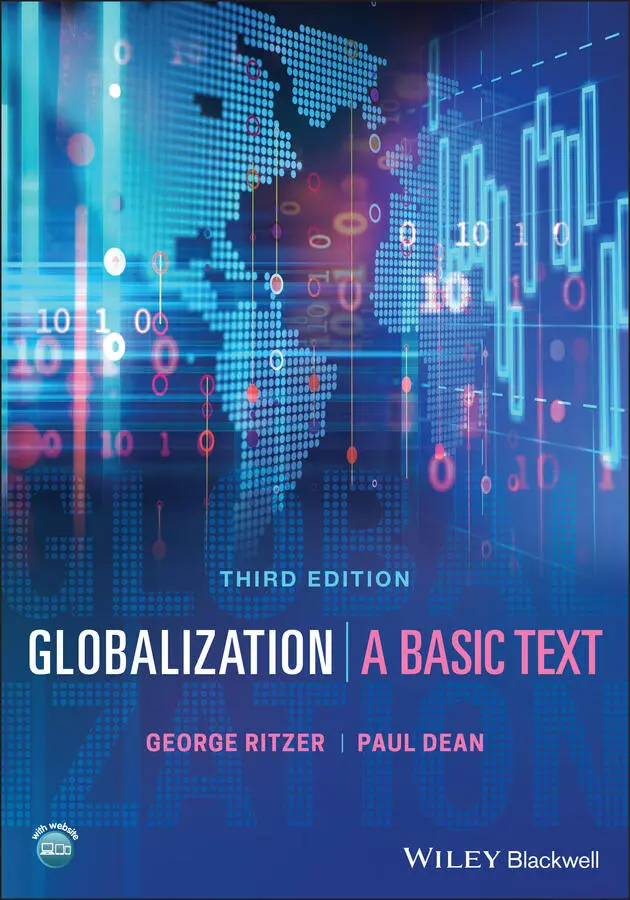
George Ritzer - Globalization
Здесь есть возможность читать онлайн «George Ritzer - Globalization» — ознакомительный отрывок электронной книги совершенно бесплатно, а после прочтения отрывка купить полную версию. В некоторых случаях можно слушать аудио, скачать через торрент в формате fb2 и присутствует краткое содержание. Жанр: unrecognised, на английском языке. Описание произведения, (предисловие) а так же отзывы посетителей доступны на портале библиотеки ЛибКат.
- Название:Globalization
- Автор:
- Жанр:
- Год:неизвестен
- ISBN:нет данных
- Рейтинг книги:3 / 5. Голосов: 1
-
Избранное:Добавить в избранное
- Отзывы:
-
Ваша оценка:
Globalization: краткое содержание, описание и аннотация
Предлагаем к чтению аннотацию, описание, краткое содержание или предисловие (зависит от того, что написал сам автор книги «Globalization»). Если вы не нашли необходимую информацию о книге — напишите в комментариях, мы постараемся отыскать её.
, distinguished researchers and authors George Ritzer and Paul Dean deliver an up-to-date introduction to major trends and topics related to the study of globalization. The book includes accessible and rigorous material on the key theories and major topics in globalization, as well as modern developments like the rise of populism and far-right political groups, Brexit, migration and backlash to it, trade negotiations, social media and the spread of misinformation, climate change, social justice issues, and COVID-19.
The new edition includes a greater focus on the structures of inequality that encourage or discourage global flows. Additionally, new examples and sources from Central and South America, Africa, and Asia are used to illustrate key concepts, and round out the international coverage of book. Throughout, the authors use clear and helpful metaphors including solids, liquids, gases, and flows to introduce and explain the complex nature of globalization in an engaging and understandable way.
Readers will also benefit from the inclusion of:
A thorough introduction to globalization and related processes, including imperialism, colonialism, development, and westernization An exploration of neoliberalism, including its roots, principles, criticisms, and Neo-Marxist alternatives A practical discussion of global political structures and processes, as well as global economic flows of production and consumption A concise treatment of negative global flows and processes, including dangerous imports, diseases, crime, terrorism, and war Analysis of the changing nature of globalization and de-globalization, and the social movements and technological developments driving these changes More images, charts, and graphs to help illustrate and highlight the concepts contained in the book Perfect for advanced undergraduates studying globalization across sociology, political science, geography, anthropology, and economics,
will also be essential reading for students taking courses in culture, economy and inequality, and migration taught from a global perspective.
Globalization — читать онлайн ознакомительный отрывок
Ниже представлен текст книги, разбитый по страницам. Система сохранения места последней прочитанной страницы, позволяет с удобством читать онлайн бесплатно книгу «Globalization», без необходимости каждый раз заново искать на чём Вы остановились. Поставьте закладку, и сможете в любой момент перейти на страницу, на которой закончили чтение.
Интервал:
Закладка:
7 Held, David, and Anthony McGrew. 2000. “The Great Globalization Debate: An Introduction.” In David Heldand Anthony McGrew, eds., The Global Transformations Reader: An Introduction to the Globalization Debate. Cambridge: Polity Press, pp. 1–50.
8 Hoffman, Stanley. 2002. “Clash of Globalizations.” Foreign Affairs 81 (4): 104/15.
9 Ritzer, George, and Zeynep Atalay, eds. 2010. Readings in Globalization: Key Concepts and Major Debates. Oxford: Blackwell.
10 Stacey, Oliver, Giulia De Lazzari, Hilary Grayson, Hazel Griffin, Emily Jones, Amanda Taylor, and David Thomas. 2018. The Globalization of Science Curricula. Cham, Switzerland: Springer.
11 Zürn, Michael, and Pieter de Wilde. 2016. “Debating Globalization: Cosmopolitanism and Communitarianism as Political Ideologies.” Journal of Political Ideologies 21 (3): 280–301.
NOTES
1 1The title of this chapter is derived from an anthology the first author edited many years ago. See Ritzer (1972).
2 2Immigrants can be thought of as “transnational” when they are involved in a variety of relationships (e.g. social, economic, political) that cut across the nations of settlement and origin creating a new transnational field (Basch et al. 1994). While there are certainly many immigrants who fit into this category and their number is likely growing, there has been a tendency to overestimate their number and to conflate transmigrants and immigrants. Thus, Portes (2001a: 183) concludes: “It is more useful to conceptualize transnationalism as one form of economic, political and cultural adaptation that co-exists with other, more traditional forms [e.g. assimilation].” He usefully limits the idea of transnational activities to “those initiated and sustained by non-institutional actors, be they organized groups or networks of individuals across national borders. Many of these activities are informal, that is they take place outside the pale of state regulation and control… . they represent goal-oriented initiatives that require coordination across national borders by members of civil society. These activities are undertaken on their own behalf, rather than on behalf of the state or corporate bodies” (Portes 2001a: 186).
3 3By the way, this idea of such a basic “urge” is quite controversial and is critiqued by postmodernists (and others) as being suggestive of “essentialism,” or the notion that there is some fundamental characteristic of humans that lies at their essence and explains much of what they do. See Ritzer (1997).
4 4Robertson’s analysis ends at this point since his essay was published in 1990.
5 5Goffman (1961: 81). The quotation: “To be awkward or unkempt, to talk or move wrongly, is to be a dangerous giant, a destroyer of worlds. As every psychotic and comic ought to know, any accurately improper move can poke through the thin sleeve of immediate reality.”
CHAPTER 3 GLOBALIZATION AND RELATED PROCESSESS IMPERIALISM, COLONIALISM, DEVELOPMENT, WESTERNIZATION, EASTERNIZATION, AND AMERICANIZATION
Imperialism
Imperialism
Colonialism
Postcolonialism
Development
Westernization
Westernization
Americanization
A Broader and Deeper View of the Americanization of Consumer Culture,
Minimizing the Importance of Americanization
Anti-Americanism
Comparisons with Globalization
The Era of the “Posts”
Chapter Summary
Globalization has come to be the preeminent term for describing and thinking about processes that affect, and structures common to, large portions of the world today. However, there are many other concepts that either describe earlier historical, or contemporary, realities that deal with at least a portion of that which is encompassed by globalization. In this chapter we deal with several concepts that are related to globalization – imperialism, colonialism (and postcolonialism), development (and dependency), Westernization, Easternization, and Americanization (and anti-Americanization).
We devote much more attention to Americanization than the other processes even though there is much to indicate, and many scholars argue (and as will be discussed in many places in this book), that the era of American preeminence in the global arena is in decline and can only fall further in the future. For example, Fareed Zakaria (2008, 2011) argues that we are living in a “post-American world.” While there is much to recommend such arguments, the fact is that Americanization was of great global importance after WW II and until very recently. While it is greatly weakened, it remains to this day an important global force (Nye, Jr. 2015). Furthermore, even if it were to disappear tomorrow (a highly unlikely possibility), its effects throughout the world would linger and be felt for many years, decades, or even centuries to come. It is important to point out early on that while all of these concepts are discussed separately, many of them overlap, sometimes quite substantially. For example, imperialism is sometimes difficult to distinguish from colonialism; Americanization is a sub-type of Westernization and it has also involved imperialism, colonialism, and a commitment to development (and dependency). Similar overlaps abound among and between all of these concepts. Furthermore, globalization cannot be completely divorced from these other ideas. In some cases their past impact lingers in the global age and they continue to affect globalization. In other cases, they continue to be viable and to affect, and even to be part of, globalization.
IMPERIALISM
Imperialismis a broad concept that describes various methods employed by one country to gain control (sometimes through territorial conquest) of another country (or geographic area) and then to exercise control, especially political, economic, and military control, over that country (or geographic area), and perhaps many other countries (as, most famously, did the British Empire) (Smith 2016). It is an idea and reality that came of age in the mid-to late-1800s (although its history, as we will see, is far more ancient), and is therefore rooted, at least since that time, in the idea of the nation-state and the control that it exercises over other nation-states as well as less well-defined geographic areas.
Imperialism can encompass a wide range of domains of control. In the era of the cultural turn in sociology, the latter is of increasing interest and concern and has come to be labeled cultural imperialism(Inglis 2017). More specific manifestations of cultural imperialism are sufficiently important to earn a label of their own with the most important being media imperialism(see Chapters 8and 9for a discussion of these two forms of imperialism).
The term imperialism itself comes from the Roman imperium (Markoff 2007) and was first associated with domination and political control over one or more neighboring nations. The term “empire” is derived from imperium and it was used to describe political forms that had characteristics of Roman rule, especially the great power of the leader (the Roman imperator or emperor) and the huge chasm between the power of the ruler and the ruled (Gibbon 1998). Over time, the notion of empire, and of the process of imperialism, came to be associated with rulership over vast geographic spaces and the people who lived there. It is this characteristic that leads to the association between imperialism and globalization. In fact, many of the processes discussed in this book under the heading of globalization – trade, migration, communication, and so on – existed between the imperial power and the geographic areas that it controlled.
Читать дальшеИнтервал:
Закладка:
Похожие книги на «Globalization»
Представляем Вашему вниманию похожие книги на «Globalization» списком для выбора. Мы отобрали схожую по названию и смыслу литературу в надежде предоставить читателям больше вариантов отыскать новые, интересные, ещё непрочитанные произведения.









Обсуждение, отзывы о книге «Globalization» и просто собственные мнения читателей. Оставьте ваши комментарии, напишите, что Вы думаете о произведении, его смысле или главных героях. Укажите что конкретно понравилось, а что нет, и почему Вы так считаете.