George Ritzer - Globalization
Здесь есть возможность читать онлайн «George Ritzer - Globalization» — ознакомительный отрывок электронной книги совершенно бесплатно, а после прочтения отрывка купить полную версию. В некоторых случаях можно слушать аудио, скачать через торрент в формате fb2 и присутствует краткое содержание. Жанр: unrecognised, на английском языке. Описание произведения, (предисловие) а так же отзывы посетителей доступны на портале библиотеки ЛибКат.
- Название:Globalization
- Автор:
- Жанр:
- Год:неизвестен
- ISBN:нет данных
- Рейтинг книги:3 / 5. Голосов: 1
-
Избранное:Добавить в избранное
- Отзывы:
-
Ваша оценка:
Globalization: краткое содержание, описание и аннотация
Предлагаем к чтению аннотацию, описание, краткое содержание или предисловие (зависит от того, что написал сам автор книги «Globalization»). Если вы не нашли необходимую информацию о книге — напишите в комментариях, мы постараемся отыскать её.
, distinguished researchers and authors George Ritzer and Paul Dean deliver an up-to-date introduction to major trends and topics related to the study of globalization. The book includes accessible and rigorous material on the key theories and major topics in globalization, as well as modern developments like the rise of populism and far-right political groups, Brexit, migration and backlash to it, trade negotiations, social media and the spread of misinformation, climate change, social justice issues, and COVID-19.
The new edition includes a greater focus on the structures of inequality that encourage or discourage global flows. Additionally, new examples and sources from Central and South America, Africa, and Asia are used to illustrate key concepts, and round out the international coverage of book. Throughout, the authors use clear and helpful metaphors including solids, liquids, gases, and flows to introduce and explain the complex nature of globalization in an engaging and understandable way.
Readers will also benefit from the inclusion of:
A thorough introduction to globalization and related processes, including imperialism, colonialism, development, and westernization An exploration of neoliberalism, including its roots, principles, criticisms, and Neo-Marxist alternatives A practical discussion of global political structures and processes, as well as global economic flows of production and consumption A concise treatment of negative global flows and processes, including dangerous imports, diseases, crime, terrorism, and war Analysis of the changing nature of globalization and de-globalization, and the social movements and technological developments driving these changes More images, charts, and graphs to help illustrate and highlight the concepts contained in the book Perfect for advanced undergraduates studying globalization across sociology, political science, geography, anthropology, and economics,
will also be essential reading for students taking courses in culture, economy and inequality, and migration taught from a global perspective.
Globalization — читать онлайн ознакомительный отрывок
Ниже представлен текст книги, разбитый по страницам. Система сохранения места последней прочитанной страницы, позволяет с удобством читать онлайн бесплатно книгу «Globalization», без необходимости каждый раз заново искать на чём Вы остановились. Поставьте закладку, и сможете в любой момент перейти на страницу, на которой закончили чтение.
Интервал:
Закладка:
To Harvey, the new imperialism is the uncomfortable mix of these two types under the broad heading of capitalist imperialism. In addition, what is “new” here, at least in reference to the classic imperialism of say the British, is that it is the US that is the paradigm for, and the leader in, the new imperialism. Harvey not only describes US imperialism, but is highly critical of it. He sees it as burdened by a series of internal and external contradictions and problems which make it unsustainable in the long term (and perhaps even in the short term).
Ghosh (2019) adds that another new element of the new, twenty-first century imperialism is less about direct control of land and more exercised through global institutions (see Chapter 6), international regulations, and multilateral agreements. Imperialism continues to be shaped by large capital controlling the economic territory of smaller capital, but it is now more subtle. It includes, for example, the privatization of services (e.g. water, health, education, sanitation) that were once administered by local and national governments, and are now controlled by large corporations in more powerful countries. Ghosh is less concerned with the US as a sole imperial power and instead argues that, with the exception of China, the relative power of geopolitical regions within global capitalist imperialism persists. In other words, the new imperialism largely maintains global inequalities and power relations, but through different means.
COLONIALISM
Colonialismis clearly related to imperialism, and is sometimes used interchangeably with it, 3but it has a more specific meaning (Steinmetz 2016). At the most extreme, imperialism involves a control without the creation of colonies (Harvey 2006). Colonialism generally involves settlers as well as much more formal mechanisms of control than imperialism (Ashcroft 2012a). Thus, colonialism often entails the colonizer creating an administrative apparatus to run its internal affairs, including its settlements, within the colonized country (or geographic area). Edward Said well describes the key differences between imperialism and colonialism, as well as their relationship to one another: “imperialism means the practice, the theory, and the attitudes of a dominating metropolitan centre ruling a distant territory; ‘colonialism’, which is almost always a consequence of imperialism, is the implanting of settlements on distant territory” (cited in Ashcroft et al. 1998: 45). While both imperialism and colonialism involve economic and political (as well as cultural) control, imperialism is (following Lenin) more defined by economic control (and exploitation), while colonialism is more about political control.
Although colonialism has an ancient history, it can be said to have had two great and more recent ages. These occurred during and after the Renaissance (fourteenth through seventeenth centuries) and are associated mainly with European societies. The first, beginning in the fifteenth century, was led by European powers, especially Spain and Portugal, and involved creating colonies in Africa, Asia, and the Americas. The second, or modern, phase lasted roughly between 1820 and the end of WW I. It involved other European powers (most importantly Great Britain, France, and Germany), as well as the US and Japan. For an example of this, see Figure 3.1 of colonial powers and their colonies.
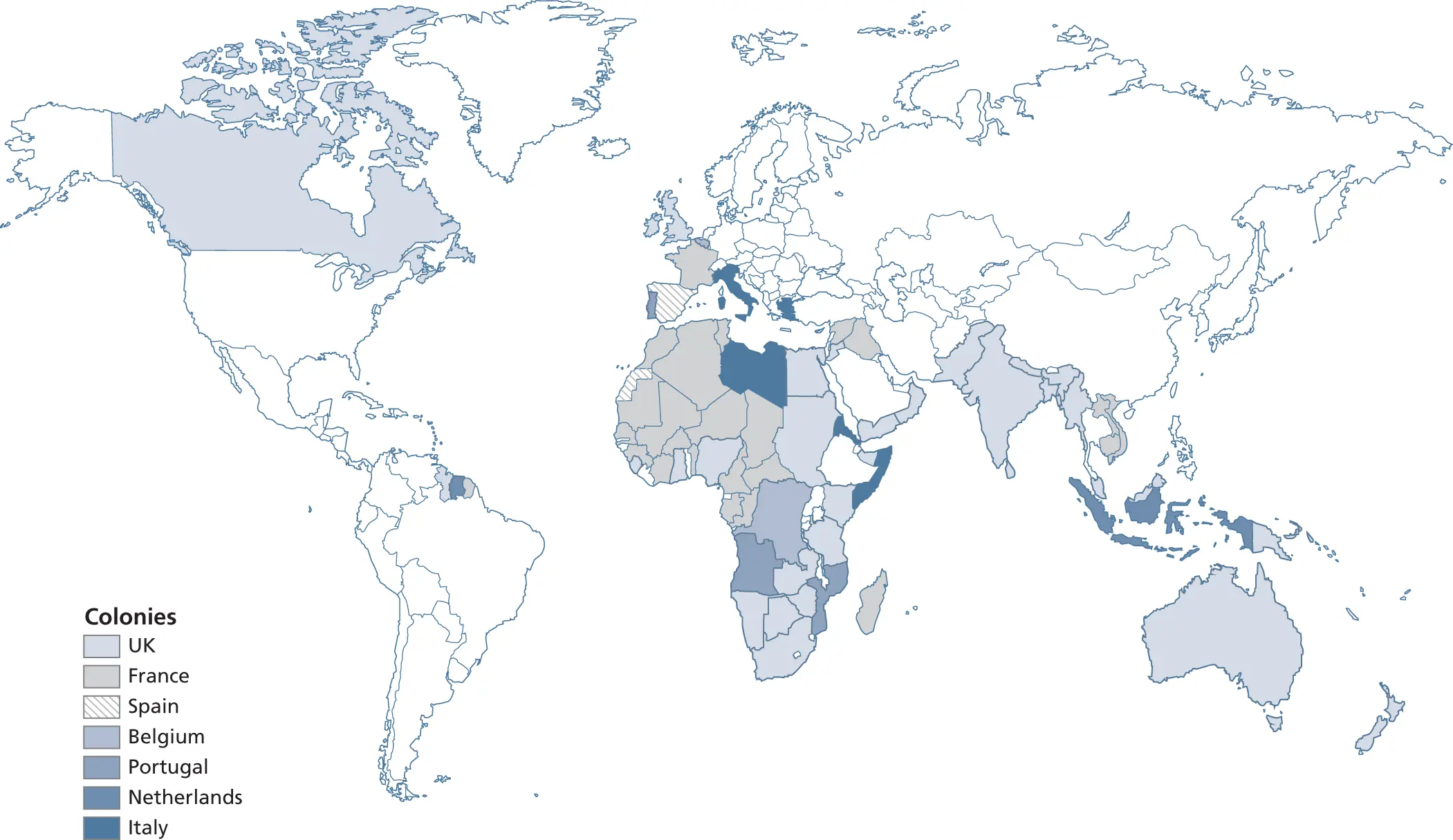
Figure 3.1 Colonial empires and their colonies: 1920. Source: Data from World 1920 empires colonies territory. Retrieved from: https://commons.wikimedia.org/wiki/File:World_1920_empires_colonies_territory.png.
Some colonies (e.g. India as a colony of the British) persisted well into the twentieth century. However, during that period the momentum shifted in the direction of decolonization , or “the process of revealing and dismantling colonialist power in all its forms. This includes dismantling the hidden aspects of those institutional and cultural forces that had maintained the colonialist power and that remain even after political independence is achieved” (Ashcroft et al. 1998: 63). Decolonization movements began to succeed with greater frequency as the twentieth century unfolded. They were followed by decolonization and the achievement of political independence (Grimal 1978). Decolonization was particularly important after the close of WW II. That was followed by a period of neo-colonialism (Nkrumah 1965), where efforts at control over the former colonies, and other nation-states, grew much more indirect, subtle (e.g. through cultural and educational institutions), and focused on economic control and exploitation. Like the new imperialism noted above, the subtlety of neo-colonialism made it more insidious and harder to detect and therefore more difficult to resist and combat. Furthermore, neo-colonialism has been very uneven with African countries having been impacted to a greater degree than other regions (Young 2017).
POSTCOLONIALISM
Today, few, if any, colonies remain with the result that we can now think in terms of postcolonialism(Ashcroft 2012b; Mulcahey 2017). 4Clearly, this implies the era in once-colonized areas after the colonizing power has departed (although postcolonial thinking and work could already be well under way before the colonizing power departs). However, in recent years it has come to take on more specific meanings that relate to various developments that take place in a former colony after the colonizing power departs. For example, it relates to a critical issue in globalization studies today, that of national identity, especially the difficulty of gaining identity (as an Indian, for example) after a colonial power (the British in the case of India) has departed. The most notable work on this is Edward Said’s Orientalism (1979/1994: 93) which deals with this problem in the context of both overt and more subtle negative stereotypes developed in the West about those who live in the East. The issue raised is the difficulty experienced by “Orientals” in developing a positive identity in light of all of the negativity about them in the West which, of course, dominated the East in various ways (imperialism, colonialism, etc., until very recently). This negativity is especially clear in the history of Western literature 5(and film) about the East (and, as a result, this issue is of special importance in Edward Said’s field of literary criticism). In fact, it is argued that “postcolonial theory was a creation of literary study” (Ashcroft et al. 2006: 5).
Postcolonial theorists focus on literary texts for several reasons. For one thing, literary texts can be used as a way of exercising cultural control over the “natives” (Janmohamed 2006). For example, textbooks written by the colonial power will reflect its perspective including its right to be in power, its superiority, and the inferiority of the “natives.” For another, those texts can be subverted by those who oppose the colonial power and can be used to help bring down its regime. Finally, knowledge of the importance of texts can lead to new texts that can be used by newly freed colonies to portray themselves positively and to better understand, critique, and overcome the often continuing legacies of postcolonialism. These postcolonial texts can be an important base for the new society created in the aftermath of colonialism.
However, the focus on texts by postcolonial theorists has been criticized on several grounds. For one thing, it is argued that it is mainly Western intellectuals, especially Europeans, who have produced these texts. Postcolonial thinkers are therefore seen as too closely aligned with those who produced the colonial texts that helped enslave the subalterns. That is, postcolonial scholarship is producing what is “at best only a refined version of the very discourse it seeks to displace” (Ashcroft et al. 2006: 11). Furthermore, postcolonialists’ orientation as European, or at least European-trained, scholars has led to work that is produced for other scholars and therefore largely incomprehensible to the native peoples without similar academic training. Finally, their work is seen as far removed from the needs and interests of the native peoples who would be the agents of any movement against colonialism or the legacy of postcolonialism. The work of postcolonialists is seen as quite distant from that of, say, Frantz Fanon (e.g. The Wretched of the Earth [1968]) who wrote in more widely accessible terms and was oriented to practical action to bring down both colonialism and the postcolonial legacy. Thus, many scholars in the field are calling for greater representation from authors of the colonized territories and their descendants (Branche 2018).
Читать дальшеИнтервал:
Закладка:
Похожие книги на «Globalization»
Представляем Вашему вниманию похожие книги на «Globalization» списком для выбора. Мы отобрали схожую по названию и смыслу литературу в надежде предоставить читателям больше вариантов отыскать новые, интересные, ещё непрочитанные произведения.









Обсуждение, отзывы о книге «Globalization» и просто собственные мнения читателей. Оставьте ваши комментарии, напишите, что Вы думаете о произведении, его смысле или главных героях. Укажите что конкретно понравилось, а что нет, и почему Вы так считаете.