Polymer Composites for Electrical Engineering
Здесь есть возможность читать онлайн «Polymer Composites for Electrical Engineering» — ознакомительный отрывок электронной книги совершенно бесплатно, а после прочтения отрывка купить полную версию. В некоторых случаях можно слушать аудио, скачать через торрент в формате fb2 и присутствует краткое содержание. Жанр: unrecognised, на английском языке. Описание произведения, (предисловие) а так же отзывы посетителей доступны на портале библиотеки ЛибКат.
- Название:Polymer Composites for Electrical Engineering
- Автор:
- Жанр:
- Год:неизвестен
- ISBN:нет данных
- Рейтинг книги:5 / 5. Голосов: 1
-
Избранное:Добавить в избранное
- Отзывы:
-
Ваша оценка:
Polymer Composites for Electrical Engineering: краткое содержание, описание и аннотация
Предлагаем к чтению аннотацию, описание, краткое содержание или предисловие (зависит от того, что написал сам автор книги «Polymer Composites for Electrical Engineering»). Если вы не нашли необходимую информацию о книге — напишите в комментариях, мы постараемся отыскать её.
Polymer Composites for Electrical Engineering
Polymer Composites for Electrical Engineering
Polymer Composites for Electrical Engineering — читать онлайн ознакомительный отрывок
Ниже представлен текст книги, разбитый по страницам. Система сохранения места последней прочитанной страницы, позволяет с удобством читать онлайн бесплатно книгу «Polymer Composites for Electrical Engineering», без необходимости каждый раз заново искать на чём Вы остановились. Поставьте закладку, и сможете в любой момент перейти на страницу, на которой закончили чтение.
Интервал:
Закладка:
2.2.4 Solid–Solid Composite PCMs
Different from solid–liquid PCMs, solid–solid PCMs can store heat via phase transition from one crystalline form to another similar form without generation/leakage of liquid or gas and additional encapsulation. The main strategy to obtain solid–solid PCMs is to construct secondary structure capable of preventing liquid noncrystalline phase from flowing through chemical bonding. In solid–solid polymeric PCMs, the phase change component as the “soft segment” is structurally incorporated into the macromolecular backbone as the “hard segment” via side‐chain grafting, block‐polymerization, hyper‐branching, or crosslinking copolymerization approaches. Phase transition behaviors and thermophysical properties of solid–solid polymeric PCMs can be tailored by adjusting the relative length and physicochemical structure of the soft and hard segments.[72] At present, solid–solid polymeric PCMs have been designed and optimized as thermoplastics and thermosets for TES systems.[73, 74]
Owing to the active terminal groups on PEG and its derivatives, great progresses in PEG‐based solid–solid PCMs have been witnessed in recent decades.[3] Commonly, it gains wide popularity in the preparation of PU‐based solid–solid PCMs via the direct reaction of PEG with crosslinker‐like isocyanate.[75] Alternatively, the preparation route of PU‐based PCMs involves pre‐polymerization of PEG with diisocyanate and chain extending or crosslinking with the participation of the chemicals containing multifunctional groups like 1,4‐butanediol,[76] tetrahydroxy compound,[77] and hyperbranched polyester[78]. For example, PU‐based solid–solid PCMs with the maximum latent heat storage capacity of 136.8 J g −1were synthesized utilizing PEG and hexamethylene diisocyanate trimer through one‐step and solvent‐free method.[79]
Compared with the sophisticated encapsulation procedure and weak physical interaction between supporting materials and phase change parts in leakage‐proof polymeric phase change composites discussed above, chemical grafting or blocking is a promising route to fabricate shape‐stabilized PCMs with superior chemical stability and thermal reliability, but it is accompanied by a decrease in phase change latent heat or energy storage density. The origin of this reduction may result from several aspects: dilution of working substance, mobility or packing restrictions of the crystalline moieties, and strong interaction between phase change part and polymer backbone. Figure 2.6summarizes the melting enthalpy and melting temperature ranges of polymeric solid–solid PCMs.[72] Besides, the majorities of these solid–solid polymeric PCMs are fabricated in solvents, which is not environmentally friendly and hinders their applications.
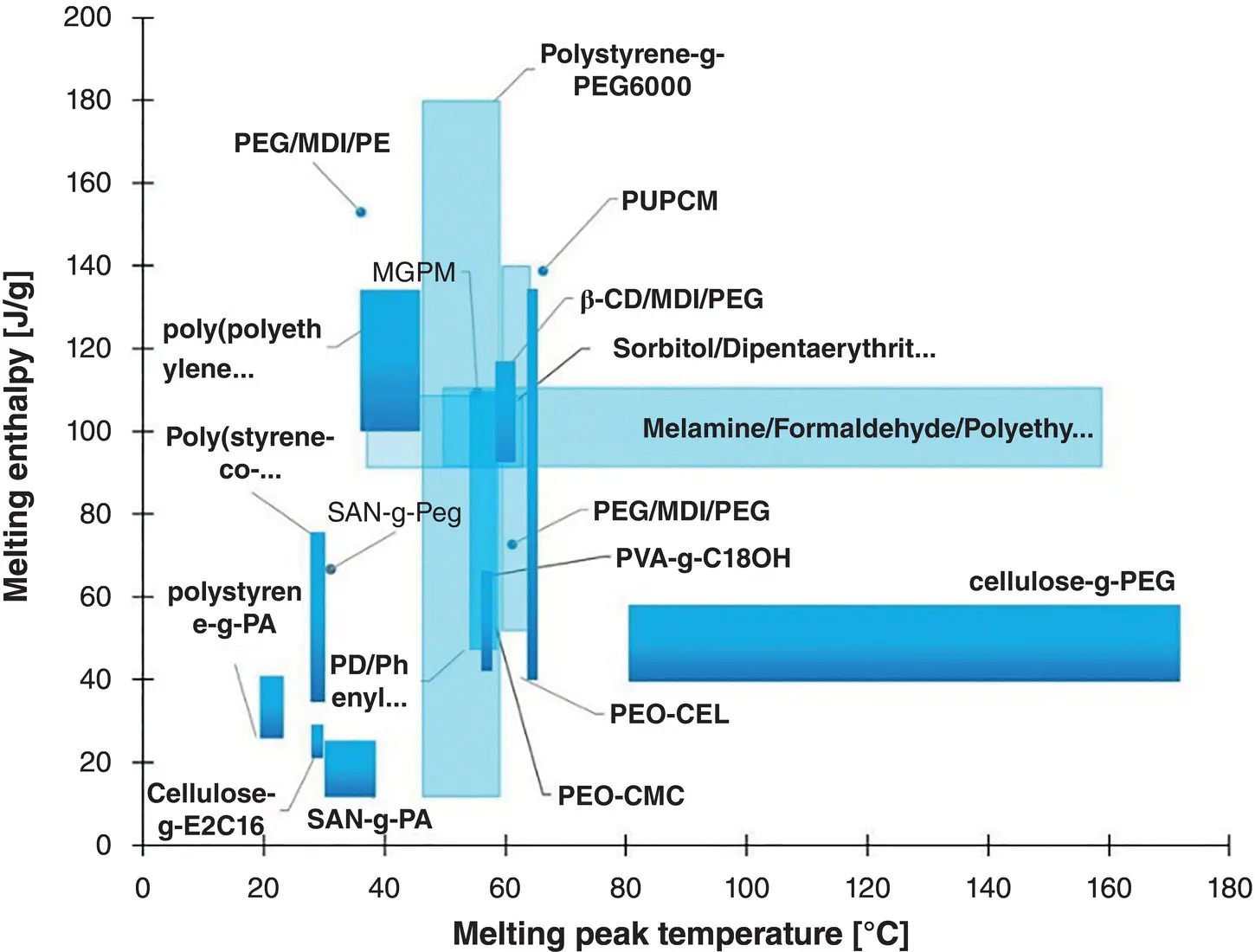
Figure 2.6 The melting enthalpy and melting temperature ranges for solid–solid polymeric PCMs.
Source : Fallahi et al. [72]. Reproduced with permission from Elsevier Ltd.
2.3 Thermally Conductive Polymeric Phase Change Composites
Heat is transferred mainly by heat conduction in solids. The main carriers are photons, electrons, and phonons, and phonon mechanism (lattice vibration) for heat transferring predominates in polymeric phase change composites. Apart from poor formability, another fatal shortcoming for PCMs is low thermal conductivity (0.1–0.3 W m −1K −1), which affects the working efficiency during heat charge/discharge process. Thermally conductive fillers, mainly including metals, carbon materials, ceramics, and their hybrids, are usually employed as enhancement component to improve the thermal conductivity of polymeric phase change composites. The thermal conductivity of the composites is closely related to the intrinsic thermal conductivity, addition content, geometric size, and distribution state/stacking mode of the functional fillers as well as the interface interaction between the filler and the matrix. The thermal conductivities of common organic PCMs and thermally conductive fillers are shown in Table 2.3.
The thermal conductivity can be determined by either steady‐state technique tracking the heat flow across a sample with a known thickness or transient technique measuring the energy dissipation through a sample when subjected to a heat pulse. Transient plane source (TPS) or hot disk and laser flash as transient techniques are commonly applied to measure thermal conductivity of the composites.[83] It is worth mentioning that more and more researchers use infrared thermal imagers to record the temperature distribution of samples during heating or cooling, further reflecting the thermal response rate of the sample. Generally speaking, the dispersion of thermally conductive fillers in the composites prepared by facile solution or melt blending is random, and thus forming disordered heat conduction network with large thermal resistance and limited thermal conductivity enhancement. In other words, in order to significantly improve the thermal conductivity of the composites, a large number of thermally conductive fillers, especially non‐carbon materials, have to be added, which in turn affects the energy storage density of the phase change composites. To balance the thermal conductivity and inherent energy storage density and make full use of the performance characteristics of functional fillers, the introduction of 3D structural materials assembled from small building blocks into the phase change matrices has become a research hotspot.[80] The preconstructed 3D structural materials can improve the utilization rate of thermally conductive filler and endow the composites with optimized thermally conductive network. Also, the use of 3D architectures can avoid the unstable factors such as sedimentation during the long‐term recycle.
Table 2.3 Thermal conductivities of frequently used organic PCMs and thermally conductive fillers.
Sources : Based on [80–82].
| Materials | Thermal Conductivity (W m −1K −1) | |
|---|---|---|
| Organic PCMs | PEG | 0.30 |
| PW | 0.25 | |
| n ‐Octadecane | 0.15 | |
| Erythritol | 0.72 | |
| Octadecanoic acid | 0.18 | |
| Metals | Silver | 429 |
| Cupper | 380–400 | |
| Aluminum | 204 | |
| Nickel | 158 | |
| Carbon materials | Carbon fiber (CF) | 1000 |
| CNT | 2000–6000 | |
| Graphite | 100–400 | |
| Graphene | 5300 | |
| Ceramics | BN | 250–300 |
| Aluminum nitride (AlN) | 200 | |
| Silicon carbide (SiC) | 120 | |
| Aluminum oxide (Al 2O 3) | 30–40 |
2.3.1 Metals
Among metal materials, the outstanding thermal conductivity of silver and copper is favored in the preparation of high thermally conductive composites. Qian et al.[84] fabricated leakage‐proof PEG/diatomite phase change composites. When a large amount of diatomite was added, the thermal conductivity improvement of the composite was very limited. Furthermore, the thermal conductivity of PEG/diatomite/silver nanoparticle ternary phase change composites was greatly improved by depositing spherical silver nanoparticles with the diameter of 3–10 nm on diatomite and then compounding with PEG. Compared with PEG/diatomite composites, the thermal conductivity of the ternary composites with silver nanoparticle loading of 7.2 wt% was increased by 127%, up to 0.82 W m −1k −1. Similarly, physical blending and impregnation were adopted to prepare PEG/EVM/silver nanowire composites, in which EVM with porous structure and silver nanowire with the length of 5–20 μm and the diameter of 50–100 nm acted as supporting skeleton and thermally conductive component to improve the shape stability and thermal conductivity of the phase change composites, respectively.[51] Apart from silver, thermal conductivity improvement of form‐stable PEG/SiO 2phase change composites has been achieved by in‐situ cupper doping.[85]
Читать дальшеИнтервал:
Закладка:
Похожие книги на «Polymer Composites for Electrical Engineering»
Представляем Вашему вниманию похожие книги на «Polymer Composites for Electrical Engineering» списком для выбора. Мы отобрали схожую по названию и смыслу литературу в надежде предоставить читателям больше вариантов отыскать новые, интересные, ещё непрочитанные произведения.






Обсуждение, отзывы о книге «Polymer Composites for Electrical Engineering» и просто собственные мнения читателей. Оставьте ваши комментарии, напишите, что Вы думаете о произведении, его смысле или главных героях. Укажите что конкретно понравилось, а что нет, и почему Вы так считаете.