Polymer Composites for Electrical Engineering
Здесь есть возможность читать онлайн «Polymer Composites for Electrical Engineering» — ознакомительный отрывок электронной книги совершенно бесплатно, а после прочтения отрывка купить полную версию. В некоторых случаях можно слушать аудио, скачать через торрент в формате fb2 и присутствует краткое содержание. Жанр: unrecognised, на английском языке. Описание произведения, (предисловие) а так же отзывы посетителей доступны на портале библиотеки ЛибКат.

- Название:Polymer Composites for Electrical Engineering
- Автор:
- Жанр:
- Год:неизвестен
- ISBN:нет данных
- Рейтинг книги:5 / 5. Голосов: 1
-
Избранное:Добавить в избранное
- Отзывы:
-
Ваша оценка:
Polymer Composites for Electrical Engineering: краткое содержание, описание и аннотация
Предлагаем к чтению аннотацию, описание, краткое содержание или предисловие (зависит от того, что написал сам автор книги «Polymer Composites for Electrical Engineering»). Если вы не нашли необходимую информацию о книге — напишите в комментариях, мы постараемся отыскать её.
Polymer Composites for Electrical Engineering
Polymer Composites for Electrical Engineering
Polymer Composites for Electrical Engineering — читать онлайн ознакомительный отрывок
Ниже представлен текст книги, разбитый по страницам. Система сохранения места последней прочитанной страницы, позволяет с удобством читать онлайн бесплатно книгу «Polymer Composites for Electrical Engineering», без необходимости каждый раз заново искать на чём Вы остановились. Поставьте закладку, и сможете в любой момент перейти на страницу, на которой закончили чтение.
Интервал:
Закладка:
Yang et al.[33] fabricated a polyurea/TiO 2hybrid shell to encapsulate n ‐octadecane by a two‐step liquid phase deposition method. The n ‐octadecane/polyurea pre‐microcapsules were first synthesized through interfacial polymerization, followed by the deposition of TiO 2on the surface of pre‐microcapsules. Tang et al.[34] synthesized a PMMA/SiO 2hybrid shell to encapsulate n ‐octadecane PCMs using a novel photocurable pickering emulsion method, and the introduction of ultraviolet (UV) irradiation effectively shortened the polymerization time and decreased the processing temperature. Furthermore, TiC was introduced into the PMMA‐SiO 2hybrid shell to improve the thermal conductivity and thermal stability of the polymeric phase change composites.[35] Similarly, a PMMA/TiO 2/boron nitride (BN) hybrid shell with high thermal conductivity has been developed to encapsulate PW through a pickering emulsion method ( Figure 2.4a).[36] MF, graphene oxide (GO), and PW acted as shell, extra protective screen, and core, respectively, to prepare microencapsulated phase change composites with high encapsulation ratio (up to 93.9 wt%) through in‐situ polymerization ( Figure 2.4b).[37] Along this line, carbon nanotube (CNT) as thermally conductive enhancement component was added into MF/GO shell system to facilitate thermal charging/discharging of microencapsulated phase change composites.[38]
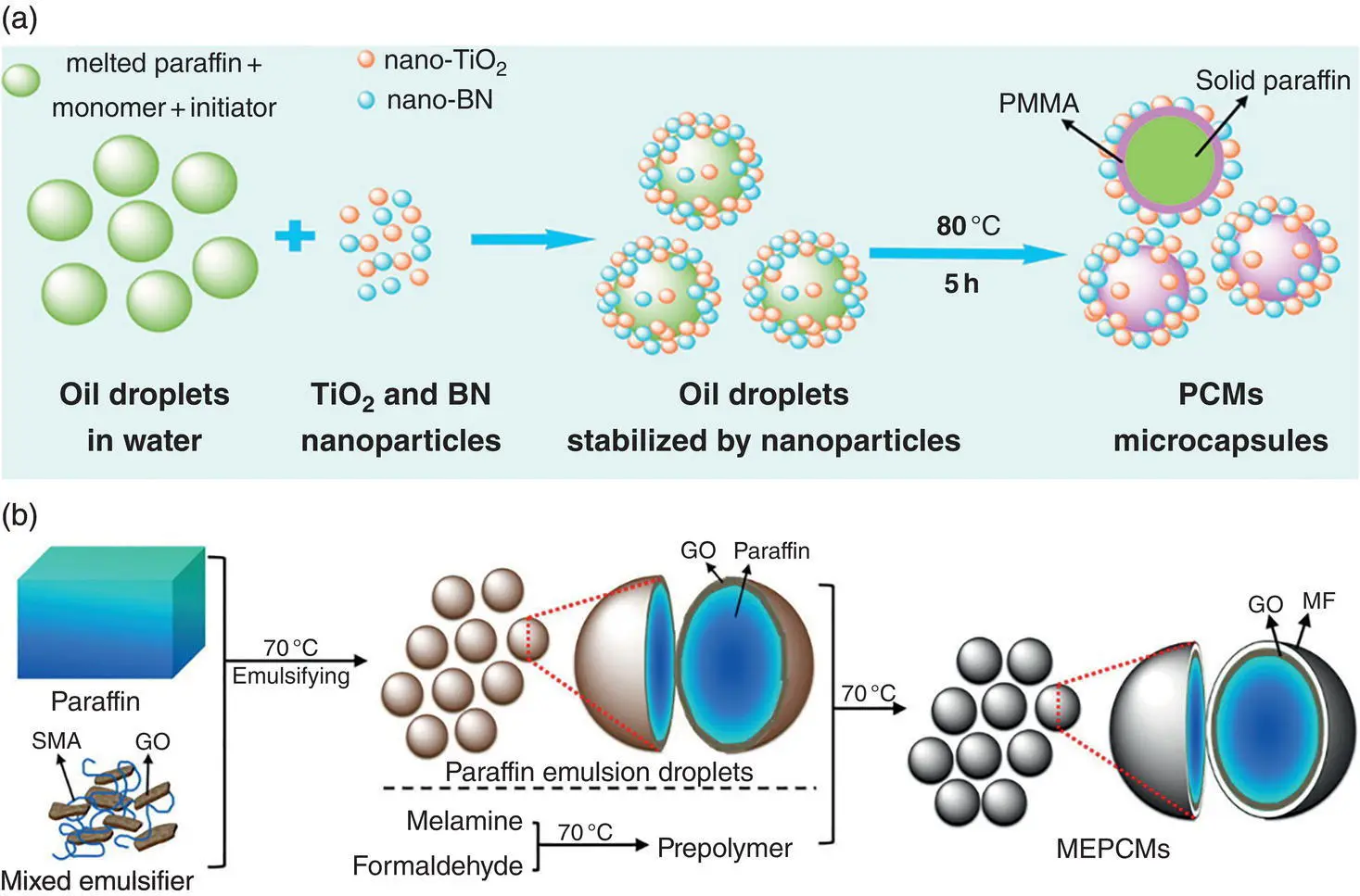
Figure 2.4 Schematic diagrams of the fabrication route of composite phase change microcapsules with paraffin core and (a) PMMA/BN/TiO 2hybrid shell.
Source : Sun and Xiao [36]. Reproduced with the permission from the American Chemical Society
or (b) MF/GO hybrid shell.
Source : Zhang et al. [37]. Reproduced with the permission from Elsevier Ltd.
2.2.2 Physical Blending
It is quite appealing that supporting materials are directly introduced into the phase change matrices via physical blending to produce shape‐stabilized phase change composites. Compounding organic PCMs, especially PW, with robust or flexible polymers featuring high melting temperature or network structure is an effective strategy to achieve this goal. Accordingly, a facile melt blending has been conducted to fabricate polymeric phase change composites, including polyethylene (PE)/PW,[39] ethylene propylene diene monomer (EPDM)/PW,[40] styrene‐b‐(ethylene‐co‐butylene)‐b‐styrene (SEBS)/PW,[41] olefin block copolymer (OBC)/PW,[42] OBC/hexadecane,[43] epoxy/PW,[44] polyolefin elastomer (POE)/lauric acid,[45] POE/stearic acid,[46] PMMA/stearic acid,[47] etc. For example, Chen et al.[48] introduced high‐density PE (HDPE), low‐density PE (LDPE), and linear LDPE (LLDPE) into PW through melt blending to fabricate three kinds of polymeric PCMs. The results indicated that the leakage behavior could be controlled by the co‐continuous structure, and the PE phase had a minor influence on the crystallinity structure and thermal transition temperatures of PW phase. For these polymeric PCMs, the organic PCMs content is maintained in the range of 30–60 wt%, and most of them can be used as shape memory devices. To impart high thermal conductivity to these polymeric PCMs, functional fillers can be added to prepare thermally conductive polymeric phase change composites,[49, 50] and more discussion will be provided in the next section.
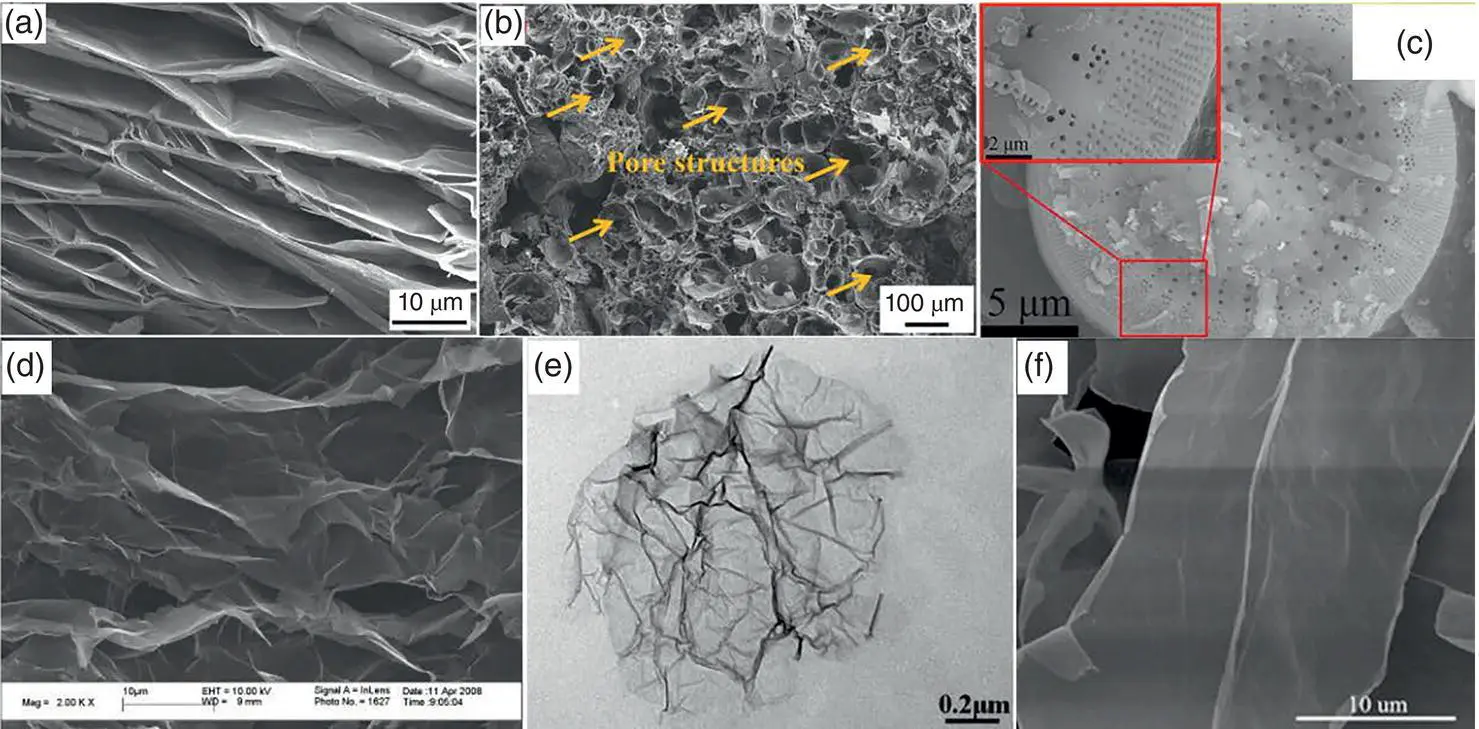
Figure 2.5 Microstructures of (a) EVM.
Source : Deng et al. [51].
(b) EP.
Source : Zhang et al. [52].
(c) diatomite.
Source : Qian et al. [53].
(d) EG.
Source : Wang et al. [54].
(e) graphene.
Source : Shi et al. [18].
and (f) GO.
Source : Yang et al. [55].
The innovations of nanotechnology open up new frontiers in energy conversion and storage materials and systems, and thus multifarious functional nanomaterials can act as supporting materials to prepare shape‐stabilized polymeric phase change composites. Effective supporting nanomaterials shown in Figure 2.5possess the following three main characteristics:
1 Micro/nanoporous structure can provide capillary force to accommodate PCMs. Typical candidates include expanded vermiculite (EVM),[51] expanded perlite (EP),[52] diatomite,[53] expanded graphite (EG),[54] and activated carbon[56].
2 Large specific surface area can yield strong surface tension to absorb PCMs. The typical representatives are two‐dimensional (2D) graphene with a specific surface area of 2630 m2 g−1[57] and MXene[58].
3 Hydrogen bonding interaction can restrict the molecular chain motion of PCMs. Typical materials are SiO2,[59] GO,[14] and cellulose[60]. There are strong hydrogen bonding interactions between these materials and PEG with oxygen‐containing functional groups. A typical example is the PEG‐based shape‐stabilized composites with ultra‐low content of GO (4 wt%).[14]
2.2.3 Porous Supporting Scaffolds
Considering the complicated technological process of micro/nanoencapsulated PCMs and the low utilization efficiency of functional materials in the processing of phase change composites through physical blending, impregnating PCMs into porous supporting scaffolds to develop form‐stable PCMs with high energy storage density has attracted extensive attention in recent years. Lightweight three‐dimensional (3D) porous supporting architectures not only inherit the intrinsic characteristics from individually functional components but also create new collective properties from the monoliths, including large specific surface area, high porosity, and unique network structure, and these features are beneficial to improving the comprehensive performance of PCMs through the strong interactions between PCMs and supporting components in the form of hydrogen bonding, interfacial adhesion, capillary force, and van der Waals forces. Therefore, their physicochemical characteristics, such as pore size, specific surface area, and hydrophilicity or hydrophobicity, have an important influence on the properties of the final composites. The porous supporting scaffolds for polymeric phase change composites can be divided into three categories: polymeric porous scaffolds, inorganic porous scaffolds, and organic–inorganic hybrid porous scaffolds.
Polymeric porous scaffolds with high strength/weight ratio and porosity, such as poly(vinyl alcohol) (PVA) aerogel,[61] PU foam,[62] and polypropylene (PP) aerogel,[63] have been acted as excellent supporting materials for PCMs. More interestingly, a rapid preparation of PEG‐based phase change composites containing 3D cellulose network constructed by UV‐induced thiol‐ene click chemistry has been achieved by a solvent exchange strategy without additional freeze‐drying operation.[64] In comparison to polymeric porous scaffolds, inorganic porous scaffolds can provide supporting effect and conductive network simultaneously. The above‐mentioned partial supporting nanomaterials can be constructed into 3D porous scaffolds (e.g. biological porous carbon,[16] GO aerogel,[65] GO/BN scaffolds,[66] and hybrid graphene aerogels[55]) by high‐temperature pyrolysis (biomass carbonization), self‐assembly, and other methods, and then they can be introduced into phase change matrices to effectively prepare shape‐stabilized polymeric phase change composites. Additionally, it is difficult for a portion of functional fillers to form 3D structural materials by themselves, and organic components are often required as additives. The most popular one is cellulose‐based composite scaffolds, successfully developing cellulose/CNT,[67] cellulose/graphene nanoplatelets (GNPs),[68] cellulose/BN,[69] cellulose/MXene,[70] and cellulose/black phosphorus[71] hybrid aerogels for polymeric phase change composites.
Читать дальшеИнтервал:
Закладка:
Похожие книги на «Polymer Composites for Electrical Engineering»
Представляем Вашему вниманию похожие книги на «Polymer Composites for Electrical Engineering» списком для выбора. Мы отобрали схожую по названию и смыслу литературу в надежде предоставить читателям больше вариантов отыскать новые, интересные, ещё непрочитанные произведения.










Обсуждение, отзывы о книге «Polymer Composites for Electrical Engineering» и просто собственные мнения читателей. Оставьте ваши комментарии, напишите, что Вы думаете о произведении, его смысле или главных героях. Укажите что конкретно понравилось, а что нет, и почему Вы так считаете.