The Addiction Progress Notes Planner
Здесь есть возможность читать онлайн «The Addiction Progress Notes Planner» — ознакомительный отрывок электронной книги совершенно бесплатно, а после прочтения отрывка купить полную версию. В некоторых случаях можно слушать аудио, скачать через торрент в формате fb2 и присутствует краткое содержание. Жанр: unrecognised, на английском языке. Описание произведения, (предисловие) а так же отзывы посетителей доступны на портале библиотеки ЛибКат.
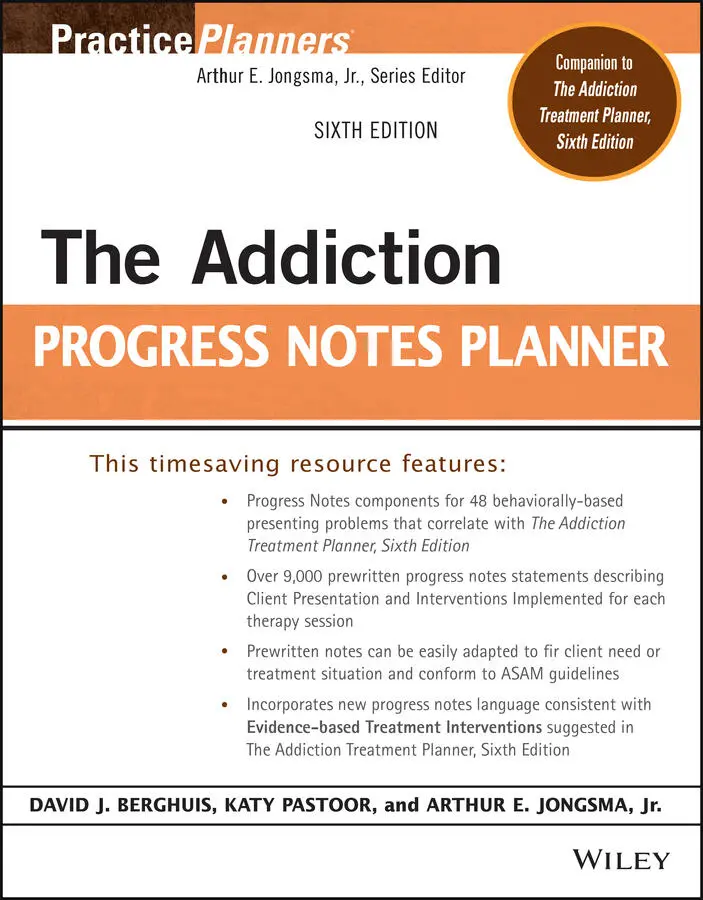
- Название:The Addiction Progress Notes Planner
- Автор:
- Жанр:
- Год:неизвестен
- ISBN:нет данных
- Рейтинг книги:5 / 5. Голосов: 1
-
Избранное:Добавить в избранное
- Отзывы:
-
Ваша оценка:
The Addiction Progress Notes Planner: краткое содержание, описание и аннотация
Предлагаем к чтению аннотацию, описание, краткое содержание или предисловие (зависит от того, что написал сам автор книги «The Addiction Progress Notes Planner»). Если вы не нашли необходимую информацию о книге — напишите в комментариях, мы постараемся отыскать её.
The Addiction Progress Notes Planner, Sixth Edition
Addictions Treatment Planner, Sixth Edition
Addiction Treatment Planner, Sixth Edition
The Addiction Progress Notes Planner
The Addiction Progress Notes Planner — читать онлайн ознакомительный отрывок
Ниже представлен текст книги, разбитый по страницам. Система сохранения места последней прочитанной страницы, позволяет с удобством читать онлайн бесплатно книгу «The Addiction Progress Notes Planner», без необходимости каждый раз заново искать на чём Вы остановились. Поставьте закладку, и сможете в любой момент перейти на страницу, на которой закончили чтение.
Интервал:
Закладка:
4 Fails to Listen (4)The client does not seem to listen to others even when spoken to directly.The client reports problems with day-to-day functioning because of failure to listen to others.The client reports greater control over listening when others are speaking to them.
5 Restless (5)The client reported being unable to sit still for a significant length of time and often feels restless.The client gave evidence of being restless within the session, often moving about in a chair.The client's ability to rest comfortably for a longer period of time has increased.
6 Lack of Follow-Through (6)The client reported struggling to follow through on instructions and fails to finish duties.Family members reported frustration at the client's pattern of failing to finish duties.The client has shown progress in follow-through and completing duties.
7 Inability to Engage Quietly (7)The client reports an inability to engage in leisure activities quietly.The client has identified problems with others because of inability to engage in leisure activities quietly.The client has improved in ability to engage in leisure activities at an appropriate noise level.
8 Disorganization (8)The client has a history of disorganization in many areas of their life.The client's disorganization is evident in areas related to home and work, leading them to be less efficient and less effective than they could be.The client has made significant progress in increasing organization and is using that organization to become more efficient.The client uses lists and reminders to increase organizational ability.
9 On the Go (9)The client is often described as “on the go” or acting as if “driven by a motor.”The client has identified problems with overall functioning because of their “on the go” behaviors.The client has been able to improve in functioning as they have reduced their “on the go” behaviors.
10 Avoidance (10)The client often avoids, dislikes, or is reluctant to engage in tasks that require sustained mental effort.The client has struggled to maintain employment or struggles in school because of avoidance of tasks that require sustained mental effort.The client has reduced their avoidance of difficult tasks and reports improved functioning in a variety of areas.
11 Excessive Talking (11)The client talks excessively.The client's family and friends have reported frustrations because of excessive talking.The client has improved in the ability to talk an appropriate amount.
12 Losing Items (12)The client often loses items necessary for tasks or activities.The client identified problematic functioning because of losing items necessary for day-to-day tasks.The client has done better self-management in order to reduce loss of necessary items.
13 Interrupting (13)The client often interrupts, doesn't wait for their turn, or blurts out answers before a question has been completed.The client's friends and family have identified problems related to the client's inability to function appropriately in social situations.The client's work relationships have suffered owing to an inability to function appropriately.The client has reduced the need to interrupt others, now waits for others, blurts out answers less, and has identified positive results from this improvement.
14 Distractibility (14)The client reported being easily distracted and their attention is drawn away from the task at hand.The client gave evidence of distractibility within today's session.The client's distractibility is diminishing and focused concentration is increasing.
15 Forgetfulness (15)The client identified often being forgetful in daily activities.The client's day-to-day functioning has suffered owing to forgetfulness.The client has identified ways to be less forgetful and identified positive experiences.
16 Hyperactivity (16)The parents and teachers described the client as being a highly energetic and hyperactive individual.The client presented with a high energy level and had difficulty sitting still for extended periods of time.The client has trouble channeling high energy into constructive or sustained, purposeful activities.Both parents and teachers reported a decrease in the client's level of hyperactivity.The client has consistently channeled energy into constructive and purposeful activities.
17 Increased Vulnerability to Addiction Behaviors (17)The client reported a history of increased vulnerability to addiction behaviors because of attention-deficit/hyperactivity disorder (ADHD) traits.The client's ADHD traits were observed to create an increased vulnerability to addiction behaviors.As the client's ADHD traits have been appropriately treated, vulnerability to addiction behaviors has decreased.
INTERVENTIONS IMPLEMENTED
1 Build Trust and Establish Rapport (1) *Caring was conveyed to the client through support, warmth, and empathy.The client was provided with nonjudgmental support and a level of trust was developed.The client was urged to feel safe in expressing ADHD symptoms.The client began to express feelings more freely as rapport and trust level have increased.The client has continued to experience difficulty being open and direct about the expression of painful feelings; the client was encouraged to use the safe haven of therapy to express these difficult issues.
2 Focus on Strengthening Therapeutic Relationship (2)The relationship with the client was strengthened using empirically supported factors.The relationship with client was strengthened through the implementation of a collaborative approach, agreement on goals, demonstration of empathy, verbalization of positive regard, and collection of client feedback.The client reacted positively to the relationship-strengthening measures taken.The client verbalized feeling supported and understood during therapy sessions.Despite attempts to strengthen the therapeutic relationship the client reports feeling distant and misunderstood.The client has indicated that sessions are not helpful and will be terminating therapy.
3 Identify Targets (3)The various stimuli that have triggered the client's ADHD behavior were assessed, including situations, people, and thoughts.The thoughts, feelings, and actions that have characterized the client's ADHD behavior and their consequences were reviewed.The client was assisted in identifying target behaviors, antecedents, consequences, and the appropriate placement of interventions.Placement of interventions was prioritized in school-based situations and, to a lesser extent, home-based and peer-based situations.Placement of interventions was prioritized in home-based situations and, to a lesser extent, school-based and peer-based situations.Placement of interventions was prioritized in peer-based situations and, to a lesser extent, home-based and school-based situations.
4 Rule Out Alternative Conditions (4)Alternative conditions that could cause inattention, hyperactivity, and impulsivity were reviewed.Behavioral, physical, and emotional problems were reviewed in regard to the effect on the client's inattention, hyperactivity, and impulsivity.The client's level of normal developmental behavior was reviewed.
5 Coordinate Psychological Testing (5)The client was administered psychological testing in order to establish or rule out the presence of ADHD problems.The Connors ADHD Rating Scale (CARS) was administered to the client.The Substance Abuse Subtle Screening Inventory–3 (SASSI-3) was administered to the client.Psychological testing has established the presence of an ADHD problem.The psychological testing failed to confirm the presence of ADHD.
6 Monitor and Rate ADHD Symptoms (6)The client was taught techniques to monitor their ADHD symptoms.The client was asked to rate the severity of their ADHD symptoms on a daily basis, on a scale from 1 to 100.The client was assisted in rating their ADHD symptoms.The client has not monitored their ADHD symptoms and was redirected to do so.
Читать дальшеИнтервал:
Закладка:
Похожие книги на «The Addiction Progress Notes Planner»
Представляем Вашему вниманию похожие книги на «The Addiction Progress Notes Planner» списком для выбора. Мы отобрали схожую по названию и смыслу литературу в надежде предоставить читателям больше вариантов отыскать новые, интересные, ещё непрочитанные произведения.












Обсуждение, отзывы о книге «The Addiction Progress Notes Planner» и просто собственные мнения читателей. Оставьте ваши комментарии, напишите, что Вы думаете о произведении, его смысле или главных героях. Укажите что конкретно понравилось, а что нет, и почему Вы так считаете.