The Addiction Progress Notes Planner
Здесь есть возможность читать онлайн «The Addiction Progress Notes Planner» — ознакомительный отрывок электронной книги совершенно бесплатно, а после прочтения отрывка купить полную версию. В некоторых случаях можно слушать аудио, скачать через торрент в формате fb2 и присутствует краткое содержание. Жанр: unrecognised, на английском языке. Описание произведения, (предисловие) а так же отзывы посетителей доступны на портале библиотеки ЛибКат.
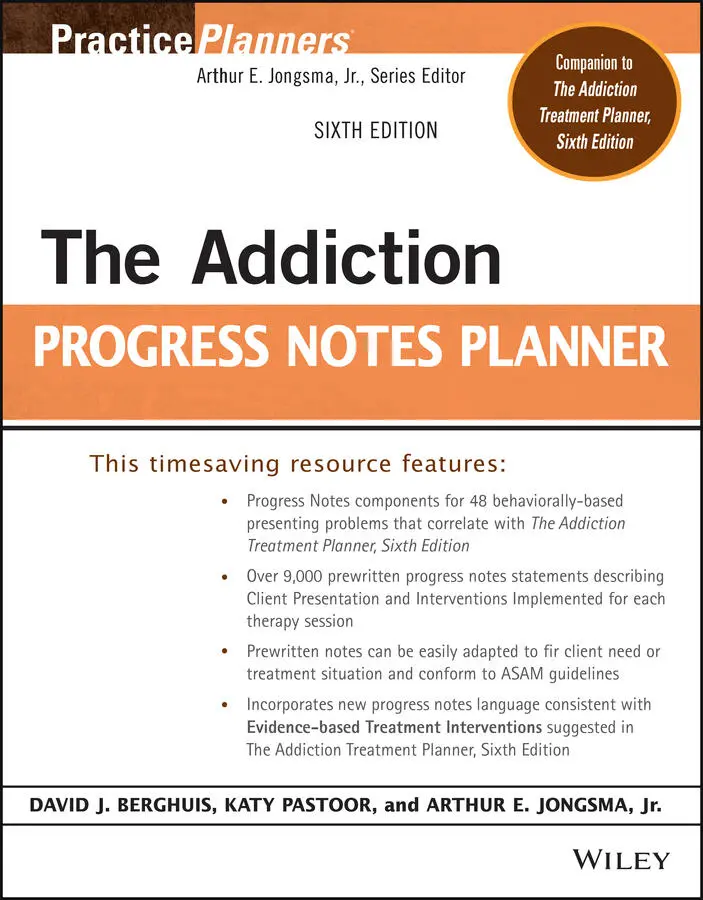
- Название:The Addiction Progress Notes Planner
- Автор:
- Жанр:
- Год:неизвестен
- ISBN:нет данных
- Рейтинг книги:5 / 5. Голосов: 1
-
Избранное:Добавить в избранное
- Отзывы:
-
Ваша оценка:
The Addiction Progress Notes Planner: краткое содержание, описание и аннотация
Предлагаем к чтению аннотацию, описание, краткое содержание или предисловие (зависит от того, что написал сам автор книги «The Addiction Progress Notes Planner»). Если вы не нашли необходимую информацию о книге — напишите в комментариях, мы постараемся отыскать её.
The Addiction Progress Notes Planner, Sixth Edition
Addictions Treatment Planner, Sixth Edition
Addiction Treatment Planner, Sixth Edition
The Addiction Progress Notes Planner
The Addiction Progress Notes Planner — читать онлайн ознакомительный отрывок
Ниже представлен текст книги, разбитый по страницам. Система сохранения места последней прочитанной страницы, позволяет с удобством читать онлайн бесплатно книгу «The Addiction Progress Notes Planner», без необходимости каждый раз заново искать на чём Вы остановились. Поставьте закладку, и сможете в любой момент перейти на страницу, на которой закончили чтение.
Интервал:
Закладка:
44 Assign Books on Shame (44)The client was assigned to read excerpts from books related to shame.The client was assigned to read Healing the Shame That Binds You (Bradshaw) and Facing Shame (Fossum & Mason).The client has followed through with learning about shame through books (e.g., Healing the Shame That Binds You [Bradshaw], Facing Shame [Fossum & Mason]), and the key concepts were processed.The client has not followed through on reading books related to shame (e.g., Healing the Shame That Binds You [Bradshaw], Facing Shame [Fossum & Mason]) and was redirected to do so.
45 Develop Positive Self-Descriptive Statements (45)The client was asked to make a list of 10 positive self-descriptive statements.The client was assigned “Positive Self-Talk” in the Adult Psychotherapy Homework Planner (Jongsma & Bruce).The client has followed through on making a list of positive self-descriptive statements, and these were reviewed.It was reflected to the client that they have developed a pattern of describing self more positively and have been feeling an increased level of self-esteem.The client has not followed through on developing a list of positive self-descriptive statements and was encouraged to do so.
46 Use Step 3 (46)The client was taught a 12-step program's third step, focusing on how to turn problems, worries, and anxieties over to a higher power.The client was taught about trusting that a higher power is going to help resolve the situation.The client has begun turning problems, worries, and anxieties over to a higher power and is trusting that the higher power is going to help resolve the situation; this progress was reinforced.The client rejected the idea of turning problems, worries, and anxieties over to a higher power and does not feel that this concept will be helpful in resolving anxiety; the client was urged to remain open to these concepts.
47 Develop Alternative Actions (47)The client was assisted in developing a list of situations in which they feel anxious and crave substances.The client was assigned “Coping With Stress” and “Benefits of Helping Others” in the Addiction Treatment Homework Planner (Lenz, Finley, & Jongsma).The client was assisted in developing an alternative constructive plan of action for when they feel anxious and crave substances (e.g., relaxation exercises, physical exercise, call a sponsor, go to a meeting, call the counselor, talk to someone).The client was reinforced in implementing positive coping strategies to deal with situations that trigger anxiety and craving substance use.The client has resisted identifying anxiety-producing situations and times when they crave substances and is noted to be vulnerable to relapse because of this resistance.
48 Probe Family-of-Origin Experiences (48)Today's therapy session explored family-of-origin experiences for learning to be fearful and anxious.The client was asked to explore how childhood experiences relate to current anxious thoughts, feelings, and behavior.The client was given support and affirmation regarding the uncomfortable feelings related to fear-producing situations from their family of origin.The client continued to exhibit anxiety related to family-of-origin experiences and was provided with remedial information in this area.
49 Assign Step 4 Exercise (49)The client was taught about a 12-step program's Step 4, focusing on detailing the exact nature of their wrongs and forgiveness.The client was directed to write an autobiography detailing the exact nature of their wrongs.The client was assigned the Step 4 exercise from The Alcoholism and Drug Abuse Client Workbook (Perkinson).Active listening skills were provided as the client has completed an autobiography and has detailed the exact nature of their wrongs.The client endorsed the need to forgive self and others and has begun to process this; this insight was reinforced.The client described struggles regarding how to forgive self and others; these barriers were processed.The client has not completed the Step 4 exercise and was redirected to do so.
50 Develop Recovery Group Involvement (50)The client was taught about how active involvement in a recovery group is a way to build trust in others and confidence in self.The client was assigned “Aftercare Plan Components” in the Adult Psychotherapy Homework Planner (Jongsma & Bruce).The client was referred to an appropriate recovery group.The client described involvement in an active recovery group, and the benefits they have experienced were reviewed.The client acknowledged that they have not followed through with involvement in a recovery group, and the client was redirected to do so.
51 Educate the Family About Anxiety Disorders (51)A family session was held to educate the client's family and significant others regarding anxiety disorder, treatment, and prognosis. Active listening was modeled.Family members expressed their positive support of the client and a more accurate understanding of anxiety and substance-abuse concerns.Family members were neither understanding nor willing to provide support to the client, in spite of diagnosis of an anxiety disorder; they were urged to reconsider this refusal.
52 Direct Family Members to List Support for Recovery (52)Family members were assisted in identifying ways in which they could be supportive of the client's sobriety.A family session was held to facilitate communication of techniques that the family can use to assist in the client's recovery.The client reported family members assisting significantly in encouragement and other techniques to help them recover from anxious behavior and addiction; the client was urged to express gratitude.The client's significant others were strongly encouraged to attend Al-Anon meetings on a regular basis to help support the client's recovery.
53 Assess Satisfaction (53)A treatment satisfaction survey was administered to the client.The client's survey responses indicated a high level of satisfaction with treatment services; these results were processed.The client's survey responses indicated a medium level of satisfaction with treatment services; these results were processed.The client's survey responses indicated a low level of satisfaction with treatment services; these results were processed.Although the client was encouraged to complete a treatment satisfaction survey, it was refused.
NOTES
1 *The numbers in parentheses correlate to the number of the Behavioral Definition statement in the companion chapter with the same title in The Addiction Treatment Planner, Sixth Edition, by Perkinson, Jongsma, & Bruce (Wiley, 2022).
2 *The numbers in parentheses correlate to the number of the Therapeutic Intervention statement in the companion chapter with the same title in The Addiction Treatment Planner, Sixth Edition, by Perkinson, Jongsma, & Bruce (Wiley, 2022).
ATTENTION-DEFICIT/HYPERACTIVITY DISORDER (ADHD)—ADOLESCENT
CLIENT PRESENTATION
1 Lack of Attention to Detail (1) *The client reported failure to give close attention to detail or makes mistakes with things of low interest, even though they may be important to the client's life.The client's lack of ability to give close attention has resulted in missing out on the comprehension of important details.The client's ability to give close attention seems to be increasing as they reported increased attention skills.
2 Fidgety (2)The client reported being unable to sit still for any length of time but often feels fidgety.The client gave evidence of being fidgety within the session, often moving about in the chair.The client's ability to fidget less has increased.
3 Difficulty Sustaining Attention (3)The client reported difficulty sustaining attention to tasks or activities.The client gave evidence of difficulty sustaining attention within today's session.The client's difficult sustaining attention is diminishing and focused concentration is increasing.
Читать дальшеИнтервал:
Закладка:
Похожие книги на «The Addiction Progress Notes Planner»
Представляем Вашему вниманию похожие книги на «The Addiction Progress Notes Planner» списком для выбора. Мы отобрали схожую по названию и смыслу литературу в надежде предоставить читателям больше вариантов отыскать новые, интересные, ещё непрочитанные произведения.












Обсуждение, отзывы о книге «The Addiction Progress Notes Planner» и просто собственные мнения читателей. Оставьте ваши комментарии, напишите, что Вы думаете о произведении, его смысле или главных героях. Укажите что конкретно понравилось, а что нет, и почему Вы так считаете.