The Addiction Progress Notes Planner
Здесь есть возможность читать онлайн «The Addiction Progress Notes Planner» — ознакомительный отрывок электронной книги совершенно бесплатно, а после прочтения отрывка купить полную версию. В некоторых случаях можно слушать аудио, скачать через торрент в формате fb2 и присутствует краткое содержание. Жанр: unrecognised, на английском языке. Описание произведения, (предисловие) а так же отзывы посетителей доступны на портале библиотеки ЛибКат.
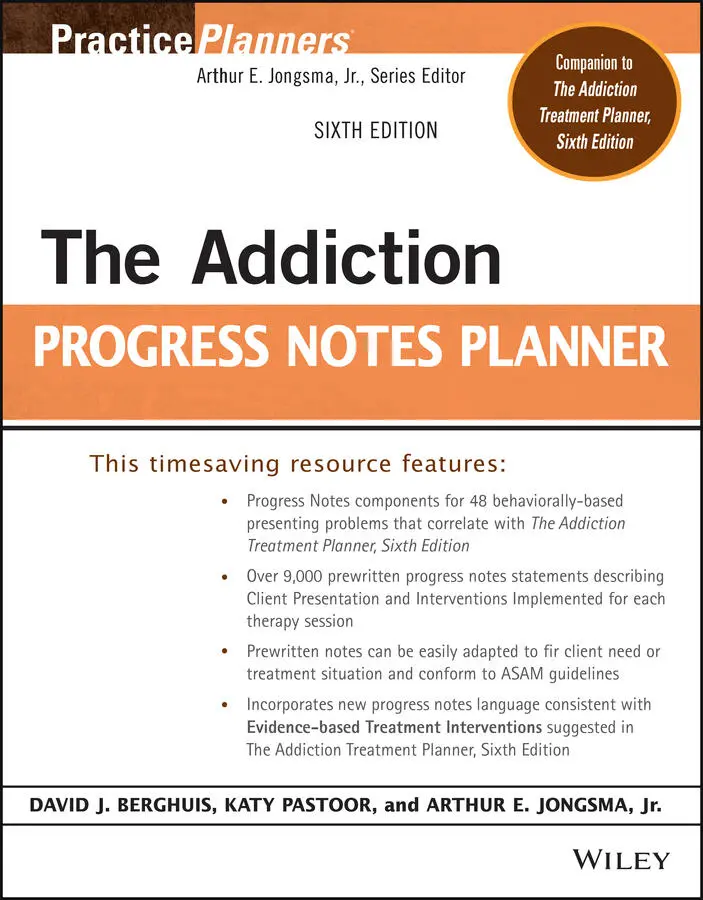
- Название:The Addiction Progress Notes Planner
- Автор:
- Жанр:
- Год:неизвестен
- ISBN:нет данных
- Рейтинг книги:5 / 5. Голосов: 1
-
Избранное:Добавить в избранное
- Отзывы:
-
Ваша оценка:
The Addiction Progress Notes Planner: краткое содержание, описание и аннотация
Предлагаем к чтению аннотацию, описание, краткое содержание или предисловие (зависит от того, что написал сам автор книги «The Addiction Progress Notes Planner»). Если вы не нашли необходимую информацию о книге — напишите в комментариях, мы постараемся отыскать её.
The Addiction Progress Notes Planner, Sixth Edition
Addictions Treatment Planner, Sixth Edition
Addiction Treatment Planner, Sixth Edition
The Addiction Progress Notes Planner
The Addiction Progress Notes Planner — читать онлайн ознакомительный отрывок
Ниже представлен текст книги, разбитый по страницам. Система сохранения места последней прочитанной страницы, позволяет с удобством читать онлайн бесплатно книгу «The Addiction Progress Notes Planner», без необходимости каждый раз заново искать на чём Вы остановились. Поставьте закладку, и сможете в любой момент перейти на страницу, на которой закончили чтение.
Интервал:
Закладка:
7 Assess Level of Insight (7)The client's level of insight toward the presenting problems was assessed.The client was assessed in regard to the syntonic versus dystonic nature of their insight about the presenting problems.The client was noted to demonstrate good insight into the problematic nature of the behavior and symptoms.The client was noted to be in agreement with others' concerns and is motivated to work on change.The client was noted to be ambivalent regarding the problems described and is reluctant to address the issues as a concern.The client was noted to be resistant regarding acknowledgment of the problem areas, is not concerned about them, and has no motivation to make changes.
8 Assess for Correlated Disorders (8)The client was assessed for evidence of research-based correlated disorders.The client was assessed in regard to the level of vulnerability to suicide.The client was identified as having a comorbid disorder, and treatment was adjusted to account for these concerns.The client has been assessed for any correlated disorders, but none were found.
9 Assess for Culturally Based Confounding Issues (9)The client was assessed for age-related issues that could help to better understand their clinical presentation.The client was assessed for gender-related issues that could help to better understand their clinical presentation.The client was assessed for cultural syndromes, cultural idioms of distress, or culturally based perceived causes that could help to better understand their clinical presentation.Alternative factors have been identified as contributing to the client's currently defined “problem behavior” and these were taken into account in regard to treatment.Culturally based factors that could help to account for the client's currently defined “problem behavior” were investigated, but no significant factors were identified.
10 Assess Severity of Impairment (10)The severity of the client's impairment was assessed to determine the appropriate level of care.The client was assessed in regard to their impairment in social, relational, vocational, and occupational endeavors.It was reflected to the client that their impairment appears to create mild to moderate effects on the client's functioning.It was reflected to the client that their impairment appears to create severe to very severe effects on the client's functioning.The client was continuously assessed for the severity of impairment, as well as the efficacy and appropriateness of treatment.
11 Accept Powerlessness and Unmanageability Over ADHD Symptoms (11)The client was taught about the use of a 12-step recovery program's Step 1 exercise to acknowledge unmanageability of ADHD symptoms and addiction.The client was assigned the Step 1 exercise from The Alcoholism and Drug Abuse Client Workbook (Perkinson).The client was noted to accept the concept of being powerless and unable to manage ADHD symptoms and addiction problems.It was noted that the client has had increased serenity after accepting powerlessness and inability to manage ADHD symptoms and addiction.The client rejected the concept of powerlessness and unmanageability over ADHD and addiction symptoms and was urged to monitor this dynamic.
12 Teach About the Relationship Between ADHD and Addiction (12)The client was taught, through the use of a biopsychosocial approach, about the relationship between ADHD symptoms and addictive behavior.The client was assisted in acknowledging several instances in which ADHD symptoms have prompted addictive behavior.As ADHD symptoms have decreased, the client has identified a corresponding decrease in addictive behavior; this progress was highlighted.
13 Develop an ADHD and Addiction Recovery Program (13)The client was assisted in developing a program of recovery that includes the elements necessary to bring ADHD and addictive behavior under control.The client was assigned “Developing a Recovery Program” in the Addiction Treatment Homework Planner (Lenz, Finley, & Jongsma).The client was reinforced as they identified specific portions of their ADHD/addiction recovery program, including the use of medication, behavior modification, environmental controls, aftercare meetings, and further therapy.It was noted that the client has begun to use the recovery program.The client has not used their specific recovery program and was redirected to pursue these elements.
14 Teach About a Higher Power (14)The client was presented with information about how faith in a higher power can aid in recovery from ADHD traits and addiction.The client was assisted in processing and clarifying ideas and feelings regarding the existence of a higher power.The client was encouraged to describe beliefs about the concept of a higher power.The client rejected the idea of a higher power and was urged to remain open to this concept.
15 Refer to a Specialist to Remediate Learning Disabilities (15)The client was referred to an education specialist to design remedial procedures for learning disabilities present in addition to ADHD.The client reported meeting with the educational specialist, who has been able to design remedial procedures for learning disabilities.The client described benefits from the remedial procedures used to counter the effects of learning disabilities.The client has not yet met with an education specialist to design remedial procedures for learning disabilities and was redirected to do so.
16 Refer for Medication Evaluation (16)A referral to a prescribing clinician was made for the purpose of evaluating the client for a prescription of psychotropic medications.The client has followed through on a referral to a prescribing clinician and has been assessed for a prescription of psychotropic medication, but none were prescribed.Psychotropic medications have been prescribed for the client.The client has been monitored for side effects of the medication.The client has refused a prescription of psychotropic medication provided by the prescribing clinician.
17 Monitor Medication Compliance and Effectiveness (17)The client reported that the medication has helped to improve attention, concentration, and impulse control without any side effects, and the benefits of this were reviewed.The client was assigned the exercise “Evaluating Medication Effects” from the Adolescent Psychotherapy Homework Planner (Jongsma, Peterson, McInnis, & Bruce).The client reported little to no improvement while taking the medication and was redirected to the prescribing clinician.The client has not complied with taking medication on a regular basis and was redirected to do so.The client and parents were encouraged to report the side effects of the medication to the prescribing clinician.
18 Educate Family About ADHD (18)The client's parents and siblings were educated about the symptoms of ADHD.The therapy session helped the client's parents and siblings gain a greater understanding and appreciation of the symptoms of ADHD.The family members were given the opportunity to express their thoughts and feelings about having a child or sibling with ADHD.
19 Discuss Treatment Options (19)The various treatment options available for ADHD were discussed with the client and/or parents.The options regarding behavioral parent training, classroom-based behavioral management programs, peer-based programs, medication, and cognitive behavioral therapy were reviewed.Pros and cons of each of the various treatment options were reviewed.Risks and benefits of each treatment option were reviewed to assist the parents in making fully informed decisions.The appropriate treatment for the client's developmental age was discussed.
20 Assign Parents to Read ADHD Information (20)The parents were assigned to read information to increase their knowledge about symptoms of ADHD.The client's parents were directed to read Taking Charge of ADHD (Barkley).The parents were directed to read Parenting Children With ADHD: 10 Lessons That Medicine Cannot Teach (Monastra).The parents were assigned to read The Family ADHD Solution: A Scientific Approach to Maximizing Your Child's Attention and Minimizing Parental Stress (Bertin).The parents have read the information about ADHD, and key points were processed.The client's parents have not read the information about ADHD and were redirected to do so.
Читать дальшеИнтервал:
Закладка:
Похожие книги на «The Addiction Progress Notes Planner»
Представляем Вашему вниманию похожие книги на «The Addiction Progress Notes Planner» списком для выбора. Мы отобрали схожую по названию и смыслу литературу в надежде предоставить читателям больше вариантов отыскать новые, интересные, ещё непрочитанные произведения.












Обсуждение, отзывы о книге «The Addiction Progress Notes Planner» и просто собственные мнения читателей. Оставьте ваши комментарии, напишите, что Вы думаете о произведении, его смысле или главных героях. Укажите что конкретно понравилось, а что нет, и почему Вы так считаете.