The Addiction Progress Notes Planner
Здесь есть возможность читать онлайн «The Addiction Progress Notes Planner» — ознакомительный отрывок электронной книги совершенно бесплатно, а после прочтения отрывка купить полную версию. В некоторых случаях можно слушать аудио, скачать через торрент в формате fb2 и присутствует краткое содержание. Жанр: unrecognised, на английском языке. Описание произведения, (предисловие) а так же отзывы посетителей доступны на портале библиотеки ЛибКат.
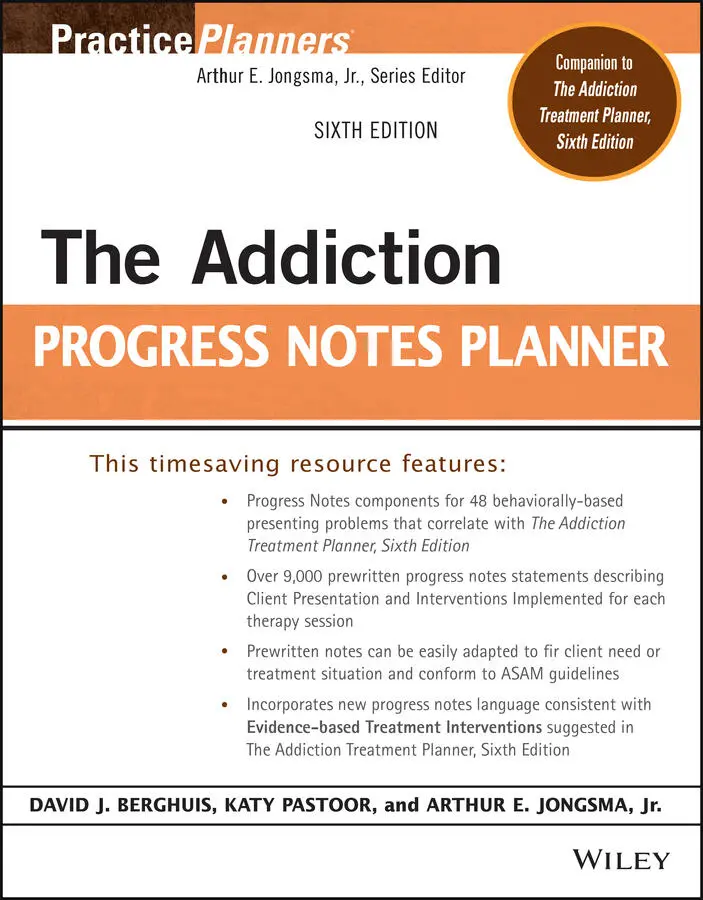
- Название:The Addiction Progress Notes Planner
- Автор:
- Жанр:
- Год:неизвестен
- ISBN:нет данных
- Рейтинг книги:5 / 5. Голосов: 1
-
Избранное:Добавить в избранное
- Отзывы:
-
Ваша оценка:
The Addiction Progress Notes Planner: краткое содержание, описание и аннотация
Предлагаем к чтению аннотацию, описание, краткое содержание или предисловие (зависит от того, что написал сам автор книги «The Addiction Progress Notes Planner»). Если вы не нашли необходимую информацию о книге — напишите в комментариях, мы постараемся отыскать её.
The Addiction Progress Notes Planner, Sixth Edition
Addictions Treatment Planner, Sixth Edition
Addiction Treatment Planner, Sixth Edition
The Addiction Progress Notes Planner
The Addiction Progress Notes Planner — читать онлайн ознакомительный отрывок
Ниже представлен текст книги, разбитый по страницам. Система сохранения места последней прочитанной страницы, позволяет с удобством читать онлайн бесплатно книгу «The Addiction Progress Notes Planner», без необходимости каждый раз заново искать на чём Вы остановились. Поставьте закладку, и сможете в любой момент перейти на страницу, на которой закончили чтение.
Интервал:
Закладка:
29 Conduct Worry Exposure (29)The client was asked to vividly imagine worst-case consequences of worries, holding them in mind until the anxiety associated with them decreases.The client was asked to imagine consequences of worries as described in Mastery of Your Anxiety and Worry: Therapist Guide (Zinbarg, Craske, & Barlow).The client was supported as they maintained a focus on the worst-case consequences of worry until the anxiety weakened.The client was assisted in generating reality-based alternatives to the worst-case scenarios, and these were processed within the session.
30 Conduct Exposure in Vivo (30)The client was assisted in engaging in activities usually avoided because of unrealistic worry.The client was assisted in removing any unnecessary, anxiety-drive safety behaviors as described in Mastery of Your Anxiety and Worry: Therapist Guide (Zinbarg, Craske, & Barlow).The client was supported while engaging in difficulty activities until anxiety weakened.
31 Assign Homework on Situational Exposures (31)The client was assigned homework exercises to perform worry exposures and record their experience.The client was assigned situational exposure homework from Mastery of Your Anxiety and Worry: Workbook (Craske & Barlow).The client's use of worry exposure techniques was reviewed and reinforced.The client has struggled in implementation of worry exposure techniques and was provided with corrective feedback.The client has not attempted to use the worry exposure techniques and was redirected to do so.
32 Teach Problem-Solving Strategies (32)The client was taught a specific problem-solving strategy to reduce unproductive worry or avoidance.The client was taught problem-solving strategies including specifically defining a problem, generating options for addressing it, evaluating the pros and cons of each option, selecting and implementing an action plan, and reevaluating and refining the plan.The client was provided feedback on the use of the problem-solving strategies.The client was unable to make use of problem-solving strategies and remedial feedback was given.
33 Assign Problem-Solving Exercise (33)The client was assigned a homework exercise in which they solve a current problem about which they worry.The client was assigned a problem to solve as described in Mastery of Your Anxiety and Worry: Workbook (Craske & Barlow).The client was assigned “Applying Problem-Solving to Interpersonal Conflict” from the Adult Psychotherapy Homework Planner (Jongsma & Bruce).The client was provided with feedback about ther use of the problem-solving assignment.
34 Engage in Behavioral Activation (34)The client was engaged in “behavioral activation” by scheduling activities that have a high likelihood for pleasure and mastery.The client was directed to complete tasks from the “Identify and Schedule Pleasant Activities” assignment from the Adult Psychotherapy Homework Planner (Jongsma & Bruce).Instruction, rehearsal, role-playing, role reversal, and other techniques were used to engage the client in behavioral activation.The client was reinforced for success in scheduling activities that have a high likelihood for pleasure and mastery.The client has not engaged in pleasurable activities and was redirected to do so.
35 Develop Interpersonal Skills and Relationships (35)As interpersonal deficits were identified as a primary factor in the client's anxiety, they were assisted in developing new interpersonal skills and relationships.The client displayed a clear understanding of the new interpersonal skills and relationships and was reinforced for this success.The client has struggled in regard to developing new interpersonal skills and relationships and was redirected in this area.
36 Assign Homework on Social Skills (36)The client was assigned a homework exercise in which they implement social skills in everyday life.The client was assigned the homework exercise “Restoring Socialization Comfort” from the Adult Psychotherapy Homework Planner (Jongsma & Bruce).The client's use of homework exercises in daily life was reviewed, with reinforcement for success and corrective feedback toward improvement.The client did not complete homework exercises and was redirected to do so.
37 Use Acceptance-Based Therapies (37)Techniques from acceptance-based therapies were used to help the client accept worries and overcome avoidance.The client was assisted in identifying and expanding acceptance rather than judgment and avoidance or internal experiences.The client was assisted in promoting action in areas of importance.The client was asked to read The Mindful Way Through Anxiety (Orsillo & Roemer) and key concepts were reviewed.
38 Differentiate Between Lapse and Relapse (38)A discussion was held with the client regarding the distinction between a lapse and a relapse.A lapse was associated with an initial and reversible return of symptoms, fears, or urges to avoid.A relapse was associated with the decision to return to fearful and avoidant patterns.The client was provided with support and encouragement while displaying an understanding of the difference between a lapse and a relapse.The client struggled to understand the difference between a lapse and a relapse and was provided with remedial feedback in this area.
39 Discuss Management of Lapse Risk Situations (39)The client was assisted in identifying future situations or circumstances in which lapses could occur.The session focused on rehearsing the management of future situations or circumstances in which lapses could occur.The client was reinforced for appropriate use of lapse management skills.The client was redirected in regard to poor use of lapse management skills.
40 Encourage Continued Use of Strategies (40)The client was instructed to continue using new and effective therapeutic skills (e.g., relaxation, cognitive restructuring, exposure and problem-solving).The client was urged to find ways to build new strategies into their life as much as possible.The client was reinforced as they reported ways in which they have incorporated coping strategies into their life and routine.The client was redirected about ways to incorporate new strategies into their routine and life.
41 Develop a “Coping Card” (41)The client was given a “coping card” or other reminder on which new and effective worry management skills and other important information are available to the client for later use.The client was assisted in developing the “coping card” in order to list helpful coping strategies.The client was encouraged to use the “coping card” when struggling with anxiety-producing situations.
42 Schedule a “Maintenance” Session (42)The client was scheduled for a “maintenance” session between 1 and 3 months after therapy ends.The client was advised to contact the therapist if they need to be seen prior to the “maintenance” session.The client's “maintenance” session was held and the client was reinforced for successful implementation of therapy techniques.The client's “maintenance” session was held and the client was coordinated for further treatment, as progress has not been sustained.
43 Process Family-of-Origin Experiences (43)Today's therapy session explored family-of-origin experiences for learning to be fearful and anxious.The client was asked to explore how childhood experiences relate to current anxious thoughts, feelings, and behavior.The client was encouraged to honestly and openly share regarding past rejection experiences, harsh criticism, abandonment, or trauma.The client was given support and affirmation regarding the uncomfortable feelings related to fear-producing situations from their family of origin.As the client has progressed in treatment, verbally expressing and clarifying feelings from the past have become easier.The client has continued to struggle with openly and honestly sharing feelings associated with past rejection experiences, harsh criticism, abandonment, or trauma and was urged to do so as they feel safer.
Читать дальшеИнтервал:
Закладка:
Похожие книги на «The Addiction Progress Notes Planner»
Представляем Вашему вниманию похожие книги на «The Addiction Progress Notes Planner» списком для выбора. Мы отобрали схожую по названию и смыслу литературу в надежде предоставить читателям больше вариантов отыскать новые, интересные, ещё непрочитанные произведения.












Обсуждение, отзывы о книге «The Addiction Progress Notes Planner» и просто собственные мнения читателей. Оставьте ваши комментарии, напишите, что Вы думаете о произведении, его смысле или главных героях. Укажите что конкретно понравилось, а что нет, и почему Вы так считаете.