The Addiction Progress Notes Planner
Здесь есть возможность читать онлайн «The Addiction Progress Notes Planner» — ознакомительный отрывок электронной книги совершенно бесплатно, а после прочтения отрывка купить полную версию. В некоторых случаях можно слушать аудио, скачать через торрент в формате fb2 и присутствует краткое содержание. Жанр: unrecognised, на английском языке. Описание произведения, (предисловие) а так же отзывы посетителей доступны на портале библиотеки ЛибКат.
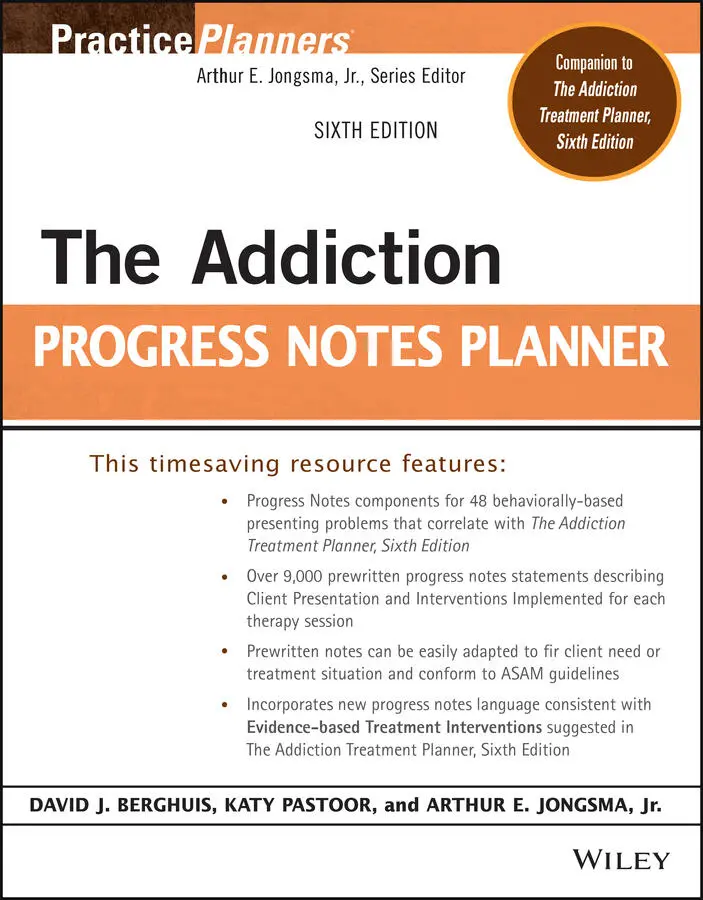
- Название:The Addiction Progress Notes Planner
- Автор:
- Жанр:
- Год:неизвестен
- ISBN:нет данных
- Рейтинг книги:5 / 5. Голосов: 1
-
Избранное:Добавить в избранное
- Отзывы:
-
Ваша оценка:
The Addiction Progress Notes Planner: краткое содержание, описание и аннотация
Предлагаем к чтению аннотацию, описание, краткое содержание или предисловие (зависит от того, что написал сам автор книги «The Addiction Progress Notes Planner»). Если вы не нашли необходимую информацию о книге — напишите в комментариях, мы постараемся отыскать её.
The Addiction Progress Notes Planner, Sixth Edition
Addictions Treatment Planner, Sixth Edition
Addiction Treatment Planner, Sixth Edition
The Addiction Progress Notes Planner
The Addiction Progress Notes Planner — читать онлайн ознакомительный отрывок
Ниже представлен текст книги, разбитый по страницам. Система сохранения места последней прочитанной страницы, позволяет с удобством читать онлайн бесплатно книгу «The Addiction Progress Notes Planner», без необходимости каждый раз заново искать на чём Вы остановились. Поставьте закладку, и сможете в любой момент перейти на страницу, на которой закончили чтение.
Интервал:
Закладка:
17 Assign Reading on Anxiety (17)The client was assigned to read psychoeducational chapters of books or treatment manuals on anxiety.The client was assigned information from Mastery of Your Anxiety and Worry: Workbook (Barlow & Craske) or The Anxiety and Worry Workbook (Clark & Beck).The client has read the assigned information on anxiety, and key points were reviewed.The client has not read the assigned information on anxiety and was redirected to do so.
18 Teach Relaxation Skills (18)The client was taught calming/relaxation/mindfulness skills.The client was taught skills such as applied relaxation, progressive muscle relaxation, cue-controlled relaxation, mindful breathing, and biofeedback.The client was taught how to discriminate better between relaxation and tension.The client was assigned “Progressive Muscle Relaxation” in the Adolescent Psychotherapy Homework Planner (Jongsma, Peterson, McInnis, & Bruce).The client was taught how to apply relaxation skills to daily life.The client was taught relaxation skills as described in New Directions in Progressive Muscle Relaxation (Bernstein, Borkovec, & Hazlett-Stevens) or The Relaxation and Stress Reduction Workbook (Davis et al.).The client was provided with feedback about use of relaxation skills.
19 Assign Relaxation Homework (19)The client was assigned to do homework exercises in which they practice calming/relaxation/mindfulness skills on a daily basis.The client was assigned “Deep Breathing Exercise” in the Adult Psychotherapy Homework Planner (Jongsma & Bruce).The client has regularly used relaxation exercises, and the helpful benefits of these exercises were reviewed.The client has not regularly used relaxation exercises and was provided with corrective feedback in this area.The client has used some relaxation exercises but does not find these to be helpful; the client was assisted in brainstorming how to modify these exercises to be more helpful.
20 Implement Worry Time (20)The client was taught to implement “worry time”—delaying the worry about various environmental settings until a designated “worry time.”The rationale for using a “worry time” was explained, focusing on trying to limit the association between various environmental settings and the experience of worry.The client was assigned the “Worry Time” exercise in the Adult Psychotherapy Homework Planner (Jongsma & Bruce).The client and therapist agreed upon a specific “worry time” and the client was urged to implement this process.
21 Teach Techniques to Postpone Until Worry Time (21)The client was taught how to recognize, stop, and postpone worry until the agreed-upon worry time.Skills were taught to the client, including thought-stopping, relaxation, and redirection of attention.The “Making Use of the Thought-Stopping Technique” exercise from the Adult Psychotherapy Homework Planner (Jongsma & Bruce) was assigned.The client was encouraged to use the techniques in daily life.The client's use of recognizing, stopping, and postponing worry techniques was reviewed within the session, with reinforcement for success and corrective feedback toward improvement.
22 Discuss Estimation Errors (22)In today's session, examples were discussed about how unrealistic worry typically overestimates a probability of threats.The client was assigned “Past Successful Anxiety Coping” from the Adult Psychotherapy Homework Planner (Jongsma & Bruce).It was noted that unrealistic worry often underestimates the client's ability to manage realistic demands.The client was assisted in identifying specific examples of how unrealistic worry involves estimation errors.The client was reinforced for their insightful identification of unrealistic worry and inappropriate estimation.The client has struggled to identify estimation errors in regard to their unrealistic worry and was gently offered examples in this area.
23 Analyze Fears Logically (23)The client's fears were analyzed by examining the probability of their negative expectation becoming a reality, the consequences of the expectation if it occurred, their ability to control the outcome, the worst possible result if the expectation occurred, and their ability to cope if the expectation occurred.The client was assigned “Analyze the Probability of a Feared Event” from the Adult Psychotherapy Homework Planner (Jongsma & Bruce).The client was assigned material from Cognitive Therapy of Anxiety Disorders (Clark & Beck).The client's ability to control the outcome of circumstances was examined and the effectiveness of worry on that outcome was also examined.Cognitive therapy techniques have been effective at helping the client understand beliefs and distorted messages that produce worry and anxiety.As the client has increased understanding of distorted, anxiety-producing cognitions, their anxiety level has been noted to be decreasing.Despite the client's increased understanding of distorted messages that produce worry and anxiety, their anxiety level has not diminished.
24 Develop Insight Into Worry as Avoidance (24)The client was assisted in gaining insight into how worry creates acute and/or chronic anxious apprehension, leading to avoidance that precludes finding solutions to problems and maintains a worry-avoidance cycle.The client was reinforced for their insightful understanding about how worry creates an avoidance cycle.The client struggled to understand the nature of worry as a form of avoidance and was provided with remedial information in this area.
25 Identify Distorted Thoughts (25)Through the use of cognitive behavioral therapy techniques, the client was assisted in exploring self-talk, underlying assumptions, schemas, or metacognition that mediate anxiety.The client was assisted in challenging and changing biases and conducting behavioral experiments to test predictions toward dispelling unproductive worry and increasing self-confidence in addressing the subject of worry.The client was reinforced as they verbalized an understanding of the cognitive beliefs and messages that mediate anxiety responses.The client was assisted in replacing distorted messages with positive, realistic cognitions.The client failed to identify distorted thoughts and cognitions and was provided with tentative examples in this area.
26 Assign Exercises on Self-Talk (26)The client was assigned homework exercises in which they identify fearful self-talk creates reality-based alternatives and tests through behavioral experiments.The client was assigned “Negative Thoughts Trigger Negative Feelings” from the Adult Psychotherapy Homework Planner (Jongsma & Bruce).The client's replacement of fearful self-talk with reality-based alternatives was reviewed.The client was reinforced for successes at replacing fearful self-talk with reality-based alternatives.The client was provided with corrective feedback for failures to replace fearful self-talk with reality-based alternatives.The client has not completed their assigned homework regarding fearful self-talk and was redirected to do so.
27 Construct Anxiety Stimulus Hierarchy (27)The client was assisted in constructing a hierarchy of feared and avoided activities, procedures, and conditions or social events.The client was assigned the “Gradually Reducing Your Phobic Fear” exercise in the Adult Psychotherapy Homework Planner (Jongsma & Bruce).It was difficult for the client to develop a hierarchy of stimulus situations, as the causes of their anxiety remain quite vague; they were assisted in completing the hierarchy.The client was successful at creating a focused hierarchy of specific stimulus situations that provoke anxiety in a gradually increasing manner; this hierarchy was reviewed.
28 Select Initial Exposures (28)Initial exposures were selected from the hierarchy of anxiety-producing situations, with a bias toward the likelihood of being successful.A plan was developed with the client for managing the symptoms that may occur during the initial exposure.The client was assisted in rehearsing the plan for managing the exposure-related symptoms within their imagination.Positive feedback was provided for the client's helpful use of symptom management techniques.The client was redirected for ways to improve symptom management techniques.
Читать дальшеИнтервал:
Закладка:
Похожие книги на «The Addiction Progress Notes Planner»
Представляем Вашему вниманию похожие книги на «The Addiction Progress Notes Planner» списком для выбора. Мы отобрали схожую по названию и смыслу литературу в надежде предоставить читателям больше вариантов отыскать новые, интересные, ещё непрочитанные произведения.












Обсуждение, отзывы о книге «The Addiction Progress Notes Planner» и просто собственные мнения читателей. Оставьте ваши комментарии, напишите, что Вы думаете о произведении, его смысле или главных героях. Укажите что конкретно понравилось, а что нет, и почему Вы так считаете.