Rethinking Prototyping
Здесь есть возможность читать онлайн «Rethinking Prototyping» — ознакомительный отрывок электронной книги совершенно бесплатно, а после прочтения отрывка купить полную версию. В некоторых случаях можно слушать аудио, скачать через торрент в формате fb2 и присутствует краткое содержание. Жанр: unrecognised, на английском языке. Описание произведения, (предисловие) а так же отзывы посетителей доступны на портале библиотеки ЛибКат.
- Название:Rethinking Prototyping
- Автор:
- Жанр:
- Год:неизвестен
- ISBN:нет данных
- Рейтинг книги:3 / 5. Голосов: 1
-
Избранное:Добавить в избранное
- Отзывы:
-
Ваша оценка:
Rethinking Prototyping: краткое содержание, описание и аннотация
Предлагаем к чтению аннотацию, описание, краткое содержание или предисловие (зависит от того, что написал сам автор книги «Rethinking Prototyping»). Если вы не нашли необходимую информацию о книге — напишите в комментариях, мы постараемся отыскать её.
The Design Modelling Symposium Berlin 2013 would like to challenge the participants to reflect on the possibility of computational systems that bridge design phase and occupancy of buildings. This rethinking of the designed artifact beyond its physical has had profound effects on other industries already. How does it affect architecture and engineering?
At the scale of engineering and building systems new perspectives may open up by engaging built form as a continuous prototype, which can track and respond during use and serve as a real world implementation of its design model. This has been tried many times from intelligent façades to smart homes and networked grids but much of it was only technology driven and not approached from a more holistic design perspective.
Rethinking Prototyping — читать онлайн ознакомительный отрывок
Ниже представлен текст книги, разбитый по страницам. Система сохранения места последней прочитанной страницы, позволяет с удобством читать онлайн бесплатно книгу «Rethinking Prototyping», без необходимости каждый раз заново искать на чём Вы остановились. Поставьте закладку, и сможете в любой момент перейти на страницу, на которой закончили чтение.
Интервал:
Закладка:
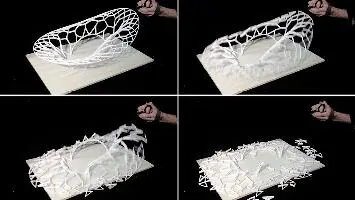
Fig. 14 Collapse of the 3D-printed funnel-shaped rib vault by cutting the continuous tension tie
Block, 2012), this type of structures need to be realized with stiff nodes in order to resist live, non-funicular loading cases, which can be defined and dimensioned through the analysis of a materialized, form-found shape.
4 Conclusion and Further Research
This paper discussed how funnel geometries could be made structurally efficient, as a combination of a three-dimensional equivalent of funicular half-arches balanced by tension ties. It showed how Thrust Network Analysis could be extended to incorporate tension elements, using directed elements in the form and force diagram, to create continuous tension rings. These concepts have been implemented by extending RhinoVAULT to these new boundary conditions. A simple design exploration showed the variety of possible shapes using only simple modification strategies. Lastly, a structural model was developed to validate the equilibrium solutions generated with the approach. This model furthermore hints at the attractive possibilities of filigree ribbed funnel structures, reminiscent of Schlaich’s beautiful tree structures.
Although the current, direct implementation allows an intuitive exploration of funicular funnel shells, as clear from the exploration in the result section, the following objectives represent routes for further research:
Understand the actual dependencies and constraints of the form and force diagram for this new type of boundary condition better to fully explore the possibilities of the funicular funnel shell typology;
Include feedback, or immediately constraints, on the global moment equilibrium during the form-finding process: Shells whose centres of gravity fall outside of the convex hull of the supports, can of course not stand as a combined pure compression shell and tension rings; and
Formulate the form-finding as a best-fit (to a target surface/geometry) optimization problem, as in Block & Lachauer (2011) or Panozzo et al. (2013) for compression-only shells.
References
Block, P.; Ochsendorf, J., 2007: Thrust Network Analysis: A New Methodology for Three-Dimensional Equilibrium. Journal of the International Association for Shell and Spatial Structures, 48(3), pp. 167–173.
Block, P., 2009: Thrust Network Analysis: Exploring Three-Dimensional Equilibrium. PhD thesis, Massachusetts Institute of Technology, Cambridge, MA.
Block P.; Lachauer L., 2011: Closest-Fit, Compression-Only Solutions for Free Form Shells. Proceedings of the IABSE-IASS Symposium 2011, London, UK.
Chilton, J., 2000: The Engineer’s Contribution to Contemporary Architecture: Heinz Isler. London: Thomas Telford Press.
Clifford, B., 2012: Volume: Bringing Surface into Question. SOM Foundation Report.
Cremona, L., 1890: Graphical Statics: Two Treatises on the Graphical Calculus and Reciprocal Fig. s.Graphic Statics. English Translation by Thomas Hudson Beare. Oxford: Clarendon Press.
Fitchen J., 1961: The Construction of Gothic Cathedrals: A Study of Medieval Vault Erection. Chicago: University of Chicago Press.
Kilian, A., 2006: Design Exploration through Bidirectional Modeling of Constraints. PhD thesis, Massachusetts Institute of Technology, Cambridge, MA.
Lachauer L.; Block P., 2012: Compression Support Structures for Slabs. Proceedings of Advances in Architectural Geometry 2012. Paris, France.
Maxwell, J. C., 1864: On Reciprocal Fig. s and Diagrams of Forces. Philosophical Magazine. 4(27), pp. 250–261.
McNeel, R.., 2013: Rhinoceros: NURBS Modeling for Windows. Computer software. http://www.rhino3d.com/. [08.08.2013]
Panozzo, D.; Block, P.; Sorkine, O., 2013: Designing Unreinforced Masonry Models. ACM Transactions on Graphics (SIGGRAPH 2013).
Rippmann M.; Lachauer L.; Block P., 2012: Interactive Vault Design. International Journal of Space Structures, 27(4), pp. 219–230.
Rippmann, M.; Lachauer, L.; Block, P., 2012: RhinoVAULT - Designing Funicular Form with Rhino. Computer software. http://block.arch.ethz.ch/tools/rhinovault/. [08.08.2013]
Rippmann, M.; Block, P., 2013: Funicular Shell Design Exploration. Proceedings of ACADIA Conference 2013. Waterloo, Canada.
Van Mele, T.; McInerney, J., DeJong, M.; Block, P., 2012: Physical and Computational Discrete Modeling of Masonry Vault Collapse. Proceedings of the 8th International Conference on Structural Analysis of Historical Constructions, Wroclaw, Poland.
From Structural Purity to Site Specificity
New Canopies for the Entrance Gates of the Messe Frankfurt
Agnes Weilandt and Oliver Tessmann
AbstractThis paper describes a structural design approach that seeks to replace structural purity and preconceived typologies by site-specific constructions. The process is exemplified by a canopy design for the Messe Frankfurt (Frankfurt fair). The competition-winning proposal is the result of a collaborative design effort of architects and structural engineers. In a computational design process the structure is optimised in regards to fabrication requirements and material consumption. Beyond the particular project, the design process is accompanied by a design-tool development. Shortcomings in existing tools became obvious in the process and showed the need for in-house development of advanced collaborative digital design tools.
Agnes Weilandt
Bollinger + Grohmann Ingenieure, Frankfurt am Main, Germany
Fachhochschule Frankfurt, Frankfurt am Main, Germany
Oliver Tessmann
School of Architecture KTH–ABE, Stockholm, Sweden
1 Introduction
The here described canopy is part of an ongoing project-based research that seeks to challenge structural typologies inherited from modernist practice and nineteenth century design procedures still prevalent in our built environment. In a series of projects we questioned structural system purity, which is often favoured by engineers for the sake of repetitive detailing and simple analysis, but neglects the architectural design approach and site-specific requirements. Our aim, in contrast, is to look forward and design both novel structural systems and the necessary computational tools and procedures (Bollinger et al., 2008).
System homogeneity is useful in vast structures with mono-functional infrastructural use and large spans (Billington, 1985). Migrating structural purity from the mono-functional into the complexity of architecture might, however, prohibit a dialogue between the load bearing and the space forming.
The canopy is one of several projects in which the purity of a structural typology went through a computationally driven evolution and alteration beyond structural optimisation. All projects have in common that their structure is not a superimposed preconceived typology but the result of a negotiation process balancing multiple criteria. The aim is to embrace further programmatic, formal and architectural considerations into the design of structures.
The history of projects is accompanied by the ongoing development of digital design tools. Available tools and procedures have a major impact on how we design. Bollinger + Grohmann Ingenieure constantly urges for close collaborations of architects and structural designers and therefore develops tools for seamless data flow between generation and analysis (Preisinger, 2012). It is the link between computationally generating structures as geometrical objects and their analysis and evaluation that requires permanent improvement. Once this connection is defined by the architects and the structural designers, computational power can be instrumentalised to not only represent but to generate variety and a multitude of possible solution (Bentley, 2002). In several projects (Fig. 1), we worked with structure generating algorithms that create vector-active systems with counter-intuitive placement of elements. The algorithm starts with many versions of systems made from stochastic distribution of structural members. They become the objects of analysis only after the generation and hence do not carry the burden of a preconceived typology.
Читать дальшеИнтервал:
Закладка:
Похожие книги на «Rethinking Prototyping»
Представляем Вашему вниманию похожие книги на «Rethinking Prototyping» списком для выбора. Мы отобрали схожую по названию и смыслу литературу в надежде предоставить читателям больше вариантов отыскать новые, интересные, ещё непрочитанные произведения.

Обсуждение, отзывы о книге «Rethinking Prototyping» и просто собственные мнения читателей. Оставьте ваши комментарии, напишите, что Вы думаете о произведении, его смысле или главных героях. Укажите что конкретно понравилось, а что нет, и почему Вы так считаете.