Rethinking Prototyping
Здесь есть возможность читать онлайн «Rethinking Prototyping» — ознакомительный отрывок электронной книги совершенно бесплатно, а после прочтения отрывка купить полную версию. В некоторых случаях можно слушать аудио, скачать через торрент в формате fb2 и присутствует краткое содержание. Жанр: unrecognised, на английском языке. Описание произведения, (предисловие) а так же отзывы посетителей доступны на портале библиотеки ЛибКат.
- Название:Rethinking Prototyping
- Автор:
- Жанр:
- Год:неизвестен
- ISBN:нет данных
- Рейтинг книги:3 / 5. Голосов: 1
-
Избранное:Добавить в избранное
- Отзывы:
-
Ваша оценка:
Rethinking Prototyping: краткое содержание, описание и аннотация
Предлагаем к чтению аннотацию, описание, краткое содержание или предисловие (зависит от того, что написал сам автор книги «Rethinking Prototyping»). Если вы не нашли необходимую информацию о книге — напишите в комментариях, мы постараемся отыскать её.
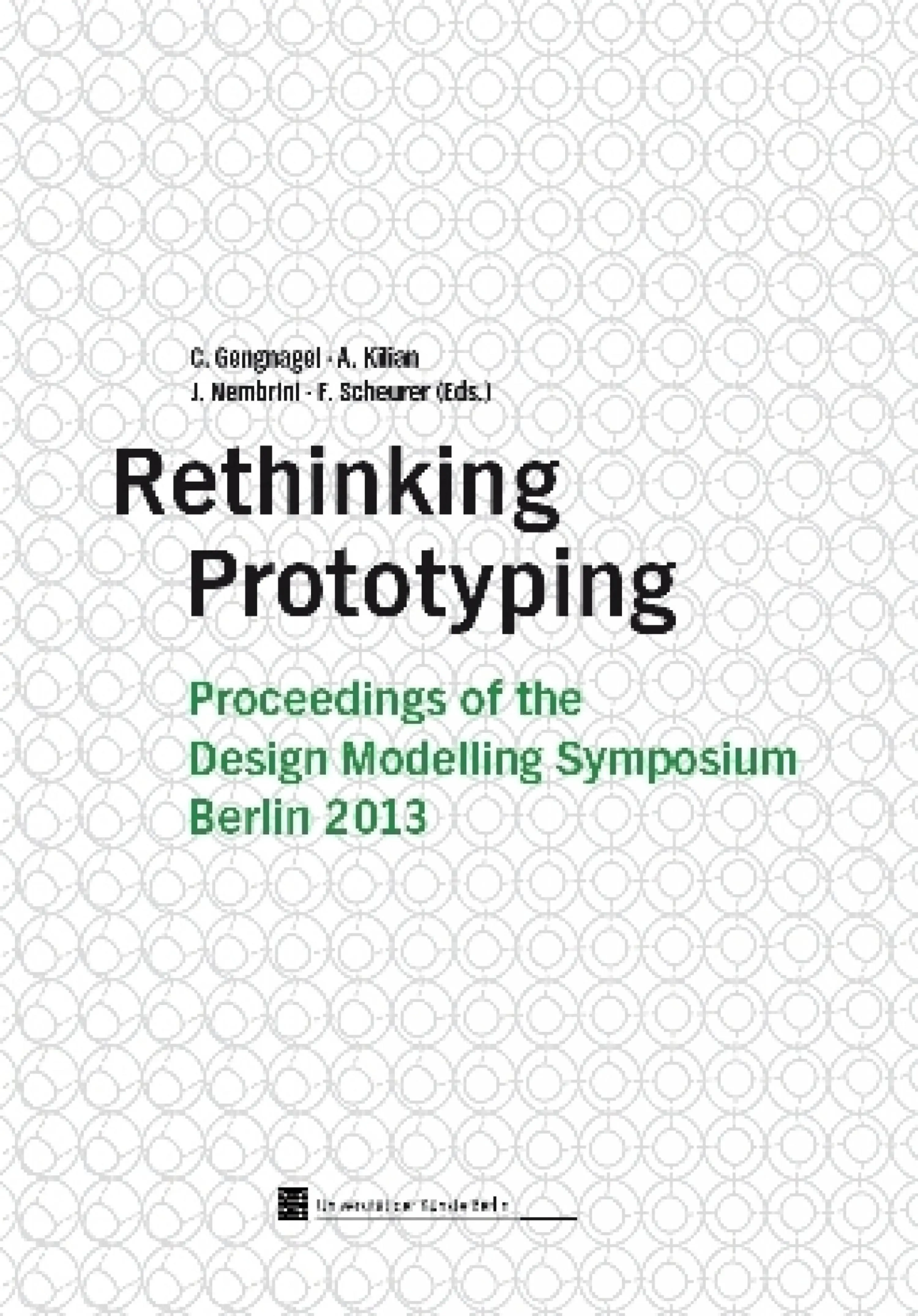
The Design Modelling Symposium Berlin 2013 would like to challenge the participants to reflect on the possibility of computational systems that bridge design phase and occupancy of buildings. This rethinking of the designed artifact beyond its physical has had profound effects on other industries already. How does it affect architecture and engineering?
At the scale of engineering and building systems new perspectives may open up by engaging built form as a continuous prototype, which can track and respond during use and serve as a real world implementation of its design model. This has been tried many times from intelligent façades to smart homes and networked grids but much of it was only technology driven and not approached from a more holistic design perspective.
Rethinking Prototyping — читать онлайн ознакомительный отрывок
Ниже представлен текст книги, разбитый по страницам. Система сохранения места последней прочитанной страницы, позволяет с удобством читать онлайн бесплатно книгу «Rethinking Prototyping», без необходимости каждый раз заново искать на чём Вы остановились. Поставьте закладку, и сможете в любой момент перейти на страницу, на которой закончили чтение.
Интервал:
Закладка:
5 Structural Optimisation
Amongst the most fabrication-friendly structures we then identified the roof versions with the best structural capacities by rating the maximal deflections of single bars or regions of the roof structure.
The most promising configurations were then used for further structural optimisation. A custom-made VB Script in MS Excel links the geometry in Rhinoceros with RSTAB , a structural analysis software from Dlubal . Every lamella, spanning between two points on the roof perimeter, is subdivided at every intersection point. The algorithm, starting from a homogeneous configuration, differentiates height and thickness of every piece and tapers the flat steel bars.
The goal of the discrete optimisation problem was a minimum weight design respecting local stress and global deflection constraints using a set of available cross sections. For solving the optimisation problem, we choose an algorithm based on the CAO algorithm proposed by Matthek and Burkhardt (Matthek, et al. 1990). The CAO seeks an optimal design by simulating the growing pattern of biological load bearing structures. So areas with high stress concentrations are strengthened and those with light stresses are degenerating.
The algorithm reduces the lamella cross sections by iteratively analysing their maximum von Mises Stresses . Tapering the pieces lead to an undulating bottom edge of every lamella. To guarantee this rolling effect every intersection point needed profiles with identical height. Hence, we constantly analysed the von Mises Stresses of all lamellas intersecting in one point. The lamella with the maximum grade of utilisation at each intersection point defined the cross section. To rationalise the structure the cross section dimensions were limited to ten different types in between 20 to 40mm thickness and 150 to 600mm height.

Fig. 9 Structural optimisation process from a homogenous structure to an undulating, material efficient, differentiated system.
Each lamella cross section change results in a redistribution of stiffness’s, which induces in a hyperstatic structure a shifting of load paths. Therefore, it was necessary to recalculate at each iteration step the von Mises Stresses for the whole structure to consider this load path shifting. The stopping criterion for the iteration was chosen as a determined percentage of lamella cross sections changing between iteration step n and n+1. So shifting of load paths due to the redistribution of stiffness’s could be considered as negligible. In a subsequent step, the lamella cross section thicknesses between each intersection point were controlled. In case of lamellas with different thicknesses at starting and ending point the higher thickness was chosen for the full length.
The global deflection constraint was implemented in the algorithm by reducing the maximum stress limit for the lamellas. It was decided to limit the deflection of the outer edge of the canopy at the side with the longest cantilevering to 50mm due to variable loads. This corresponds to l/200 for the cantilevering length of 10m. This deflection limit was achieved by limiting the von Mises Stresses to 85% of the admissible stresses.
This intuitive approach was chosen as the analysed structures showed a direct and almost linear correlation between the maximum deflections and the stresses of the heavy-duty girders located nearby the supporting columns. That way the optimum girder configuration with the appropriate section size was found.
6 Conclusion
The developed structure answers to different and irregular column positions, geometries, and its high level of recognition in an optimal way to the design task given by the Messe Frankfurt. The roof structure sought to be an alternative approach to a hierarchical organization of structure or conventional proportional systems. Structural purity would have been the wrong answer to the design challenge since the particular requirements of a complex site needed to be taken into account. The developed algorithms for the girder configurations with subsequent structural optimisation is intuitive but cope with the given optimisation problem, as the behaviour of the given structure - a cantilevering canopy - is quite predictable. The design process blurred the boundaries between design development and design-tool development. The lacking automated feedback loop between geometry generation and its structural and geometrical analysis prevented exploring a larger solution space and showed the need for further development of design tools. A series of comparable projects lead to a collection of tools, all of them highly project specific and therefore of limited use for following endeavours. The experience of linking parametric and structural design for this and several other similar projects designed at this time showed Bollinger + Grohmann Ingenieure the need to consolidate and formalise the acquired knowledge and tools. The effort could not be conducted within project-driven research because of limited budget and time. Thus, the idea of integrating structural design tools into a parametric design environment became a joint venture of the engineering office and the department of structural design of the University of Applied Arts in Vienna. The fruitful collaboration yielded Karamba , a Finite Element programme for the early design phase. The software is fully embedded in the parametric environment of Grasshopper , which makes it easy to combine parameterized geometric models, finite element calculations. Structural parameters become integral design drivers from early on instead of constraints in later design phases. The digital model becomes more than pure geometry representation; it is informed with structural capacities. The parametric design approach allows for geometric variation combined with the immediate structural analysis we are able to generate site-specific structure beyond preconceived typologies.
References
Bentley, P. J.; Corne, D., 2002: Creative Evolutionary Systems. San Diego: Academic Press.
Billington, D., 1985: The Tower and the Bridge . New York: Princeton University Press.
Bollinger, K.; Grohmann, M.; Tessmann, O.: Form, Force, Performance: Multi-Parametric Structural Design. In: Hensel, M; Menges, A. (eds.): AD Architectural Design , Volume 78, Issue 2. Special Issue: Versatillity and Vicissitude, 2008, pp. 20-25.
Matthek, C.; Burkhardt, S.: A New Method of Structural Shape Optimization Based on Biological Growth. International Journal of Fatigue , Volume 12, Issue 3, May 1990, pp. 185–190.
Preisinger, C.: Linking Structure and Parametric Geometry. In: Peters, B.; De Kastelier, X. (eds): Architectural Design Computation Works: The Building of Algorithmic Thought , John Wiley & Sons, London, 2012, p. 111-114.
DesignScript: A Learning Environment for Design Computation
Robert Aish
AbstractDesign computation is now an established part of architectural design education and practice. The challenge is to encourage designers with the minimum of prior knowledge to become operational with computational concepts but without being subsequently limited by any simplified approaches that might have been initially offered. This paper describes recent progress in the development of additional intermediate tools which are intended to encourage the designer to progress to more complex computational ideas and their successful application to design. Here it is suggested that an appropriate design computational toolset should offer a progression of concepts, tools and forms of user interaction that match the expected progression in skills and ambitions of the designer.
Читать дальшеИнтервал:
Закладка:
Похожие книги на «Rethinking Prototyping»
Представляем Вашему вниманию похожие книги на «Rethinking Prototyping» списком для выбора. Мы отобрали схожую по названию и смыслу литературу в надежде предоставить читателям больше вариантов отыскать новые, интересные, ещё непрочитанные произведения.

Обсуждение, отзывы о книге «Rethinking Prototyping» и просто собственные мнения читателей. Оставьте ваши комментарии, напишите, что Вы думаете о произведении, его смысле или главных героях. Укажите что конкретно понравилось, а что нет, и почему Вы так считаете.