Scarlett Sieber - Embedded Finance
Здесь есть возможность читать онлайн «Scarlett Sieber - Embedded Finance» — ознакомительный отрывок электронной книги совершенно бесплатно, а после прочтения отрывка купить полную версию. В некоторых случаях можно слушать аудио, скачать через торрент в формате fb2 и присутствует краткое содержание. Жанр: unrecognised, на английском языке. Описание произведения, (предисловие) а так же отзывы посетителей доступны на портале библиотеки ЛибКат.
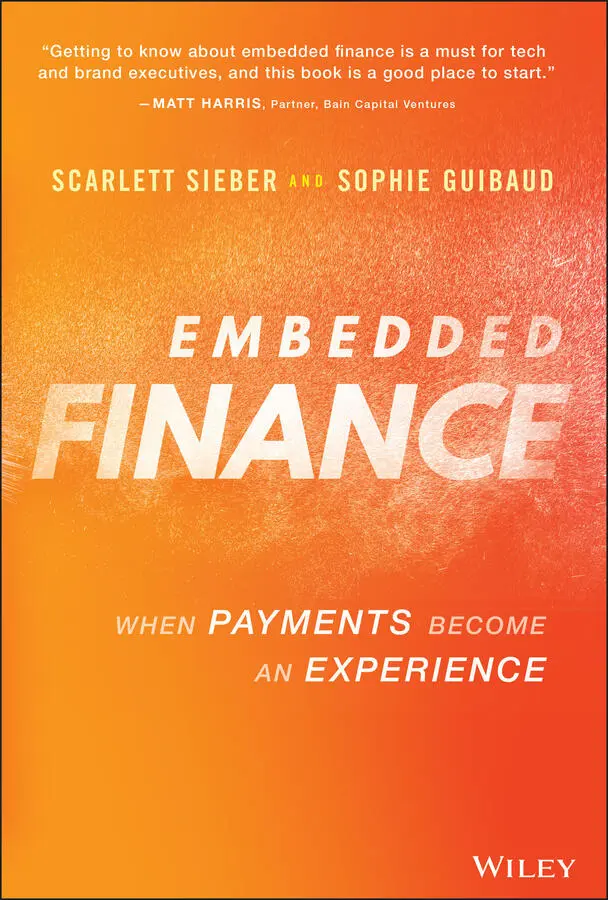
- Название:Embedded Finance
- Автор:
- Жанр:
- Год:неизвестен
- ISBN:нет данных
- Рейтинг книги:4 / 5. Голосов: 1
-
Избранное:Добавить в избранное
- Отзывы:
-
Ваша оценка:
Embedded Finance: краткое содержание, описание и аннотация
Предлагаем к чтению аннотацию, описание, краткое содержание или предисловие (зависит от того, что написал сам автор книги «Embedded Finance»). Если вы не нашли необходимую информацию о книге — напишите в комментариях, мы постараемся отыскать её.
Are you ready for it?
In , veteran growth strategists, entrepreneurs, and fintech disruptors Scarlett Sieber and Sophie Guibaud deliver a thought-provoking and page-turning discussion on the most impactful and exciting trend of fintech yet: embedded finance. In the book, you’ll explore the past, present, and future of fintech, from how embedded finance is being leveraged today by industry heavyweights like Google and Amazon to supercharge their customers’ experience to the offerings of smaller, niche players who stand poised to dominate their own corners of the market as their answer unmet customers’ needs.
The authors present:
● Practical examples around the world of how embedded finance is being used today by technology companies and brands to redefine our online and offline retail experiences as we know them
● The key trends, players, and technologies that are paving the way for embedded finance to take a dominant position in our lives
● The role, opportunities, and strategies for banks, technology companies and brands, providing them with all necessary tools to define their own embedded finance strategy
● The impact of embedded finance on society, consumers, companies, and the economy as a whole, highlighting the dominant force that is embedded finance for our future
● An exciting view of how our day-to-day lives will look like in 2030, powered by embedded finance
An indispensable and eye-opening exploration of one of the most exciting and influential technologies in development today,
details a revolution in financial services, banking, and technology that has already begun. Are you ready?
Embedded Finance — читать онлайн ознакомительный отрывок
Ниже представлен текст книги, разбитый по страницам. Система сохранения места последней прочитанной страницы, позволяет с удобством читать онлайн бесплатно книгу «Embedded Finance», без необходимости каждый раз заново искать на чём Вы остановились. Поставьте закладку, и сможете в любой момент перейти на страницу, на которой закончили чтение.
Интервал:
Закладка:
Tinkoff describes itself as a financial Super App, which is different from China's Super Apps that offer services such as ordering cabs and food delivery. Tinkoff's app offers a single view of all available financial services to the user, whether they are using those services already or not. The idea is to increase cross-selling in a way that is relevant to them. Tinkoff has developed a range of content and materials available in the app, in the form of articles, Instagram-like stories, and tickets, that makes it pleasant for the customer to come back and engage and which ultimately drives cross-selling of Tinkoff's services. Neri Tollardo explains:
If they are big sport fans, we would tell them there's this football game on this weekend, they can buy game tickets, travel tickets and book hotels. You can do a lot of lifestyle-related activities like book a theater ticket or a sports game ticket all inside the app, which gives the customer an extra reason to come and spend a little bit more time and do something that they have positive feelings about within the app. Obviously, as they do that, it drives the frequency of Tinkoff's app usage.
Tinkoff has also negotiated rates with merchants and is offering cashback to its users. This strategy is most definitely working, as out of its 14 million monthly active users, 5 million of them are daily active users of the Tinkoff app.
We can't discuss customer segmentation excellence and the success that neobanks have had without mentioning that a portion of the traditional finance service players, particularly credit unions, pioneered the customer segmentation piece for financial services.
Many of the innovations commonly attributed to neobanks using advanced technology to segment customers first appeared with credit unions or building societies. Credit unions serve specific groups, for example, the employees of the same business or industry, and therefore were advanced in tailoring their services to meet the needs of their customers, known as members. There are credit unions targeted toward the military, teachers, Disney employees, and the list goes on.
While there are a few primary examples of credit unions leading from a data perspective, such as the early payment of paychecks based on the simple data of direct deposit information, a benefit for consumers that is still a marquee function of neobanks today, there are some differences for this generation of neobanks. The key difference lies in the neobanks’ ability to utilize technology and data as a primary competitive advantage. Equipped with this information, the next generation of neobanks allows people of different communities, regardless of location, to become part of the movement.
This customization based on data and truly knowing your customer is where embedded finance comes front and center.
LOOKING ACROSS BORDERS: THE CASE OF CHINA
Yassine Regragui, fintech specialist and expert on China, explains that China's development in fintech is very unique, as it started in 2003, 19 years ago, with Alipay that was an escrow service created to build trust between the buyers and sellers of the e-commerce platform Taobao. Over the years, Alipay became a Super App that is today used by nearly everyone in China. Alipay and its competitor, WeChat Pay, now represent over 90% of mobile payments in China, while their offering extends far beyond financial services into lifestyle. The lifestyle services offered by those payment apps are now used more than 50% of the time by users engaging within the Super App. While this is something very typical to China, we are now seeing similar use cases in Southeast Asia, in Europe, in the US, and in other countries, because these payment apps are expanding their services and taking part in the daily lives of their users. The natural integration of financial services in these Super Apps, along with the fact that Chinese consumers are accustomed to going to one place to meet most of their needs, positions China to be at the forefront of fintech innovation. This is in large part thanks to the Big Tech platforms leading the charge when it comes to financial innovation, a progressive regulator encouraging competition, and the banks that offered API-based services early on to enable Big Tech to connect to it.
China's speed of innovation and technological developments can be attributed to several factors. The first factor is that those who started these payment services are nonbanking companies, including Alibaba, an e-commerce platform and Tencent, a gaming or messaging platform, who built a relationship with their users. Many gamers in the US will be familiar with Tencent for their hit games including Fortnite and PubG. This relationship and Chinese cultural tendency of being more open to new services enable the fast and consistent adoption of the new services they deploy. The second factor focuses on the ecosystem. These two giants have many external services connected to their internal ecosystem (the Super Apps) which creates a halo effect and builds trust externally through their partner's brands. The last factor is the Chinese regulators’ openness and support to encourage more competitors to enter to stimulate innovation. By contrast, Western payment companies are kept out of the Chinese market, protecting the homegrown players.
EMBEDDED FINANCE IS HERE
It has taken time for the embedded finance ecosystem to develop. First, banks needed to digitize their offerings and open products and services via APIs, which allow two sites or apps to communicate and exchange data. Next, a sophisticated fintech sector needed to emerge and begin interfacing with bank technology in order to deliver superior versions to their customers, consumer, or business. Third, regulators needed to soften their approach to nonbank vendors offering financial services. Fourth, companies needed to understand the opportunity embedded finance offers and find the right opportunities to offer products. Software-as-a-service companies are seeing the value in financial offerings, which can become the most lucrative parts of their business. Big Tech has the audience, the agility to innovate, and is already searching for solutions to improve customer stickiness and brand loyalty and diversify their revenue base. They also have the data on their users that they can leverage to provide the best possible financial services, at the best price, with the least risk. Finally, most individuals have reached the point of psychological safety needed to start accepting financial services products in other shopping contexts and through different distribution channels.
Embedded finance is officially here. Are you ready?
Summary
Embedded finance is the new way financial services reach customers. Instead of customers going to banks, embedded finance delivers financial products to customers through services they already use, in the context of their everyday lives. Embedded finance was born from fintech, the fusion of financial services and technology that emerged from the financial crisis of 2008.
Banks have always used technology to deliver services to customers. Embedded finance is the latest stage in this journey, but rather than being the banks themselves distributing the services to customers, banks use tech companies and brands as new distribution channels to reach an even larger number of customers.
Fintech changed customer expectations of what financial services could be. Fintech prioritized convenience and the user experience, delivered on mobile devices.
Consumer-facing companies are combining efforts with banks and fintech to deliver financial services in context, at the point of maximum convenience for their customers.
NOTES
1 1. https://www.ft.com/content/e543adf0-8c62-4a2c-b2d9-01fdb2f595ccAccessed January 15, 2022.
Читать дальшеИнтервал:
Закладка:
Похожие книги на «Embedded Finance»
Представляем Вашему вниманию похожие книги на «Embedded Finance» списком для выбора. Мы отобрали схожую по названию и смыслу литературу в надежде предоставить читателям больше вариантов отыскать новые, интересные, ещё непрочитанные произведения.











Обсуждение, отзывы о книге «Embedded Finance» и просто собственные мнения читателей. Оставьте ваши комментарии, напишите, что Вы думаете о произведении, его смысле или главных героях. Укажите что конкретно понравилось, а что нет, и почему Вы так считаете.