Scarlett Sieber - Embedded Finance
Здесь есть возможность читать онлайн «Scarlett Sieber - Embedded Finance» — ознакомительный отрывок электронной книги совершенно бесплатно, а после прочтения отрывка купить полную версию. В некоторых случаях можно слушать аудио, скачать через торрент в формате fb2 и присутствует краткое содержание. Жанр: unrecognised, на английском языке. Описание произведения, (предисловие) а так же отзывы посетителей доступны на портале библиотеки ЛибКат.
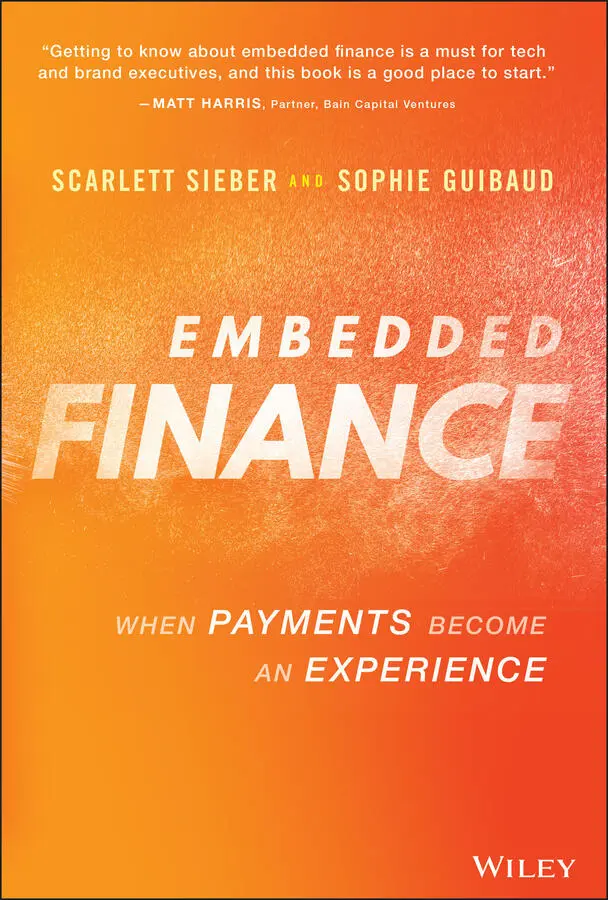
- Название:Embedded Finance
- Автор:
- Жанр:
- Год:неизвестен
- ISBN:нет данных
- Рейтинг книги:4 / 5. Голосов: 1
-
Избранное:Добавить в избранное
- Отзывы:
-
Ваша оценка:
Embedded Finance: краткое содержание, описание и аннотация
Предлагаем к чтению аннотацию, описание, краткое содержание или предисловие (зависит от того, что написал сам автор книги «Embedded Finance»). Если вы не нашли необходимую информацию о книге — напишите в комментариях, мы постараемся отыскать её.
Are you ready for it?
In , veteran growth strategists, entrepreneurs, and fintech disruptors Scarlett Sieber and Sophie Guibaud deliver a thought-provoking and page-turning discussion on the most impactful and exciting trend of fintech yet: embedded finance. In the book, you’ll explore the past, present, and future of fintech, from how embedded finance is being leveraged today by industry heavyweights like Google and Amazon to supercharge their customers’ experience to the offerings of smaller, niche players who stand poised to dominate their own corners of the market as their answer unmet customers’ needs.
The authors present:
● Practical examples around the world of how embedded finance is being used today by technology companies and brands to redefine our online and offline retail experiences as we know them
● The key trends, players, and technologies that are paving the way for embedded finance to take a dominant position in our lives
● The role, opportunities, and strategies for banks, technology companies and brands, providing them with all necessary tools to define their own embedded finance strategy
● The impact of embedded finance on society, consumers, companies, and the economy as a whole, highlighting the dominant force that is embedded finance for our future
● An exciting view of how our day-to-day lives will look like in 2030, powered by embedded finance
An indispensable and eye-opening exploration of one of the most exciting and influential technologies in development today,
details a revolution in financial services, banking, and technology that has already begun. Are you ready?
Embedded Finance — читать онлайн ознакомительный отрывок
Ниже представлен текст книги, разбитый по страницам. Система сохранения места последней прочитанной страницы, позволяет с удобством читать онлайн бесплатно книгу «Embedded Finance», без необходимости каждый раз заново искать на чём Вы остановились. Поставьте закладку, и сможете в любой момент перейти на страницу, на которой закончили чтение.
Интервал:
Закладка:
While, in general, the neobanks have started with one specific product offering, some have done well in expanding their product suites in a compelling way which in turn increases touchpoints with their customers, customer lifetime value, and the total addressable market. This larger movement has become known as the rebundling of the bank and now is being referred to as Super Apps.
What is the difference between the rebundled bank that is digital first versus the traditional players? Customer segmentation. Many neobanks started their journey by catering to specific segments of the population, such as millennials or travelers. Even more specialization is popping up around the globe supporting the theory of specialization and deep knowledge of core customers as a potential winning strategy.
With neobanks’ digital-first (or digital-only) offerings, banking services can be delivered à la carte and on-demand, and can happen in any context. Companies, such as Monese for migrants and Daylight for LGBTQ+ consumers, are addressing specific problems for their communities, and building products that make sense.
At the same time, other neobanks who started off with a specialization are now expanding from their initial highly targeted customer base to a much broader one to achieve scale and hit growth targets. Revolut, who initially targeted mostly travelers, broadened their financial services offering beyond multi-currency accounts and cheap FX toward investments, crypto, and savings, and even launched a SME offering, to maintain its growth rate and increase its total addressable market. Tinkoff similarly started off by offering simple credit products before becoming a Super App touching most segments of the Russian population, and plans to expand to the Philippines.
BEHAVIORAL SHIFTS ACROSS GENERATIONS
Embedded finance is an improvement upon fintech, because companies who are already successfully employing embedded finance already start with a significant customer base. Throughout its history, despite all the headlines and money pouring into the space, fintech has struggled with customer acquisition, which represents one of every fintech company's greatest costs. Part of this has to do with low virality of fintech apps compared to social and other types of apps. How many times a day do you scroll your social feeds, whether it be Facebook, Twitter, TikTok, or Snapchat? What about your banking app? When you do open your banking app, how long are you engaged for? You might tell a friend about a new social network because you want them to join and having them on the platform with you enhances your experience. But, you don't tell your friend about a hot new lending app that will help consolidate your credit card debt, because talking about debt or even wealth can be awkward and uncomfortable and there typically isn't an opportunity for you and your friend to connect and collaborate on the app.
The exception is with peer-to-peer apps, in which you need the person on the other end of the transaction to be part of your network. Another exception is investing and cryptocurrency services, in which people enjoy sharing expertise, and information can be shared without sharing dollar amounts.
There are signs that Gen Z consumers will show greater openness about money and have a greater comfort level sharing personal details, but it is still early in their financial lives. This is certainly true of platforms like TikTok with the craze of “FinTok” and “Finfluencers” including Queenie Tan who, as of January 2022, has nearly 120,000 followers, and Andres Garza, also known as @capital_inteligente, as of January 2022, who has nearly 1,000,000 followers. They openly talk about once taboo topics and make the concepts of financial literacy cool and relatable.
We saw this movement of open sharing for younger generations with the peer-to-peer payments app Venmo, owned by PayPal. Venmo was an early experimenter in making its interactions shareable, encouraging users to invite their friends from other social platforms and making payments fun by adding emojis as descriptions for transactions. It has since made privacy more of a default, but part of the app's original value proposition was showing friends where and how you were spending your money. P2P companies like Venmo are still growing. To quantify the scale of a company like Venmo, Venmo did 2.6 billion transactions worth $159 billion in 2020, 56% higher than the previous year. 12
Case Study: Tinkoff
Tinkoff Bank's story is unique. It was launched in 2006, before the new wave of neobanks. At the time, founder Oleg Tinkov had spent some time in the US and was amazed by the amount of mail he used to get offering him applications for credit cards. When looking at the number of credit cards per capita, there were two or three credit cards in the US and a fraction of that in Russia. Willing to seize this opportunity, he bought a bank in Russia and launched Tinkoff Bank. The beginnings of Tinkoff were dedicated to selling credit cards by mail, which was a tough process that required important optimizations, including tests of font, signature position, etc., to maximize customer conversions. It created the mindset of test and learn within Tinkoff and laid the basis for continued data analytics within the company. In 2007–2008, the financial crisis hit which led Tinkoff to change its funding model, move most of its activities online, and start taking deposits.
Over the next several years, a growing customer base started demanding more and more services from Tinkoff, which pushed the bank to launch a full product suite, including credit cards, personal loans, point-of-sale loans, and eventually secured products like home equity loans and car loans. On the transactional side, Tinkoff launched a debit card, the largest retail brokerage platform in the market with 70% of all active customers in Russia, and an insurance business focused primarily on car insurance. It also moved into the B2B space through the launch of an SME bank and an acquiring business_Tinkoff is now the second largest online card acquirer in Russia.
Over the years, Tinkoff's data model sophistication improved drastically, catalyzed by the fact that Tinkoff was becoming their customer's primary bank and, as a result, was gathering a very comprehensive data set on their customers, allowing Tinkoff to target those customers with the right product, at the right time, at the right price. Over time, Tinkoff has also added external data sources to its model. According to Neri Tollardo, VP of Strategy of Tinkoff Bank, Tinkoff has now received and processed 250 million credit applications since their launch, which means that most Russians have applied for a Tinkoff product. All that data has gone to enrich their data models, which in turn is becoming more precise and now leverages artificial intelligence to refine its predictions. Tinkoff's philosophy is simple: data is used for the benefit of the customer to make sure Tinkoff can satisfy their financial needs.
When it comes to its target market, Tinkoff's customer base has evolved over time. Tinkoff started by being a regional mass-market credit card lender, outside Russia's big cities, focused on small towns where branches were not always available. The launch of the debit card and the mobile app brought a more mass affluent, younger, and digital customer base, for which Tinkoff developed a certain number of new services. While those customers were not necessarily as interested in credit cards, they wanted to be able to use a brokerage account and buy insurance for their car. Tinkoff also has recently launched a private bank service for high-net-worth individuals. Nowadays, Tinkoff boasts 14 million active customers and covers all segments of the Russian population. Neri Tollardo believes Tinkoff offers a product for everyone.
Читать дальшеИнтервал:
Закладка:
Похожие книги на «Embedded Finance»
Представляем Вашему вниманию похожие книги на «Embedded Finance» списком для выбора. Мы отобрали схожую по названию и смыслу литературу в надежде предоставить читателям больше вариантов отыскать новые, интересные, ещё непрочитанные произведения.










Обсуждение, отзывы о книге «Embedded Finance» и просто собственные мнения читателей. Оставьте ваши комментарии, напишите, что Вы думаете о произведении, его смысле или главных героях. Укажите что конкретно понравилось, а что нет, и почему Вы так считаете.