Alan Gunn - Parasitology
Здесь есть возможность читать онлайн «Alan Gunn - Parasitology» — ознакомительный отрывок электронной книги совершенно бесплатно, а после прочтения отрывка купить полную версию. В некоторых случаях можно слушать аудио, скачать через торрент в формате fb2 и присутствует краткое содержание. Жанр: unrecognised, на английском языке. Описание произведения, (предисловие) а так же отзывы посетителей доступны на портале библиотеки ЛибКат.
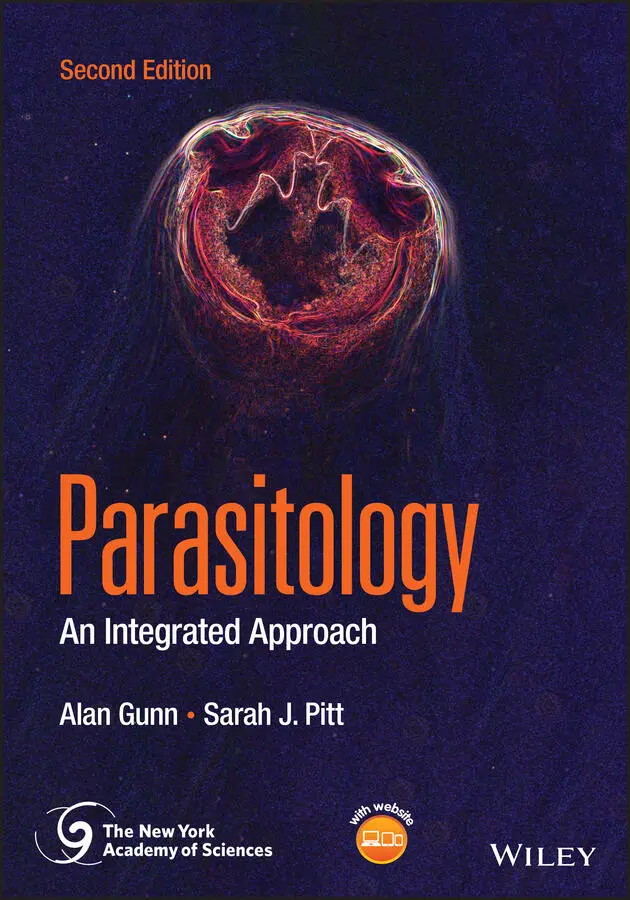
- Название:Parasitology
- Автор:
- Жанр:
- Год:неизвестен
- ISBN:нет данных
- Рейтинг книги:3 / 5. Голосов: 1
-
Избранное:Добавить в избранное
- Отзывы:
-
Ваша оценка:
Parasitology: краткое содержание, описание и аннотация
Предлагаем к чтению аннотацию, описание, краткое содержание или предисловие (зависит от того, что написал сам автор книги «Parasitology»). Если вы не нашли необходимую информацию о книге — напишите в комментариях, мы постараемся отыскать её.
Highly detailed textbook on parasites and parasite relationships Parasitology: An Integrated Approach
Parasitology: An Integrated Approach, 2nd edition
Parasitology — читать онлайн ознакомительный отрывок
Ниже представлен текст книги, разбитый по страницам. Система сохранения места последней прочитанной страницы, позволяет с удобством читать онлайн бесплатно книгу «Parasitology», без необходимости каждый раз заново искать на чём Вы остановились. Поставьте закладку, и сможете в любой момент перейти на страницу, на которой закончили чтение.
Интервал:
Закладка:
Over the years, taxonomists have identified numerous organisms and grouped them together in many different arrangements. Primarily, this has been on the basis of their morphology, and this remains a major feature of taxonomy. Increasingly, morphological studies are complemented by molecular phylogeny, and this is having have a major impact on our understanding of animal relationships, confirming some groupings whilst questioning the validity of many others. However, molecular phylogenetics does not always provide clear evidence of the relationships between species. Consequently, there is often a lack of consistency between texts, and there are frequent rearrangements.
There is some debate about how many kingdoms exist although most modern textbooks refer to six: Archaea, Bacteria, Protista, Fungi, Plantae, Animalia. Parasitic species are common in all the kingdoms but traditionally, parasitologists deal almost exclusively with organisms belonging to the kingdoms Protista and Animalia. Although many prokaryotes (archaeans and bacteria) are parasitic, their study falls within a remit of microbiology. Similarly, parasitic fungi fall within the realm of mycology; parasitic plants are reserve of botany (although, these days, many practitioners prefer the title of plant scientist).
2.2 Viruses: A Special (Unresolved) Case
Viruses are not usually considered to be living entities and therefore do not have a kingdom of their own. This, however, is a hotly debated topic. For example, although Moreira and Lopez‐Garcia (2009) argue strongly against viruses being living entities, Koonin and Starokadomskyy (2016) consider the very question of whether viruses are alive to be unscientific because the definition of what one means by life is arbitrary. Didier Raoult and his co‐workers argue that the giant viruses called nucleocytoplasmic large DNA viruses (NCLDVs) should be considered as an additional distinct domain of living organisms (Boyer et al. 2010). NCLDVs are so large that they can be mistaken for bacteria, and their genomes are typically twice the size of other viruses. The suggestion that a specific group of viruses might be living organisms has generated a great deal of controversy for which no resolution is in sight. Nevertheless, phylogenetic analysis suggests that NCLDVs evolved before modern eukaryotes, that is, before the organisms that are their current hosts. Furthermore, they may have been the source of two DNA‐dependent RNA polymerases and a DNA topoisomerase that are found in modern eukaryotes (Guglielmini et al. 2019).
2.3 Taxonomic Hierarchy
Kingdoms are subdivided into units or taxa (singular taxon) such as class, family, genus ( Table 2.1). There are no rules about how many species constitute a genus, how many orders constitute a class, or whether families are divided into subfamilies. However, it is essential that a ‘taxon’ forms a natural grouping. Consequently, research, especially molecular phylogeny, causes taxonomists to re‐arrange the hierarchy of individual species and groups of organisms on a regular basis. A class, family or any other category within one group of organisms is therefore not evolutionarily comparable with those in another group.
Table 2.1 The taxonomic hierarchy with specific reference to the sheep nasal bot fly Oestrus ovis .
| Taxonomic division | Taxon name | Common name |
| Kingdom Subkingdom Branch Infrakingdom Phylum Subphylum Class Infraclass Division Subdivision Superorder Order Suborder Superfamily Family Subfamily Genus Subgenus Species Subspecies | Animalia Bilateria Protostomia Ecdysozoa Arthropoda Hexapoda Insecta Pterygota Neoptera Endopterygota Panorpita Diptera Cyclorrhapha Oestroidea Oestridae Oestrinae Oestrus ovis , Linnaeus, 1758 | Animals Moulting invertebrates Insects and related species Insects Winged insects True flies Higher flies |
Not all taxonomists agree on the appropriate division for a grouping (taxon). For example, some workers consider there to be two suborders of Diptera: the Nematocera and the Brachycera and that the term Cyclorrhapha should be considered a division of the Brachycera rather than a suborder. Note that only the genus name and lower taxonomic descriptors are placed in italics.
The International Commission on Zoological Nomenclature (ICZN) provides rules on legal aspects of nomenclature (e.g., precedence). However, it is not unusual for workers to continue using old names that have been superseded or to fail to agree on an accepted single name. For example, the blowflies known as Lucilia cuprina and Lucilia sericata within the United Kingdom and Europe are often called Phaenicia cuprina and Phaenicia sericata by workers in the United States.
2.3.1 The Binomen System
All organisms (apart from viruses) have a two‐part name, or binomen – hence, the term binomial nomenclature. The two parts consist of the generic (or genus) name and the trivial name (also called the specific epithet or specific name).
The trivial name may be followed by the naming authority, i.e., the name of the person who first described the organism, along with the date the description was published – this is placed in brackets.
| Italics | ‘normal’ script |

Ascaris lumbricoides (Linnaeus, 1758)

| Genus | specific epithet | naming authority |
Genus + specific epithet = the binomen, also called the ‘species name’.
Surprisingly, there is no universally accepted definition of what is meant by the term ‘species. Indeed, there are currently over 20 different definitions. Furthermore, over the course of thousands of years, there is never a single point at which one species becomes two: it is like attempting to identify the day one ceases being a child and becomes an adult. To further complicate matters, some species have distinct forms that are called sub‐species, and these are distinguished through the use of trinomens. For example, the human body louse Pediculus humanus humanus and the head louse Pediculus humanus capitis are usually distinguished as separate sub‐species. However, for many years there has been a debate about whether the reported differences in their morphology and behaviour are consistent enough to justify them being considered closely related sub‐species or separate species in their own right. Current molecular evidence suggests that they are morphotypes of a single species (Light et al. 2008). Similarly, there are two physiological variants of the mosquito Culex pipiens : Culex pipiens pipiens, which bites only birds, and Culex pipiens molestus, which only bites humans. The two variants of Culex pipiens cannot be differentiated morphologically. They can be crossed in the laboratory, but, in the United Kingdom, the populations remain genetically isolated in the wild. Distinguishing between the variants is important because this mosquito can act as a vector for the potentially fatal West Nile Virus, and therefore its biting behaviour has a major impact on whether the disease spreads from birds to humans.
The difficulty of differentiating between species and sub‐species can give rise to ‘taxonomic inflation’ in those groups that are particularly well studied. For example, ant taxonomists tend not to recognize sub‐species, so everything is separated at the species level. By contrast, butterfly taxonomists are enthusiastic users of trinomens. Not surprisingly, this often results in ecological surveys revealing a greater species diversity of ants than butterflies.
Читать дальшеИнтервал:
Закладка:
Похожие книги на «Parasitology»
Представляем Вашему вниманию похожие книги на «Parasitology» списком для выбора. Мы отобрали схожую по названию и смыслу литературу в надежде предоставить читателям больше вариантов отыскать новые, интересные, ещё непрочитанные произведения.







Обсуждение, отзывы о книге «Parasitology» и просто собственные мнения читателей. Оставьте ваши комментарии, напишите, что Вы думаете о произведении, его смысле или главных героях. Укажите что конкретно понравилось, а что нет, и почему Вы так считаете.