Alan Gunn - Parasitology
Здесь есть возможность читать онлайн «Alan Gunn - Parasitology» — ознакомительный отрывок электронной книги совершенно бесплатно, а после прочтения отрывка купить полную версию. В некоторых случаях можно слушать аудио, скачать через торрент в формате fb2 и присутствует краткое содержание. Жанр: unrecognised, на английском языке. Описание произведения, (предисловие) а так же отзывы посетителей доступны на портале библиотеки ЛибКат.
- Название:Parasitology
- Автор:
- Жанр:
- Год:неизвестен
- ISBN:нет данных
- Рейтинг книги:3 / 5. Голосов: 1
-
Избранное:Добавить в избранное
- Отзывы:
-
Ваша оценка:
Parasitology: краткое содержание, описание и аннотация
Предлагаем к чтению аннотацию, описание, краткое содержание или предисловие (зависит от того, что написал сам автор книги «Parasitology»). Если вы не нашли необходимую информацию о книге — напишите в комментариях, мы постараемся отыскать её.
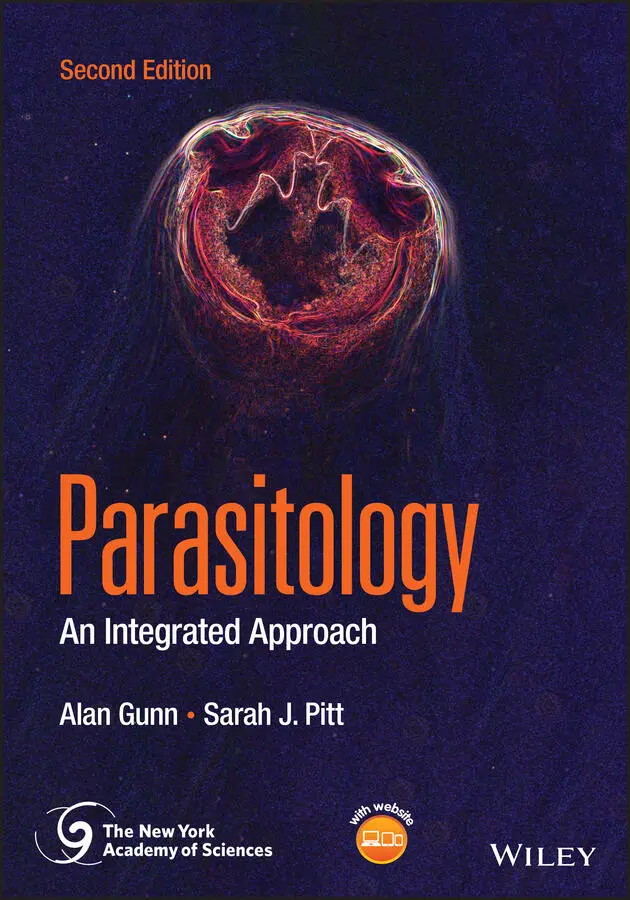
Highly detailed textbook on parasites and parasite relationships Parasitology: An Integrated Approach
Parasitology: An Integrated Approach, 2nd edition
Parasitology — читать онлайн ознакомительный отрывок
Ниже представлен текст книги, разбитый по страницам. Система сохранения места последней прочитанной страницы, позволяет с удобством читать онлайн бесплатно книгу «Parasitology», без необходимости каждый раз заново искать на чём Вы остановились. Поставьте закладку, и сможете в любой момент перейти на страницу, на которой закончили чтение.
Интервал:
Закладка:
1.8 Why Parasitic Diseases Remain a Problem
Whenever a seemingly simple but intractable problem arises, a commonly heard refrain is ‘if we can put a man on the moon, why can’t we do X, Y, or Z’. As we have seen, parasitic diseases cause suffering to us and to our domestic animals, and the economic costs are enormous. Furthermore, many diseases could be controlled by simple measures such as providing safe drinking water and appropriate waste disposal facilities. So, one might ask, why do parasitic diseases continue to afflict so many people and impact so heavily on agriculture?
As with so many apparently simple questions, the reason parasitic diseases remain a problem does not have a single simple answer and is also tied up with the most exasperating factor of all – human behaviour ( Table 1.3). To begin with, human parasitic diseases are predominantly (although not entirely) a problem of poor people who live in insanitary conditions and who do not have a healthy diet. The diseases are therefore most prevalent in developing countries where neither the government nor individual people have money to spare. For example, in 2016 the total healthcare expenditure in Zimbabwe as a percentage of the gross domestic product (GDP) was similar to that of the United Kingdom (9.41% cf 9.76%) and considerably more than that of oil‐rich Saudi Arabia (5.74%) ( https://data.worldbank.org/indicator/SH.XPD.CHEX.GD.ZS). However, in terms of total health expenditure per capita, the United Kingdom spent US$4192, Saudi Arabia US$1147, and Zimbabwe US $94 ( https://knoema.com/atlas/Zimbabwe/Health‐expenditure‐per‐capita). Needless to say, US $94 does not buy many medicines.
Table 1.3 Summary of factors contributing to the problems of parasitic diseases.
| Poverty Lack of sanitation Complacency Poor nutrition Lack of health infrastructure Lack of government interest Corruption Urbanization Social conflict/wars Movement of non‐immune people to regions where they become infected from the resident population. Movement of infected people to regions where they infect non‐immune resident population Man‐made environmental damage Natural disasters Lack of effective drugs/ parasite resistance Increasing resistance of vectors/ intermediate hosts |
We humans are extremely adaptable creatures. Consequently, we can survive harsh environments, oppressive regimes, and cruel exploitation. Unfortunately, this adaptability can degenerate into acceptance and complacency on the parts of both individuals and governments. Because parasitic diseases are so prevalent in developing countries, there is a tendency not to prioritise them: fevers and diarrhoea become an accepted part of everyday life. Furthermore, parasitic diseases tend to cause chronic disease and although the patient may ultimately die, the condition does not capture the attention of the local or world media. For example, Ebola virus is well known in the developed world because of its appalling pathology and images of patients being treated by nurses and doctors dressed in spacesuit‐like protective clothing. However, although Ebola virus causes about 70% mortality, the numbers of people who have died of the infection are relatively few. By comparison, Human African Trypanosomiasis (HAT, often referred to as ‘sleeping sickness’) causes almost 100% mortality if untreated and kills many more people than Ebola ( Table 1.2), but it seldom receives a mention in the media. The reason is simple, HAT kills slowly by comparison. Furthermore, the transmission of HAT depends upon tsetse flies, and these have demanding environmental requirements that limit their distribution. Consequently, HAT is only a threat to people living in certain parts of Africa. By contrast, Ebola spreads through close human contact and therefore the virus could conceivably spread anywhere in the world. Consequently, people in distant countries feel threatened even though their risk is incredibly small. The fact that Ebola virus has been touted as a possible biological warfare agent also helps to engender interest in the disease and funds to study and control it.
In addition to being poor, the countries in which parasitic diseases are most problematic are often unstable and suffer high levels of corruption. Consequently, those in control often devote much of their revenue into the trappings of power and military spending: many developing countries spend less than 4% of their GDP on healthcare. This means that even less of not very much is available for the treatment and control of parasitic diseases. The instability of the regimes and conflicts, which can last for decades makes it difficult to provide health services and co‐ordinate control strategies. They also lead to the destruction of basic infrastructure and the decline in agricultural and commercial activity – and this contributes to poverty and malnutrition. At its worst, conflicts lead to large numbers of refugees who are frequently housed in squalid campsites, which lack proper sanitation. These displaced people are often in poor health and malnourished, they take their parasites with them wherever they go, and they are highly vulnerable to the local strains of parasites at wherever they arrive. For example, the civil wars in the Central Asian states such as Tajikistan, which occurred after the breakup of the Soviet Union in the early 1990s, displaced people to neighbouring countries including Afghanistan. The most common type of malaria in Tajikistan at that time was caused by Plasmodium vivax, whereas in Afghanistan, the more virulent Plasmodium falciparum was found, and drug‐resistant strains were circulating. Some of the refugees who returned home in the late 1990s were infected with drug‐resistant P. falciparum and since there was a suitable mosquito vector, this form of malaria was subsequently transmitted among people who had never left Tajikistan (Pitt et al. 1998). Similarly, at the time of writing, the wars in Syria and Yemen had resulted in an almost complete collapse of their health infrastructure. In both Syria and Yemen, leishmaniasis was becoming a serious problem, and the disease was being transmitted to refugee camps in surrounding countries (Al‐Salem et al. 2016; Du et al. 2016). Syria also saw a rise of almost 100,000 cases of malaria between 2015 and 2016 ( https://www.globalcitizen.org/en/content/malaria‐yemen‐crisis‐increasing‐cases/) whilst in the Yemen, control programmes that aimed to eliminate onchocerciasis and lymphatic filariasis by 2015 foundered with no prospect of them resuming (Abdul‐Ghani 2016).
Natural disasters, such as cyclones and earthquakes, can lead to similar destruction of infrastructure and refugee problems to those of war. Widespread flooding also provides extensive breeding conditions for mosquitoes and thereby increases the spread of mosquito‐borne diseases such as malaria. The destruction of sewage systems and facilities for waste disposal, in conjunction with a warm wet environment, also facilitates the spread of faecal‐oral transmitted protozoa and helminths. It is therefore not surprising that widespread flooding in tropical countries usually results in an increase in malaria and water‐borne diseases (Boyce et al. 2016; Okaka and Odhiambo 2018).
The damage we cause to the environment can encourage the spread of disease by making conditions more suitable for vectors and intermediate hosts and/or the survival of parasite eggs and cysts. For example, clearance of the rainforests in the Amazon produces open sunlit pools that are ideal breeding grounds for the mosquito vector of malaria Anopheles darlingi (Harris et al. 2006). Also, as people move into these clearings to live or work, they come into contact with zoonotic infectious agents that may not be perfectly adapted to living in us but can still cause disease.
Читать дальшеИнтервал:
Закладка:
Похожие книги на «Parasitology»
Представляем Вашему вниманию похожие книги на «Parasitology» списком для выбора. Мы отобрали схожую по названию и смыслу литературу в надежде предоставить читателям больше вариантов отыскать новые, интересные, ещё непрочитанные произведения.











Обсуждение, отзывы о книге «Parasitology» и просто собственные мнения читателей. Оставьте ваши комментарии, напишите, что Вы думаете о произведении, его смысле или главных героях. Укажите что конкретно понравилось, а что нет, и почему Вы так считаете.