Alan Gunn - Parasitology
Здесь есть возможность читать онлайн «Alan Gunn - Parasitology» — ознакомительный отрывок электронной книги совершенно бесплатно, а после прочтения отрывка купить полную версию. В некоторых случаях можно слушать аудио, скачать через торрент в формате fb2 и присутствует краткое содержание. Жанр: unrecognised, на английском языке. Описание произведения, (предисловие) а так же отзывы посетителей доступны на портале библиотеки ЛибКат.
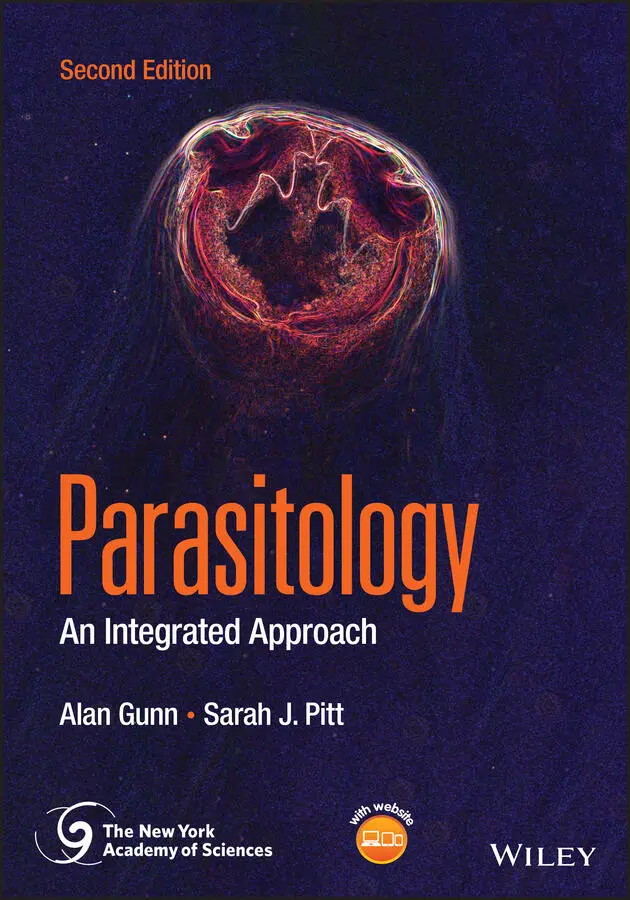
- Название:Parasitology
- Автор:
- Жанр:
- Год:неизвестен
- ISBN:нет данных
- Рейтинг книги:3 / 5. Голосов: 1
-
Избранное:Добавить в избранное
- Отзывы:
-
Ваша оценка:
Parasitology: краткое содержание, описание и аннотация
Предлагаем к чтению аннотацию, описание, краткое содержание или предисловие (зависит от того, что написал сам автор книги «Parasitology»). Если вы не нашли необходимую информацию о книге — напишите в комментариях, мы постараемся отыскать её.
Highly detailed textbook on parasites and parasite relationships Parasitology: An Integrated Approach
Parasitology: An Integrated Approach, 2nd edition
Parasitology — читать онлайн ознакомительный отрывок
Ниже представлен текст книги, разбитый по страницам. Система сохранения места последней прочитанной страницы, позволяет с удобством читать онлайн бесплатно книгу «Parasitology», без необходимости каждый раз заново искать на чём Вы остановились. Поставьте закладку, и сможете в любой момент перейти на страницу, на которой закончили чтение.
Интервал:
Закладка:
The way we live and organise our societies is a major contributor to the spread of parasitic diseases. Throughout the world, there is an increase in urbanization. This means that more people are living close together and the potential for disease transmission between them is therefore high (McMichael 2000). Vector species that can live in an urban environment, such as Anopheles stephensi and certain other mosquitoes, therefore pose a particular risk (Takken and Lindsay 2019).
If a high population density combines with inadequate sanitation, then widespread transmission of contaminative diseases is inevitable. In some slums, over 50 households may share a single toilet. Furthermore, this toilet may be 50 m or more from the dwellings. Consequently, urinating and defecating on the bare ground by both children and adults are common in some of these communities. In a study of slum dwellers in Gujarat (western India), 71% of the participants were infected with parasitic protozoa and 26% with helminth infections (Shobha et al. 2013). Not surprisingly, many claimed to suffer from diarrhoea. Similarly, a study of slum children (1–5 years old) in Karachi (Pakistan) found that the prevalence rate of intestinal parasites was 53 and 10% of the children harboured two or more parasite species (Mehraj et al. 2008). Many of these children suffered from stunted growth.
Sometimes, parasites and their vectors spread by less obvious means. For example, the increased use of cars and motorised transport has resulted in large numbers of used tyres entering the ecosystem. Used tyres retain water after it has rained, and they make excellent breeding grounds for some mosquito species. There is a huge international market in used tyres that are loaded onto lorries and ships and moved within and between countries. In the process, mosquitoes are also moved around the world and notorious vectors of disease such as the Asian tiger mosquito Aedes albopictus are now established in countries such as Spain where they were formerly absent. Aedes albopictus does not transmit parasitic diseases but is an important vector of viruses such as Dengue virus, yellow fever virus, and Zika virus. The adults are not capable of dispersing far by flight, but it has colonized many countries through the transport of its larvae in used tyres. The adult mosquitoes also disperse by unintentionally hitching a ride inside a car or other vehicle (Eritja et al. 2017). It is likely that many other mosquitoes and other vectors disperse in similar fashions. For example, there are several reports of ‘airport malaria’ in which a person contracts the disease from a mosquito that has been carried from one country to another within a plane (Isaäcson and Frean 2001).
Before the COVID‐19 pandemic that began in 2019, people were increasingly mobile and cheap air travel meant that millions of people rapidly moved between countries for leisure and business. In addition, large numbers of people moved long distances as economic migrants and political refugees. The COVID‐19 pandemic brought much of this movement to a sudden halt, and at the time of writing, it was uncertain when and to what extent mass movements will return. Anyone who moves to a new environment becomes exposed to diseases to which they have no previous experience, and hence immunity. They are therefore vulnerable to infection. Similarly, those who are already infected (but may not be aware of the fact) carry their diseases with them and could potentially transmit their infections to a non‐immune population on arrival. Obviously, when many people are moving there are many opportunities for disease transmission. For domestic animals, it is possible to instigate legislation that governs their movement. For example, a passport scheme can ensure that they have received appropriate vaccinations and/or drugs to remove infections. Similarly, a period of quarantine upon arrival at their destination can be imposed. Except in very authoritarian regimes, this is seldom feasible as a long‐term solution for human populations. Although some countries closed their borders and/or imposed strict quarantines on people during the COVID‐19 pandemic, this approach cannot be sustained for any length of time because of the economic consequences. Some countries insist that all persons entering their borders have documentation proving they have received certain vaccinations, such as for yellow fever. However, there are few anti‐parasite vaccines and even where effective prophylactic medicines are available to treat parasites, such as anti‐malarial drugs, it is notoriously difficult to persuade people to take them as prescribed.
Another of the major reasons why parasites remain a problem is the lack of suitable drugs and vaccines to treat them. The development of drugs for use in human medicine takes many years and is extremely expensive. Consequently, the drug companies need to be sure that they will obtain a good rate of return for their investments. See Chapter 14for more information on the treatment of parasitic diseases. Unfortunately, those who suffer most severely from parasitic diseases are usually poor and cannot afford expensive drugs. Similarly, the development of anti‐parasite vaccines is hampered by a combination of cost and the difficulty of generating protective immunity against parasitic infections. These issues are dealt with in detail in Chapter 15.
The control of parasites by targeting their vectors/intermediate hosts is also becoming more problematic. For many years, this approach proved highly effective, and in the 1950s, it was even believed possible that malaria might be eradicated by killing the anopheline mosquito vectors. However, some vectors are exhibiting increasing resistance against a wide range of insecticides and new chemicals are not being developed to replace those in current use. Furthermore, there are mounting concerns for the environmental damage that can result from inappropriate use of insecticides and fears over risks they pose to our health.
2 Taxonomy
CONTENTS
2.1 Introduction
2.2 Viruses: A Special (Unresolved) Case
2.3 Taxonomic Hierarchy
2.3.1 The Binomen System
2.4 Kingdom Protista
2.5 Kingdom Animalia
2.5.1 Parazoa
2.5.2 Eumetazoa
2.1 Introduction
In this chapter, we will provide a very brief introduction to the study of taxonomy. Correct diagnosis is essential for treatment and control of any disease and that requires consensus on the names and terms used in the identification process. Without it, there cannot be effective communication between workers both within and between countries. For example, even within a country, a disease or organism may be known by various common names, and language differences further complicate communication. Therefore, before we begin to consider specific parasites, it is necessary to understand of how the taxonomic system works and its relevance to parasitology.
Those who study the identification of organisms are called taxonomists, and they arrange organisms into a hierarchy of categories to demonstrate their relationship to one another. Phylogeny is the study of the evolutionary relationships between organisms. This is increasingly informed by comparisons of gene sequences in a process called molecular phylogeny in which phylogenetic trees are generated to represent the closeness of relationships.
The Ancient Greek philosopher Heraclitus of Ephesus is accredited with the well‐known saying that ‘All is flux. Nothing stays still’. This is certainly true of taxonomy, and frequent name changes and taxonomic re‐arrangements will be a constant refrain throughout this book. One needs to be aware of these changes in order to compare past reports with those published more recently. For example, an organism might now be known under a different name or what was once described as a single species is now considered to consist of two or more distinct species with different biological characteristics.
Читать дальшеИнтервал:
Закладка:
Похожие книги на «Parasitology»
Представляем Вашему вниманию похожие книги на «Parasitology» списком для выбора. Мы отобрали схожую по названию и смыслу литературу в надежде предоставить читателям больше вариантов отыскать новые, интересные, ещё непрочитанные произведения.










Обсуждение, отзывы о книге «Parasitology» и просто собственные мнения читателей. Оставьте ваши комментарии, напишите, что Вы думаете о произведении, его смысле или главных героях. Укажите что конкретно понравилось, а что нет, и почему Вы так считаете.