Gerald Durrell - The Corfu Trilogy
Здесь есть возможность читать онлайн «Gerald Durrell - The Corfu Trilogy» весь текст электронной книги совершенно бесплатно (целиком полную версию без сокращений). В некоторых случаях можно слушать аудио, скачать через торрент в формате fb2 и присутствует краткое содержание. Год выпуска: 2006, ISBN: 2006, Издательство: Penguin Books, Жанр: Природа и животные, Биографии и Мемуары, на английском языке. Описание произведения, (предисловие) а так же отзывы посетителей доступны на портале библиотеки ЛибКат.
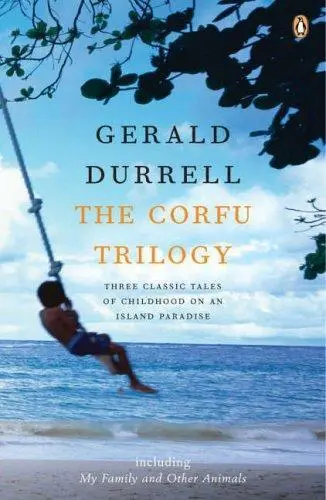
- Название:The Corfu Trilogy
- Автор:
- Издательство:Penguin Books
- Жанр:
- Год:2006
- ISBN:978–0–141–91113–7
- Рейтинг книги:4 / 5. Голосов: 3
-
Избранное:Добавить в избранное
- Отзывы:
-
Ваша оценка:
The Corfu Trilogy: краткое содержание, описание и аннотация
Предлагаем к чтению аннотацию, описание, краткое содержание или предисловие (зависит от того, что написал сам автор книги «The Corfu Trilogy»). Если вы не нашли необходимую информацию о книге — напишите в комментариях, мы постараемся отыскать её.
Durrell dedicated his life to the conservation of wildlife and it is through his efforts that creatures such as the Mauritius pink pigeon and the Mallorcan midwife toad have avoided extinction. Over his lifetime he wrote thirty-seven books, went on dozens of animal-collecting trips and presented numerous tv shows. He founded the Durrell Wildlife Conservation Trust in 1959 as a centre for the conservation of endangered species – of which his wife Lee is still Honorary Director. He was awarded the OBE in 1982.
The Corfu Trilogy
My Family and Other Animals
Birds, Beasts, and Relatives
The Garden of the Gods
The Corfu Trilogy — читать онлайн бесплатно полную книгу (весь текст) целиком
Ниже представлен текст книги, разбитый по страницам. Система сохранения места последней прочитанной страницы, позволяет с удобством читать онлайн бесплатно книгу «The Corfu Trilogy», без необходимости каждый раз заново искать на чём Вы остановились. Поставьте закладку, и сможете в любой момент перейти на страницу, на которой закончили чтение.
Интервал:
Закладка:
‘Ah, um… yes… very curious… it is laticaudata . Could you just… er… hand me a clean test-tube… um… thank you…’
He would suck the minute creature out of the bottle with a fountain-pen filler, enshrine it carefully in the tube, and then examine the rest of the catch.
‘There doesn’t seem to be anything else that’s particularly exciting… Ah, yes, I didn’t notice… there is rather a curious caddis larva… there, d’you see it?… um… it appears to have made its case of the shells of certain molluscs… It’s certainly very pretty.’
At the bottom of the little bottle was an elongated case, half an inch long, constructed out of what appeared to be silk, and thick with tiny flat snail-shells like buttons. From one end of this delightful home the owner peered, an unattractive maggot-like beast with a head like an ant’s. Slowly it crawled across the glass, dragging its beautiful house with it.
‘I tried an interesting experiment once,’ Theodore said. ‘I caught a number of these… er… larvæ, and removed their shells. Naturally it doesn’t hurt them. Then I put them in some jars which contained perfectly clear water and nothing in the way of… er… materials with which to build new cases. Then I gave each set of larvæ different-coloured materials to build with: some I gave very tiny blue and green beads, and some I gave chips of brick, white sand, even some… er… fragments of coloured glass. They all built new cases out of these different things, and I must say the result was very curious and… er… colourful. They are certainly very clever architects .’
He emptied the contents of the bottle back into the pool, put his net over his shoulder, and we walked on our way.
‘Talking of building ,’ Theodore continued, his eyes sparkling, ‘did I tell you what happened to… a… er… a friend of mine? Um, yes. Well, he had a small house in the country, and, as his family… um… increased, he decided that it was not big enough. He decided to add another floor to the house. He was, I think, a little over-confident of his own architectural… um… prowess, and he insisted on designing the new floor himself. Um, ha, yes. Well, everything went well and in next to no time the new floor was ready, complete with bedrooms, bathrooms, and so forth. My friend had a party to celebrate the completion of the work, we all drank toasts to the… um… new piece of building, and with great ceremony the scaffolding was taken down… um… removed. No one noticed anything… um… anything amiss , until a late arrival at the celebration wanted to look round the new rooms. It was then discovered that there was no staircase. It appears that my friend had forgotten to put a staircase in his plans, you know, and during the actual… er… the actual building operations he and the workmen had got so used to climbing to the top floor by means of the scaffolding that no one apparently noticed the… er… the defect .’
So we would walk on through the hot afternoon, pausing by the pools and ditches and stream, wading through the heavily scented myrtle bushes, over the hillsides crisp with heather, along white, dusty roads where we were occasionally passed by a drooping, plodding donkey carrying a sleepy peasant on its back.
Towards evening, our jars, bottles, and tubes full of strange and exciting forms of life, we would turn for home. The sky would be fading to a pale gold as we marched through the olive groves, already dim with shadow, and the air would be cooler and more richly scented. Roger would trot ahead of us, his tongue flapping out, occasionally glancing over his shoulder to make sure we were following him. Theodore and I, hot and dusty and tired, our bulging collecting bags making our shoulders ache pleasantly, would stride along singing a song that Theodore had taught me. It had a rousing tune that gave a new life to tired feet, and Theodore’s baritone voice and my shrill treble would ring out gaily through the gloomy trees:
‘There was an old man who lived in Jerusalem,
Glory Halleluiah, Hi-ero-jerum.
He wore a top hat and he looked very sprucelum,
Glory Halleluiah, Hi-ero-jerum.
Skinermer rinki doodle dum, skinermer rinki doodle dum,
Glory Halleluiah, Hi-ero-jerum…’
10
The Pageant of Fireflies
Spring merged slowly into the long, hot, sun-sharp days of summer sung in by cicadas, shrill and excited, making the island vibrate with their cries. In the fields the maize was starting to fill out, the silken tassels turning from brown to butter-blond; when you tore off the wrapping of leaves and bit into the rows of pearly seeds the juice would spurt into your mouth like milk. On the vines the grapes hung in tiny clusters, freckled and warm. The olives seemed weighed down under the weight of their fruit, smooth drops of green jade among which the choirs of cicadas zithered. In the orange groves, among the dark and shiny leaves, the fruit was starting to glow redly, like a blush spreading up the green, pitted skins.
Up on the hills, among the dark cypress and the heather, shoals of butterflies danced and twisted like wind-blown confetti, pausing now and then on a leaf to lay a salvo of eggs. The grasshoppers and locusts whirred like clockwork under my feet, and flew drunkenly across the heather, their wings shining in the sun. Among the myrtles the mantids moved, lightly, carefully, swaying slightly, the quintessence of evil. They were lank and green, with chinless faces and monstrous globular eyes, frosty gold, with an expression of intense, predatory madness in them. The crooked arms, with their fringes of sharp teeth, would be raised in mock supplication to the insect world, so humble, so fervent, trembling slightly when a butterfly flew too close.
Towards evening, when it grew cooler, the cicadas stopped singing, their place being taken by the green tree-frogs, glued damply to the lemon-tree leaves down by the well. With bulging eyes staring as though hypnotized, their backs as shiny as the leaves they sat amongst, they swelled out their vocal sacs and croaked harshly and with such violence that they seemed in danger of splitting their damp bodies with the effort. When the sun sank there was a brief, apple-green twilight which faded and became mauve, and the air cooled and took on the scents of evening. The toads appeared, putty-coloured with strange, map-like blotches of bottle-green on their skins. They hopped furtively among the long grass clumps in the olive groves, where the crane-flies’ unsteady flight seemed to cover the ground with a drifting curtain of gauze. They sat there blinking, and then would suddenly snap at a passing crane-fly; sitting back, looking a trifle embarrassed, they stuffed the trailing ends of wing and leg into their great mouths with the aid of their thumbs. Above them, on the crumbling walls of the sunken garden, the little black scorpions walked solemnly, hand in hand, among the plump mounds of green moss and the groves of tiny toadstools.
The sea was smooth, warm and as dark as black velvet, not a ripple disturbing the surface. The distant coastline of Albania was dimly outlined by a faint reddish glow in the sky. Gradually, minute by minute, this glow deepened and grew brighter, spreading across the sky. Then suddenly the moon, enormous, wine-red, edged herself over the fretted battlement of mountains, and threw a straight, blood-red path across the dark sea. The owls appeared now, drifting from tree to tree as silently as flakes of soot, hooting in astonishment as the moon rose higher and higher, turning to pink, then gold, and finally riding in a nest of stars, like a silver bubble.
With the summer came Peter to tutor me, a tall, handsome young man, fresh from Oxford, with decided ideas on education which I found rather trying to begin with. But gradually the atmosphere of the island worked its way insidiously under his skin, and he relaxed and became quite human. At first the lessons were painful to an extreme: interminable wrestling with fractions and percentages, geological strata and warm currents, nouns, verbs, and adverbs. But, as the sunshine worked its magic on Peter, the fractions and percentages no longer seemed to him an overwhelmingly important part of life and they were gradually pushed more and more into the background; he discovered that the intricacies of geological strata and the effects of warm currents could be explained much more easily while swimming along the coast, while the simplest way of teaching me English was to allow me to write something each day which he would correct. He had suggested a diary, but I was against this, pointing out that I already kept one on nature, in which was recorded everything of interest that happened each day. If I were to keep another diary, what was I to put in it? Peter could find no answer to this argument. I suggested that I might try something a little more ambitious and interesting than a diary. Diffidently, I suggested I write a book, and Peter, somewhat startled, but not being able to think of any reason why I should not write a book, agreed. So every morning I spent a happy hour or so adding another chapter to my epic, a stirring tale which involved a voyage round the world with the family, during which we captured every conceivable kind of fauna in the most unlikely traps. I modelled my style on the Boy’s Own Paper , and so each chapter ended on a thrilling note, with Mother being attacked by a jaguar, or Larry struggling in the coils of an enormous python. Sometimes these climaxes were so complicated and fraught with danger that I had great difficulty in extricating the family intact on the following day. While I was at work on my masterpiece, breathing heavily, tongue protruding, breaking off for discussions with Roger on the finer points of the plot, Peter and Margo would take a stroll in the sunken garden to look at the flowers. To my surprise, they had both suddenly become very botanically minded. In this way the mornings passed very pleasantly for all concerned. Occasionally, in the early days, Peter suffered from sudden spasms of conscience, my epic would be relegated to a drawer, and we would pore over mathematical problems. But as the summer days grew longer, and Margo’s interest in gardening became more sustained, these irritating periods became less frequent.
Читать дальшеИнтервал:
Закладка:
Похожие книги на «The Corfu Trilogy»
Представляем Вашему вниманию похожие книги на «The Corfu Trilogy» списком для выбора. Мы отобрали схожую по названию и смыслу литературу в надежде предоставить читателям больше вариантов отыскать новые, интересные, ещё непрочитанные произведения.


Обсуждение, отзывы о книге «The Corfu Trilogy» и просто собственные мнения читателей. Оставьте ваши комментарии, напишите, что Вы думаете о произведении, его смысле или главных героях. Укажите что конкретно понравилось, а что нет, и почему Вы так считаете.