Mark Jacobson - The Lampshade
Здесь есть возможность читать онлайн «Mark Jacobson - The Lampshade» весь текст электронной книги совершенно бесплатно (целиком полную версию без сокращений). В некоторых случаях можно слушать аудио, скачать через торрент в формате fb2 и присутствует краткое содержание. Город: New York, Год выпуска: 2010, ISBN: 2010, Издательство: Simon and Schuster, Жанр: История, на английском языке. Описание произведения, (предисловие) а так же отзывы посетителей доступны на портале библиотеки ЛибКат.
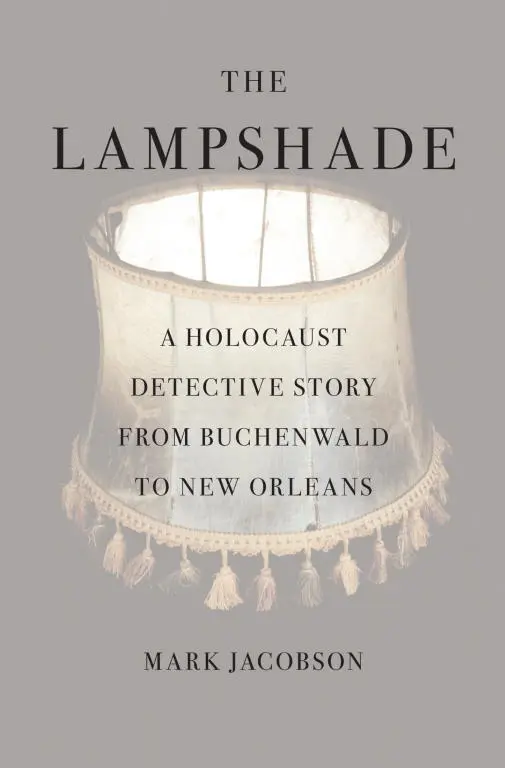
- Название:The Lampshade
- Автор:
- Издательство:Simon and Schuster
- Жанр:
- Год:2010
- Город:New York
- ISBN:978-1-4165-6627-4
- Рейтинг книги:4 / 5. Голосов: 1
-
Избранное:Добавить в избранное
- Отзывы:
-
Ваша оценка:
The Lampshade: краткое содержание, описание и аннотация
Предлагаем к чтению аннотацию, описание, краткое содержание или предисловие (зависит от того, что написал сам автор книги «The Lampshade»). Если вы не нашли необходимую информацию о книге — напишите в комментариях, мы постараемся отыскать её.
, bestselling journalist Mark Jacobson tells the story of how he came into possession of one of these awful objects, and of his search to establish the origin, and larger meaning, of what can only be described as an icon of terror.
Jacobson’s mind-bending historical, moral, and philosophical journey into the recent past and his own soul begins in Hurricane Katrina–ravaged New Orleans. It is only months after the storm, with America’s most romantic city still in tatters, when Skip Henderson, an old friend of Jacobson’s, purchases an item at a rummage sale: a very strange looking and oddly textured lampshade. When he asks what it’s made of, the seller, a man covered with jailhouse tattoos, replies, “That’s made from the skin of Jews.” The price: $35. A few days later, Henderson sends the lampshade to Jacobson, saying, “You’re the journalist, you find out what it is.” The lampshade couldn’t possibly be real, could it? But it is. DNA analysis proves it.
This revelation sends Jacobson halfway around the world, to Yad Vashem in Jerusalem and to the Buchenwald concentration camp in Germany, where the lampshades were supposedly made on the order of the infamous “Bitch of Buchenwald,” Ilse Koch. From the time he grew up in Queens, New York, in the 1950s, Jacobson has heard stories about the human skin lampshade and knew it to be the ultimate symbol of Nazi cruelty. Now he has one of these things in his house with a DNA report to prove it, and almost everything he finds out about it is contradictory, mysterious, shot through with legend and specious information.
Through interviews with forensic experts, famous Holocaust scholars (and deniers), Buchenwald survivors and liberators, and New Orleans thieves and cops, Jacobson gradually comes to see the lampshade as a ghostly illuminator of his own existential status as a Jew, and to understand exactly what that means in the context of human responsibility.
One question looms as his search goes on: what to do with the lampshade—this unsettling thing that used to be someone? It is a difficult dilemma to be sure, but far from the last one, since once a lampshade of human skin enters your life, it is very, very hard to forget.
The Lampshade — читать онлайн бесплатно полную книгу (весь текст) целиком
Ниже представлен текст книги, разбитый по страницам. Система сохранения места последней прочитанной страницы, позволяет с удобством читать онлайн бесплатно книгу «The Lampshade», без необходимости каждый раз заново искать на чём Вы остановились. Поставьте закладку, и сможете в любой момент перейти на страницу, на которой закончили чтение.
Интервал:
Закладка:
Sitting on the edge of the bed in my hotel room, Domb examined the lampshade with a wary confidence, then turned his attention to the Bode DNA report. He’d heard of the lab and knew they had done “good work” in the aftermath of 9/11. Still, it was possible to miss things. Perhaps “this lampshade has more to tell us about itself. Let’s see if we can make it talk,” he said.
“Give me a few days,” Domb said. I wasn’t in a rush to leave Jerusalem, was I?
No, I told Avi Domb: no rush.
The truth was, Jerusalem was giving me the heebie-jeebies. It had been going on for weeks, long before my arrival. The sensation began as a low-timbre but unmistakable uneasiness, a dull buzz, and slowly swelled to a borderline anxiety fit. It made no sense. After all, I’d been to Jerusalem before. I’d walked those ancient, narrow streets, been to the Western Wall, counted the Stations of the Cross, visited the Dome of the Rock. I knew the history, the six thousand years of possession and loss, during which the Holy City had been ruled, conquered, or occupied by Jebusites, Israelite kings, Arabs, Babylonians, Hittites, Persians, Philistines, Seleucids, Romans, Byzantines, Mamluks, Crusaders, Ottomans, and Brits, to say nothing of Alexander the Great and the Frankish Crusaders. The place was a power spot, all right; whatever was here, people wanted more of it. They never got enough. The array of belief, sublimation, and desire was all crammed together in a few thousand square yards.
The last time I was in the Holy City, in 1999, on the eve of the new millennium, local officials expected a large outbreak of the so-called Jerusalem syndrome, defined by doctors from the Kfar Shaul Mental Health Center in a paper published by the British Journal of Psychiatry as “a psychotic decompensation… related to religious excitement induced by proximity to the holy places of Jerusalem.” From 1980 to 1993 more than twelve hundred people had been referred to Kfar Shaul for what were described as “severe, Jerusalem-generated mental problems.” The symptoms fell into three basic types, the report explained: 1) Jerusalem syndrome superimposed on previous psychotic illness; 2) Jerusalem syndrome superimposed on and complicated by idiosyncratic ideations—such as when already religious people undergo sudden and radical conversions to other creeds; and 3) Jerusalem syndrome in a discrete form, uncomplicated by previous psychopathology. Considered to be “perhaps the most fascinating” by the report writers, this final category described people who “fall victim to a psychotic episode” while in Jerusalem, including “the need to scream, shout, or sing out loud psalms, verses from the Bible, or deliver a sermon in a holy place.”
Given this data, it made sense that in late 1999, with incessant chatter of Y2K, there would be a serious outbreak of the syndrome. However, despite the increased number of people converging on the Holy City at the eve of the new millennium, the Kfar Shaul Center reported no appreciable rise in the number of Jerusalem syndrome cases. As one doctor told me then, “The calendar, which is made by men, says one thing, but Jerusalem keeps a time of its own.”
With the comparatively quiet state of Palestinian-Israeli relations in 1999, it was no problem for the visitor to enter the Dome of the Rock on the Temple Mount, the spot from which Muhammad is said to have risen to heaven, or even walk among the faithful inside the massive Al-Aqsa Mosque. Crowds were everywhere, but after midnight, with the metal shutters of the candy and T-shirt merchants drawn, you could hear the sound of your footsteps on the ancient stones. Above, the stars were still there, fixed in the sky just as they were when King David viewed them nearly three millennia before.
A decade later, however, following Ariel Sharon’s famously provocative visit to the Temple Mount in 2000 that helped spark the Second Intifada, 9/11, worldwide terror attacks, wars between Western and Muslim nations, Hamas in Gaza, the collapse of the “peace process”—the list goes on—Jerusalem seemed a far more forbidding place. In the Old City, pairs of IDF soldiers, rifles at the ready, patrolled the Beit Habad Road inside the Damascus Gate. The Islamic sites were off-limits; the Al-Aqsa, built in 705 CE, was no longer considered by many in the city a religious building but regarded as the headquarters of the Martyrs Brigade.
The Jerusalem syndrome was now pandemic. On Friday night, at the Western Wall, the young men davened, paises flying, black hats a blur. A Lubavitcher man had his cell phone pressed to the wall; over the phone speaker you could hear several voices, as many as a small congregation, praying. The people on the other side of the line could have been anywhere, as far off as Australia or Paraguay: like the Jesuits, the Chabad, the Lubavitch outreach project, was all over the globe now. But via satellite phone, their voices, the force of their devotion, coalesced in this spot.
The modern city was no more serene. All over were half-finished construction projects, stalled in the economic turndown. Buses were shrink-wrapped with the dour countenance of Arcadi Gaydamak, the self-made Russian oligarch who was running for mayor of Jerusalem. Best known for his alleged role in a gun-smuggling scandal in Angola, Gaydamak was spending millions. He barely spoke Hebrew, hence his campaign slogan, “He doesn’t talk, he acts.” When the buses covered with his ubiquitous ads sideswiped cars, as they often did, enraged drivers screamed they’d been “Gaydamaked.” Even the weather was out of whack. One morning it snowed, not all that much, but it was only October.
“Chaotic times produce chaos,” said Farid Abu Gosh, as we drove past the last checkpoint out of the city. Chairperson of the Trust of Programs for Early Childhood, Family and Community Education, Farid, a neatly attired man of sixty with an urbane, friendly manner who has been involved in “the social aid business” for going on three decades, had offered to give me “a short tour” of the West Bank.
I met Farid at the American Colony Hotel, the still elegant outpost in eastern Jerusalem. He had a “sentimental attachment” to the place, Farid said. “I used to come here when I was young, hopeful, and had some hair on my head… I could not afford it then and I cannot afford it now, but it brings back memories.” The Trust works almost exclusively with West Bank Palestinians attempting to deal with rampant problems such as abuse of women and violence in schools, but Farid has always identified himself as “an Israeli Arab,” an accurate description of his status as an Israeli citizen of Arab descent. He was born in 1949 near Abu Ghosh, the only Arabic-speaking town in the so-called Jerusalem Corridor, the disputed stretch between the coast and the Holy City, to remain neutral during the 1948 war. It is for that reason, most say, Abu Ghosh, where King David is said to have once abandoned the Ark of the Covenant, was not attacked by Jewish forces during the Israeli independence war and still exists today while surrounding Arab towns have long disappeared.
“Neutrality in the cause of survival is not to be underestimated,” Farid said of his namesake hometown with the weary ease of a character in a Sidney Greenstreet film. “But it can be difficult to maintain, harder every day.”
Fox News likely wouldn’t refer to Farid’s West Bank tour commentary as “fair and balanced,” but the sights spoke for themselves. There were so many places like this, favelas in Rio, the slums of Mumbai, Central City in New Orleans—ramshackle pits of misery so close to yet so far from centers of great wealth. The West Bank, or at least the parts Farid chose to show me—the battered, unmaintained dirt roads, the abandoned buildings in Ramallah, the piles of garbage picked through by children and old men—was a derelict society, living on the margin. The new Jewish “settler” communities that continued to be built with their freshly paved blacktops and gated access only made the contrast more extreme.
Читать дальшеИнтервал:
Закладка:
Похожие книги на «The Lampshade»
Представляем Вашему вниманию похожие книги на «The Lampshade» списком для выбора. Мы отобрали схожую по названию и смыслу литературу в надежде предоставить читателям больше вариантов отыскать новые, интересные, ещё непрочитанные произведения.





Обсуждение, отзывы о книге «The Lampshade» и просто собственные мнения читателей. Оставьте ваши комментарии, напишите, что Вы думаете о произведении, его смысле или главных героях. Укажите что конкретно понравилось, а что нет, и почему Вы так считаете.