Lev Rosen - Depth
Здесь есть возможность читать онлайн «Lev Rosen - Depth» весь текст электронной книги совершенно бесплатно (целиком полную версию без сокращений). В некоторых случаях можно слушать аудио, скачать через торрент в формате fb2 и присутствует краткое содержание. Город: New York, Год выпуска: 2015, ISBN: 2015, Издательство: Regan Arts., Жанр: sf_postapocalyptic, Детективная фантастика, на английском языке. Описание произведения, (предисловие) а так же отзывы посетителей доступны на портале библиотеки ЛибКат.
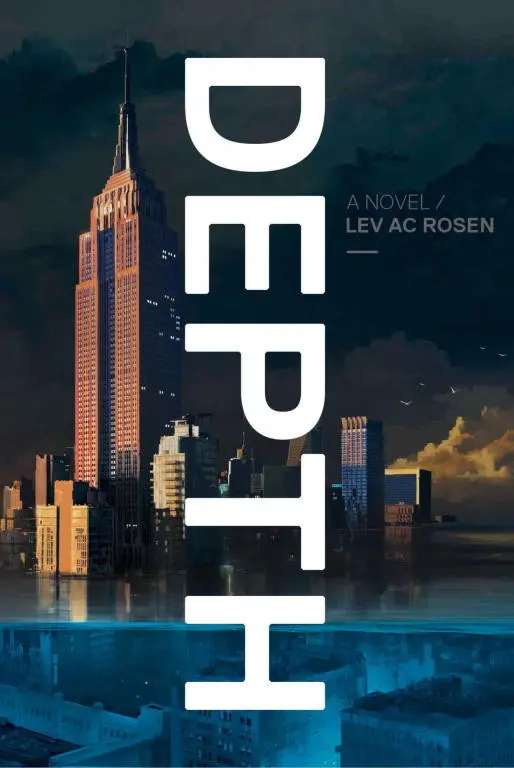
- Название:Depth
- Автор:
- Издательство:Regan Arts.
- Жанр:
- Год:2015
- Город:New York
- ISBN:978-1-941393-07-9
- Рейтинг книги:3 / 5. Голосов: 1
-
Избранное:Добавить в избранное
- Отзывы:
-
Ваша оценка:
Depth: краткое содержание, описание и аннотация
Предлагаем к чтению аннотацию, описание, краткое содержание или предисловие (зависит от того, что написал сам автор книги «Depth»). Если вы не нашли необходимую информацию о книге — напишите в комментариях, мы постараемся отыскать её.
(Tor, 2011), which was an
, on over a dozen best of the year lists, and has been nominated for multiple awards.
described it as “mixing genres with fearless panache.” His work has been featured in Esopus Magazine and on various blogs including Tor.com. He lives in Manhattan. Review
About the Author “Heinlein meets Hammett in this whip-smart whodunnit set amid the billowing fog and rising waters of a future New York.”
(Chuck Greaves, award-winning author of
) “I have long admired Lev Rosen's strange, genre-bending work—his riff on the detective story is elegant, surprising, and, yes, deep.”
(Dan Chaon, National Book Award finalist, author of
)
Depth — читать онлайн бесплатно полную книгу (весь текст) целиком
Ниже представлен текст книги, разбитый по страницам. Система сохранения места последней прочитанной страницы, позволяет с удобством читать онлайн бесплатно книгу «Depth», без необходимости каждый раз заново искать на чём Вы остановились. Поставьте закладку, и сможете в любой момент перейти на страницу, на которой закончили чтение.
Интервал:
Закладка:
“Hey, soldier,” he said when he picked up. He said it with a creak in his voice that she recognized, the way he talked as he was sitting up in bed and stretching, like he had after sex, asking her if she wanted something to drink. Then he’d walk to his kitchen naked and bring back a few beers. They’d lay in bed and drink, the sweat from the bottles slowly dripping down their arms and onto their bodies.
“Hi,” Simone said, realizing she’d let the pause linger.
“You called me.” He was smiling; she could tell.
“Did I wake you?”
“Don’t worry about it. I had to work late, I was just grabbing a few hours where I could.”
“If you need to sleep, I can call back—”
“What’s wrong, Simone?”
“Can you…” she trailed off. “Can you meet me at the battlefield? I don’t want to talk about this over the phone.”
“Yeah, I’ll be there in ten minutes.” She could hear him moving, putting on clothes.
“Thanks.” She hung up before he could reply. She turned around again and leaned back on the desk, taking a long look at the body. She memorized the way the body fell, one arm over the back of the chair, head leaning. Natural, but not. Just the wrong side of alive. She stared at the burns again, circles of different sizes, like a map of the solar system, and the lines of dried blood like empty riverbeds. Then she tightened her coat around her, turned out the lights, and left, locking the door behind her.
Outside, it was colder than it had been when she’d gone inside. How long had she been staring at the body? It hadn’t felt long, but it must have been an hour, at least. The night was brittle, and the fog rose up like steel walls.
She went over suspects who would put the body in her office. This wasn’t about someone trying to frame her; it wasn’t calculated enough for that. It was a warning. Whoever had done this was telling her they were willing to kill—and worse—for the painting, and leaving Linnea in her office meant, “find the painting, or you’re next.” But find it for whom?
Simone sighed as she realized who had done this. No one else made sense; it had to be him. Charming Dash Ormond. Linnea was just another of those dead bodies that always seemed to end his cases. But Simone didn’t know who’d hired him. She could call and ask, but Dash would just deny the whole thing. And there wouldn’t be a shred of evidence on the body pointing to him, either. Cold, beautiful Dash would be clean about it. He must have been cleaning off the blood when he went to “wash up” during her visit. She must have really scared him, waiting like that when he’d just gotten back from leaving a body in her office. She wouldn’t be sending him any more drinks at the bar, she thought. Maybe she’d send him a bottle of something wherever he ended up, though.
She got to the battlefield first. It wasn’t too far from the office. It wasn’t really a battlefield, either. That was just what Simone and Peter had called the Douglass Farm Building as kids, when they played with their army figures, laying out strategies and maps for taking over hostile territory. The corn was usually the hostile territory. They attacked from the potatoes.
There were a lot of farms around the city. Most produce was grown in the ocean as algae before being turned into paste for 3D printers, or in the crystal floating houses that bobbed on light plastic, hovering on the waves, built for this environment. But there were a couple of farm boats and a few dozen farm buildings. Not all buildings broke the water’s surface at the twenty-first floor. That was just a generalization. New York had had an upward slope once. The Douglass Farm was a building that, because of the height of the floors, had a partially submerged top story—a foot or two of water at the bottom and nothing to stand on above. No one had known exactly what to do with buildings like this—rooftops on the ocean, with nothing livable beneath them. Then someone got the bright idea to open up the rooftop, leaving the rest of the building in place. They coated the inside with thick, insulating layers of desalination filters, and then covered the rest up with soil: a seaside farm with constant freshwater underneath, and if the waves started looking high, just put up a big tent for a while. The vegetables grown on them always tasted saltier and windier, somehow, but they were cheap compared to the stuff from the mainland or other countries.
The farms were strangely beautiful, too. The desalination filters—so many of them together—resulted in the walls of the buildings being crusted over in salt, making them look like the tip of an iceberg sticking out of the sea, leveled into a plateau and patterned in rows of plants. When she was little and they’d scaled the fences to sneak in, like she did now, Simone had thought it something from a fairy tale. Tonight it looked like a mountain of bone. Beyond the fence, the farm was still laid out as it had been back then. She headed for the borderline, where the potatoes met the corn, and squatted down to touch the dirt. Then she stood, lit a cigarette, and waited.
Peter showed up when the cigarette was half gone, eleven minutes after they’d hung up, even though he lived much farther away.
“Hey,” he said, when he was still far enough away to just be a shadow in the fog.
“Hey,” she said back. He came closer. He was wearing a plaid shirt, open more than he would normally wear it. She stared at the gap in the fabric where his skin and chest hair showed through. He glanced down at where she was looking and buttoned the extra button. She took another drag on her cigarette.
“What did you want to meet about?” She looked up into his eyes. “You sounded upset.”
“There’s a dead body in my office,” she said. He narrowed his eyes. “I didn’t put it there.”
“I didn’t say you did,” he said, taking a step back.
“I just didn’t want you to have to ask. It’s Linnea St. Michel. She’s been beat up pretty bad. Cuts, burns… someone wanted something from her.”
“And then they left her for you?” Simone shrugged. “Kluren isn’t going to like this. That’s why you called me, right? To report it. You didn’t want me to… help you hide it, did you? Pitch her in the water?”
“No,” Simone said. “She deserves better than that. But Kluren is going to lock me up as soon as she sees the body.”
“Yeah, but you’ll get out. Caroline can help with that.”
“The body is a warning. Someone wants me to…” She turned around. She didn’t know how much Peter knew.
“You kept digging, didn’t you?”
Simone took a long drag on the cigarette. She could vaguely feel him stepping closer, a faint heat on her shoulders. “Yeah.”
“So who is the body a warning from?”
“Don’t know. I mean, I know the delivery man, but not the guy who sent it.”
“Who’s the delivery man?”
“You’re not going to find him, and if you do, he’s going to be cleaner than a bar of soap.”
“So you’re not going to tell me.”
“It’ll make things more complicated if he thinks cops are sniffing around him.”
“You’re going to have to tell Kluren something.”
“I’ll tell her the body was there when I came in. I don’t need to tell her my guess as to who put it there.” Peter was silent at that, but she heard him kicking the dirt behind her. She turned around and found him closer than she’d thought, almost face to face, except that he was looking down at the ground. She reached a hand out, half the distance between then, but then pulled it back. When he looked up, she focused on his eyes, and how they seemed almost colorless in the dark.
“Okay, soldier. Show me this body.”
HER OFFICE WAS A forensic circus within twenty minutes. Peter had walked back with her, both of them silent. When she unlocked the door and opened it for him, he didn’t say anything but laid a hand on her shoulder and tapped his earpiece. His hand stayed there, almost locking her in place as he talked to other officers on duty. The forensic team showed up with two uniforms who spoke directly to Peter, ignoring Simone, except to occasionally glare at her, as though the dead body was her fault. They took the place over pretty quickly, dusting and shining lights and examining the body while Peter and Simone waited in the hallway outside.
Читать дальшеИнтервал:
Закладка:
Похожие книги на «Depth»
Представляем Вашему вниманию похожие книги на «Depth» списком для выбора. Мы отобрали схожую по названию и смыслу литературу в надежде предоставить читателям больше вариантов отыскать новые, интересные, ещё непрочитанные произведения.












Обсуждение, отзывы о книге «Depth» и просто собственные мнения читателей. Оставьте ваши комментарии, напишите, что Вы думаете о произведении, его смысле или главных героях. Укажите что конкретно понравилось, а что нет, и почему Вы так считаете.