Lev Rosen - Depth
Здесь есть возможность читать онлайн «Lev Rosen - Depth» весь текст электронной книги совершенно бесплатно (целиком полную версию без сокращений). В некоторых случаях можно слушать аудио, скачать через торрент в формате fb2 и присутствует краткое содержание. Город: New York, Год выпуска: 2015, ISBN: 2015, Издательство: Regan Arts., Жанр: sf_postapocalyptic, Детективная фантастика, на английском языке. Описание произведения, (предисловие) а так же отзывы посетителей доступны на портале библиотеки ЛибКат.
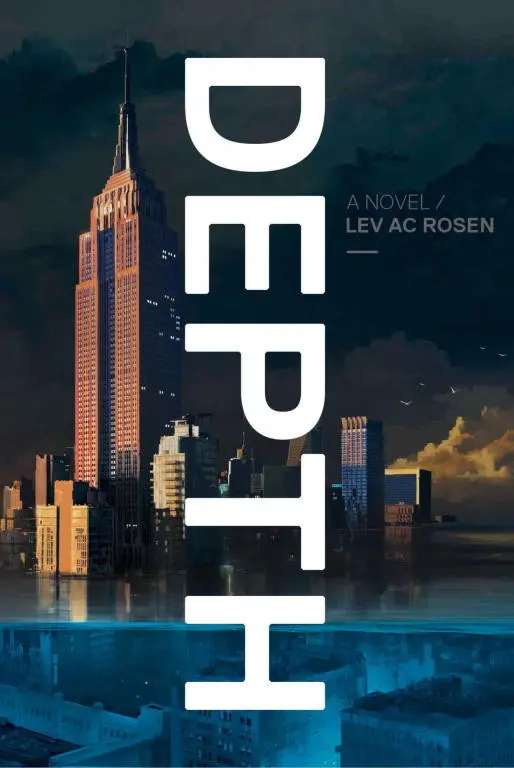
- Название:Depth
- Автор:
- Издательство:Regan Arts.
- Жанр:
- Год:2015
- Город:New York
- ISBN:978-1-941393-07-9
- Рейтинг книги:3 / 5. Голосов: 1
-
Избранное:Добавить в избранное
- Отзывы:
-
Ваша оценка:
Depth: краткое содержание, описание и аннотация
Предлагаем к чтению аннотацию, описание, краткое содержание или предисловие (зависит от того, что написал сам автор книги «Depth»). Если вы не нашли необходимую информацию о книге — напишите в комментариях, мы постараемся отыскать её.
(Tor, 2011), which was an
, on over a dozen best of the year lists, and has been nominated for multiple awards.
described it as “mixing genres with fearless panache.” His work has been featured in Esopus Magazine and on various blogs including Tor.com. He lives in Manhattan. Review
About the Author “Heinlein meets Hammett in this whip-smart whodunnit set amid the billowing fog and rising waters of a future New York.”
(Chuck Greaves, award-winning author of
) “I have long admired Lev Rosen's strange, genre-bending work—his riff on the detective story is elegant, surprising, and, yes, deep.”
(Dan Chaon, National Book Award finalist, author of
)
Depth — читать онлайн бесплатно полную книгу (весь текст) целиком
Ниже представлен текст книги, разбитый по страницам. Система сохранения места последней прочитанной страницы, позволяет с удобством читать онлайн бесплатно книгу «Depth», без необходимости каждый раз заново искать на чём Вы остановились. Поставьте закладку, и сможете в любой момент перейти на страницу, на которой закончили чтение.
Интервал:
Закладка:
“Oooh,” Marina said, smiling. “Very good. I’m impressed, really. Keeping tabs on your clients like that. Does he know?” Simone kept staring. “Well, as the painting still hasn’t surfaced, I’m still taking bids on it. Pastor Sorenson here has outbid every competitor so far, but if I can get a higher number out of him, well, he won’t blame me for trying. I work on a retainer and a percentage, after all.”
“You can see why I’m anxious to get the paintin’,” Sorenson said. “With Ms. Beck here handling the sale, the price just keeps goin’ up.”
“You haven’t answered my question. Why deCostas? He’s just a student.”
“With some serious investors. When I was finding out about you, I found out about him. He seemed like a potential buyer, so I approached him.”
“He didn’t mind, after you’d pointed a gun at him?”
“Said having the gun pointed at him was the second most exciting thing he’s done since he got here.” Marina paused to let her statement sink in. Her smile was cool as a bullet. “But he couldn’t afford it.”
Simone crossed her arms.
“We just want to know where Linnea is,” Sorenson. “So I can get my paintin’.”
“The thing I don’t get,” Simone said, pausing, considering how much to pretend to know, “is what the fuss over this painting is. Reinel shouldn’t sell for more than ten grand, tops. I imagine you’re paying quite a bit more, Pastor?” Sorenson straightened his back and nodded after a moment.
“You don’t know, then,” Marina said, getting off the desk. “Well, I guess that’s the thing we’ve kept the most secret. It’s a Reinel, sure. But it’s not about the art. You know what he did, right, in his paintings?”
“Maps and photos sprayed with Privilux, yeah.”
“Right. This particular piece is a portrait of a couple, one of the last Reinel did before he got into the whole coral thing.” She waved her hand, as if discounting his entire body of work—Circe included. For a moment, Simone wanted to slap her. “The waters were just rising. People were still thinking it wasn’t going to be a big deal—just lay down those floating plastic platforms, and the city would be fine. But the couple isn’t important. The trucks are. In the background.” She took a step forward and Simone raised an eyebrow. “Big trucks,” Marina continued, “marked with the C-Rail Corporation’s logo. It’s an ugly logo; all yellow and blue. You know it?” Simone shook her head, and Marina looked disappointed in her. “Anyway, there are C-Rail trucks, and they’re unloading huge parts of… a tunnel, I guess, or a tube—a big one; large enough for a train to drive through. And they’re unloading them into a building.”
“Seriously?” Simone asked, closing her eyes.
“And,” Marina continued, though she didn’t need to, “the location of the building is marked on the map part of the painting.” Marina stared at Simone. “One would need to compare it to old maps and do some research, of course. But you could figure out where the painting was painted.” Simone held her breath, then expelled it. She was disappointed in them right now, in the entire city. It felt like she was tied to a pole with rough rope while around her everyone jumped into the water and drowned, while she screamed at them to stop. Instead, she forced herself to smile.
“I can’t—” She pinched the bridge of her nose, trying to hold back her anger. This was the only theory she’d actually had, but she’d dismissed it as too absurd. And here it was, alive in front of her. “A pipeline? You think this painting shows the location of a pipeline between here and the mainland—a magical, waterproof one that would stand up to any pressure?” Simone relaxed and looked up, made herself chuckle. Marina chuckled with her, which answered that question—Marina didn’t believe, but she had no problem selling fantasies. Sorenson did not look amused.
“It’s real,” Sorenson said forcefully. “Or one of them is. The government tunnel was never finished—they didn’t have the budget, they were too busy airliftin’ monuments from DC to Salt Lake City. But private corporations—several of them—all tried to take advantage of New York’s soon-to-be offshore status. Private companies funded by millionaires and defense contractors, like C-Rail. I’ve seen the records: These tunnels were all built, or at least started. But the waters rose faster than they thought. None of the tunnels were made really ready. But some are just waitin’ under the waves. Almost ready. And the American government ain’t the only one lookin’.” Sorenson took this moment to gesture fiercely at his chest with one hand, as though he were being martyred. “There are more unsavory sorts who would love to get their hands on a passage like that, finish it up, use it for the black market. That Mr. Ryan for one. Can you imagine? Or this deCostas fellow, making it an EU property? Or even the Khans—then it would be a private, family-owned tunnel. You may be friends with Caroline, but do you know her parents?” Simone shrugged. She’d shaken their hands once or twice. Sorenson furrowed his eyebrows. “Vicious, greedy, power-hungry. And others that are worse. We all know each other, and we’re all lookin’ for a workin’ tunnel. There were over a dozen started. I think at least one of them is in near-workin’ condition. We could finish it and connect the drowned city to the mainland. No more day trips to the Appalachian Islands, hopin’ your ship doesn’t snag on a building, and then another day by maglev train to the mainland proper. No more rickety planes that can’t hold cargo. No more storms makin’ shipping unsafe and a bad investment. The mainland could extend its reach—we could get building supplies out here within days. Extra military could be sent to control a crisis and not get here a week too late. We could set up more missionaries, rebuild the city, make it part of the mainland. Think of how good that would be for the city.”
Simone pursed her lips. She and Sorenson had very different ideas of what “good for the city” meant. She didn’t want New York to become like the mainland, with its decency laws and dress codes. And if they were easily connected, that’s exactly what would happen.
“I don’t know if it’s real or not,” Marina said, sounding bored. “But that’s what the painting shows. So if it is real, I could understand its value. We can’t use traditional imaging techniques to just map the ocean floor around the city. Too much debris—cameras, sensors, and even echo-devices all get clogged and useless within moments. But a map? A map is easy.”
Simone shook her head, looking down.
“Someone killed Henry for a fairy tale,” she said.
“Not a fairy tale,” Marina said. “A dream. People are always killing for dreams.”
“Linnea killed Henry,” Sorenson said. “She double-crossed him so she wouldn’t have to split the money.”
“Everyone keeps telling me that,” Simone said.
“You don’t believe it?” Sorenson asked. Simone shrugged.
“Lot of people want this painting, like you said. Even more than I knew about, it sounds like. Why haven’t people been searching for it before now?”
“No one knew it existed,” Marina said, rolling her eyes. “Reinel gave the painting to the couple he painted. That was what he always did. Usually they sold it, or their kids did, but this one was never in a museum. It was in someone’s home, for decades. They probably didn’t realize what they had.” She looked down, splayed out her hand, and glanced over her nails. “You think Henry had the painting and it was stolen. But I don’t think so. It’s not a small painting.”
“He didn’t have it with him,” Simone said. “But maybe a key.”
Читать дальшеИнтервал:
Закладка:
Похожие книги на «Depth»
Представляем Вашему вниманию похожие книги на «Depth» списком для выбора. Мы отобрали схожую по названию и смыслу литературу в надежде предоставить читателям больше вариантов отыскать новые, интересные, ещё непрочитанные произведения.











Обсуждение, отзывы о книге «Depth» и просто собственные мнения читателей. Оставьте ваши комментарии, напишите, что Вы думаете о произведении, его смысле или главных героях. Укажите что конкретно понравилось, а что нет, и почему Вы так считаете.