Дэн Симмонс - The Fall of Hyperion
Здесь есть возможность читать онлайн «Р”СЌРЅ РЎРёРјРјРѕРЅСЃ - The Fall of Hyperion» весь текст электронной книги совершенно бесплатно (целиком полную версию без сокращений). В некоторых случаях можно слушать аудио, скачать через торрент в формате fb2 и присутствует краткое содержание. Город: London, Год выпуска: 2006, ISBN: 2006, Издательство: Orion Publishing Group, Жанр: Эпическая фантастика, Космическая фантастика, на английском языке. Описание произведения, (предисловие) а так же отзывы посетителей доступны на портале библиотеки ЛибКат.
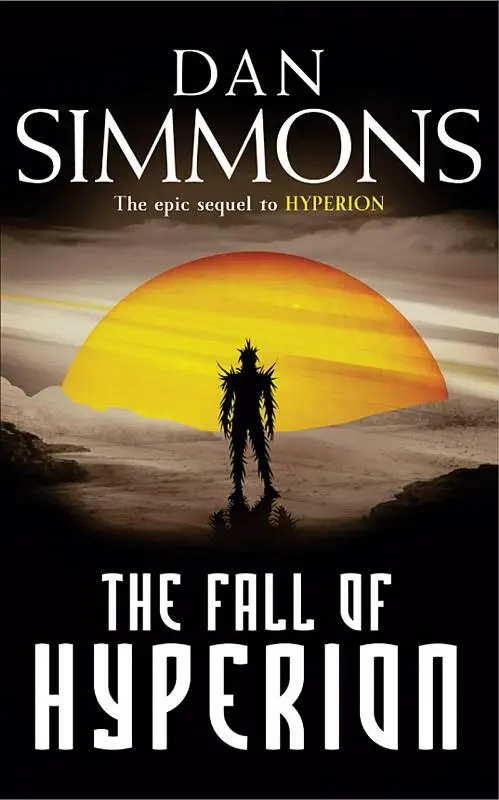
- Название:The Fall of Hyperion
- Автор:
- Издательство:Orion Publishing Group
- Жанр:
- Год:2006
- Город:London
- ISBN:9780575076389
- Рейтинг книги:5 / 5. Голосов: 1
-
Избранное:Добавить в избранное
- Отзывы:
-
Ваша оценка:
The Fall of Hyperion: краткое содержание, описание и аннотация
Предлагаем к чтению аннотацию, описание, краткое содержание или предисловие (зависит от того, что написал сам автор книги «The Fall of Hyperion»). Если вы не нашли необходимую информацию о книге — напишите в комментариях, мы постараемся отыскать её.
The Fall of Hyperion — читать онлайн бесплатно полную книгу (весь текст) целиком
Ниже представлен текст книги, разбитый по страницам. Система сохранения места последней прочитанной страницы, позволяет с удобством читать онлайн бесплатно книгу «The Fall of Hyperion», без необходимости каждый раз заново искать на чём Вы остановились. Поставьте закладку, и сможете в любой момент перейти на страницу, на которой закончили чтение.
Интервал:
Закладка:
“Of course obsolescent,” laughed Reynolds. “Do you think a sculptor wishes to defeat the clay? Does a painter attack the canvas? For that matter, does an eagle or a Thomas hawk assault the sky?”
“Eagles are extinct,” grumbled Morpurgo. “Perhaps they should have attacked the sky. It betrayed them.”
Reynolds turned back to me. Waiters removed his abandoned salad and brought the soup course I was finishing. “M. Severn, you are an artist… an illustrator at least,” he said. “Help me explain to these people what I mean.”
“I don’t know what you mean.” While I waited for the next course, I tapped my wineglass. It was filled immediately. From the head of the table, thirty feet away, I could hear Gladstone, Hunt, and several of the relief fund chairmen laughing.
Spenser Reynolds did not look surprised at my ignorance. “For our race to achieve the true satori, for us to move to that next level of consciousness and evolution that so many of our philosophies proclaim, all facets of human endeavor must become conscious strivings for art.”
General Morpurgo took a long drink and grunted. “Including such bodily functions as eating, reproducing, and eliminating waste, I suppose.”
“Most especially such functions!” exclaimed Reynolds. He opened his hands, offering the long table and its many delights. “What you see here is the animal requirement of turning dead organic compounds to energy, the base act of devouring other life, but Treetops has turned it into an art! Reproduction has long since replaced its crude animal origins with the essence of dance for civilized human beings. Elimination must become pure poetry!”
“I’ll remember that the next time I go in to take a shit,” said Morpurgo.
Tyrena Wingreen-Feif laughed and turned to the man in red and black to her right. “Monsignor, your church… Catholic, early Christian isn’t it?… don’t you have some delightful old doctrine about mankind achieving a more exalted evolutionary status?”
We all turned to look at the small, quiet man in the black robe and strange little cap. Monsignor Edouard, a representative of the almost-forgotten early Christian sect now limited to the world of Pacem and a few colony planets, was on the guest list because of his involvement with the Armaghast relief project, and until now he had been quietly applying himself to his soup. He looked up with a slightly surprised look on a face lined with decades of exposure to weather and worry.
“Why yes,” he said, “the teachings of St. Teilhard discuss an evolution toward the Omega Point.”
“And is the Omega Point similar to our Zen Gnostic idea of practical satori?” asked Sudette Chier.
Monsignor Edouard looked wistfully at his soup, as if it were more important than the conversation at that moment. “Not really too similar,” he said. “St. Teilhard felt that all of life, every level of organic consciousness was part of a planned evolution toward ultimate mergence with the Godhead.” He frowned slightly. “The Teilhard position has been modified much over the past eight centuries, but the common thread has been that we consider Jesus Christ to have been an incarnate example of what that ultimate consciousness might be like on the human plane.”
I cleared my throat. “Didn’t the Jesuit Paul Duré write extensively on the Teilhard hypothesis?”
Monsignor Edouard leaned forward to see around Tyrena and looked directly at me. There was surprise on that interesting face. “Why yes,” he said, “but I am amazed that you’re familiar with the work of Father Duré.”
I returned the gaze of the man who had been Duré’s friend even while exiling the Jesuit to Hyperion for apostasy. I thought of another refugee from the New Vatican, young Lenar Hoyt, lying dead in a Time Tomb while the cruciform parasites carrying the mutated DNA of both Duré and himself carried out their grim purpose of resurrection.
How did the abomination of the cruciform fit into Teilhard and Duré’s view of inevitable, benevolent evolution toward the Godhead?
Spenser Reynolds obviously thought that the conversation had been out of his arena for too long. “The point is,” he said, his deep voice drowning out other conversation halfway down the table, “that warfare, like religion or any other human endeavor that taps and organizes human energies on such a scale, must abandon its infantile preoccupation with Ding an Sich literalism—usually expressed through a slavish fascination with ‘goals’—and revel in the artistic dimension of its own ocuvre. Now my own most recent project—”
“And what is your cult’s goal, Monsignor Edouard?” Tyrena Wingreen-Feif asked, stealing the conversational ball away from Reynolds without raising her voice or shifting her gaze from the cleric.
“To help mankind to know and serve God,” he said and finished his soup with an impressive slurp. The archaic little priest looked down the table toward the projection of Councilor Albedo. “I’ve heard rumors, Councilor, that the TechnoCore is pursuing an oddly similar goal. Is it true that you are attempting to build your own God?”
Albedo’s smile was perfectly calculated to be friendly with no sign of condescension. “It is no secret that elements of the Core have been working for centuries to create at least a theoretical model of a so-called artificial intelligence far beyond our own poor intellects.” He made a deprecating gesture. “It is hardly an attempt to create God, Monsignor, more in the line of a research project exploring the possibilities your St. Teilhard and Father Duré pioneered.”
“But you believe that it’s possible to orchestrate your own evolution to such a higher consciousness?” asked Commander Lee, the naval hero, who had been listening attentively. “Design an ultimate intelligence the way we once designed your crude ancestors out of silicon and microchips?”
Albedo laughed. “Nothing so simple or grandiose, I’m afraid. And when you say 'you,' Commander, please remember that I am but one personality in an assemblage of intelligences no less diverse than the human beings on this planet… indeed, in the Web itself. The Core is no monolith. There are as many camps of philosophies, beliefs, hypotheses—religions, if you will—as there would be in any diverse community.” He folded his hands as if enjoying an inside joke. “Although I prefer to think of the quest for an Ultimate Intelligence as a hobby more than a religion. Rather like building ships in a bottle, Commander, or arguing over how many angels would fit on the head of a pin, Monsignor.”
The group laughed politely, except for Reynolds who was frowning unintentionally as he no doubt pondered how to regain control of the conversation.
“And what about the rumor that the Core has built a perfect replica of Old Earth in the quest for an Ultimate Intelligence?” I asked, amazing myself with the question.
Albedo’s smile did not falter, the friendly gaze did not quiver, but there was a nanosecond of something conveyed through the projection.
What? Shock? Fury? Amusement? I had no idea. He could have communicated with me privately during that eternal second, transmitting immense quantities of data via my own Core umbilical or along the unseen corridors we have reserved for ourselves in the labyrinthine datasphere which humankind thought so simply contrived. Or he could have killed me, pulling rank with whatever gods of the Core controlled the environment for a consciousness like mine—it would have been as simple as the director of an institute calling down to order the technicians to permanently anesthetize an obnoxious laboratory mouse.
Conversation had halted up and down the table. Even Meina Gladstone and her cluster of ultra-VIPs glanced down our way.
Читать дальшеИнтервал:
Закладка:
Похожие книги на «The Fall of Hyperion»
Представляем Вашему вниманию похожие книги на «The Fall of Hyperion» списком для выбора. Мы отобрали схожую по названию и смыслу литературу в надежде предоставить читателям больше вариантов отыскать новые, интересные, ещё непрочитанные произведения.







Обсуждение, отзывы о книге «The Fall of Hyperion» и просто собственные мнения читателей. Оставьте ваши комментарии, напишите, что Вы думаете о произведении, его смысле или главных героях. Укажите что конкретно понравилось, а что нет, и почему Вы так считаете.