Дэн Симмонс - The Fall of Hyperion
Здесь есть возможность читать онлайн «Р”СЌРЅ РЎРёРјРјРѕРЅСЃ - The Fall of Hyperion» весь текст электронной книги совершенно бесплатно (целиком полную версию без сокращений). В некоторых случаях можно слушать аудио, скачать через торрент в формате fb2 и присутствует краткое содержание. Город: London, Год выпуска: 2006, ISBN: 2006, Издательство: Orion Publishing Group, Жанр: Эпическая фантастика, Космическая фантастика, на английском языке. Описание произведения, (предисловие) а так же отзывы посетителей доступны на портале библиотеки ЛибКат.
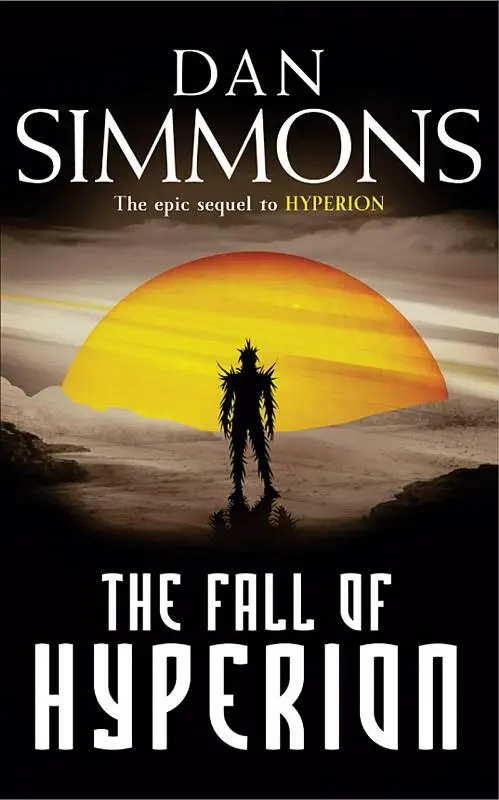
- Название:The Fall of Hyperion
- Автор:
- Издательство:Orion Publishing Group
- Жанр:
- Год:2006
- Город:London
- ISBN:9780575076389
- Рейтинг книги:5 / 5. Голосов: 1
-
Избранное:Добавить в избранное
- Отзывы:
-
Ваша оценка:
The Fall of Hyperion: краткое содержание, описание и аннотация
Предлагаем к чтению аннотацию, описание, краткое содержание или предисловие (зависит от того, что написал сам автор книги «The Fall of Hyperion»). Если вы не нашли необходимую информацию о книге — напишите в комментариях, мы постараемся отыскать её.
The Fall of Hyperion — читать онлайн бесплатно полную книгу (весь текст) целиком
Ниже представлен текст книги, разбитый по страницам. Система сохранения места последней прочитанной страницы, позволяет с удобством читать онлайн бесплатно книгу «The Fall of Hyperion», без необходимости каждый раз заново искать на чём Вы остановились. Поставьте закладку, и сможете в любой момент перейти на страницу, на которой закончили чтение.
Интервал:
Закладка:
She laughed—sharp little sounds like metal chipping rock. Half a dozen of her circle laughed along with her.
“You’d better make sure that Silenus is dead,” I said. “The Cantos would make better reading if they were complete.”
Tyrena Wingreen-Feif looked at me strangely, the chimes for dinner sounded through shifting leaves, Spenser Reynolds offered the grande dame his arm as people began climbing the last staircase toward the stars, and I finished my drink, left the empty glass on a railing, and went up to join the herd.
The CEO and her entourage arrived shortly after we were seated, and Gladstone gave a brief talk, probably her twentieth of the day, excluding her morning speech to the Senate and Web. The original reason for tonight’s dinner had been the recognition of a fundraising effort for the Armaghast Relief Fund, but Gladstone’s talk soon turned to the war and the necessity of prosecuting it vigorously and efficiently while leaders from all parts of the Web promoted unity.
I gazed out over the railing while she spoke. The lemon sky had dissolved to a muted saffron and then quickly faded to a tropical dusk so rich that it seemed as if a thick, blue curtain had been drawn across the sky. God’s Grove had six small moons, five of them visible from this latitude, and four were racing across the sky as I watched the stars emerge. The air was oxygen rich here, almost intoxicating, and carried a heavy fragrance of moistened vegetation which reminded me of the morning visit to Hyperion. But no EMVs or skimmers or flying machines of any sort were allowed on God’s Grove—petrochemical emissions or fusion-cell wakes had never polluted these skies—and the absence of cities, highways, and electrical lighting made the stars seem bright enough to compete with the Japanese lanterns and glow-globes hanging from branches and stanchions.
The breeze had come up again after sunset, and now the entire tree swayed slightly, the broad platform moving as softly as a ship on a gentle sea, weirwood and muirwood stanchions and supports creaking softly with the gentle swells. I could see lights shining up through distant treetops and knew that many of them came from “rooms"—a few of thousands leased by the Templars—which one could add to one’s multi-world farcaster-connected residence if one had the million-mark beginning price for such an extravagance.
The Templars did not sully themselves with the day-to-day operations of Treetops or the leasing agencies, merely setting strict, inviolable ecological conditions to any such endeavor, but they benefited from the hundreds of millions of marks brought in by such enterprises. I thought of their interstellar cruise ship, the Yggdrasill, a kilometer-long Tree from the planet’s most sacred forest, driven by Hawking drive singularity generators and protected by the most complex force shields and Erg force fields that could be carried. Somehow, inexplicably, the Templars had agreed to send the Yggdrasill on an evacuation mission that was a mere cover for the FORCE invasion task force.
And as things tend to happen when priceless objects are set in harm’s way, the Yggdrasill was destroyed while in orbit around Hyperion, whether by Ouster attack or some other force not yet determined. How had the Templars reacted? What conceivable goal could have made them risk one of the four Treeships in existence? And why had their Treeship captain—Het Masteen—been chosen as one of the seven Shrike Pilgrims and then proceeded to disappear before the windwagon reached the Bridle Range on the shores of the Sea of Grass?
There were too damned many questions, and the war was only a few days old.
Meina Gladstone had finished her remarks and urged us all to enjoy the fine dinner. I applauded politely and waved over a steward to have my wineglass filled. The first course was a classic salad a la the empire period, and I applied myself to it with enthusiasm. I realized that I’d eaten nothing since breakfast that day. Spearing a sprig of watercress, I remembered Governor-General Theo Lane eating bacon and eggs and kippers as the rain fell softly from Hyperion’s lapis lazuli sky. Had that been a dream?
“What do you think of the war, M. Severn?” asked Reynolds, the action artist. He was several seats down and across the broad table from me, but his voice carried very well. I could see Tyrena raise an eyebrow toward me from where she sat, three seats to my right.
“What can one think of war?” I said, tasting the wine again. It was quite good, though nothing in the Web could match my memories of French Bordeaux. “War does not call for judgment,” I said, “merely survival.”
“On the contrary,” said Reynolds, “like so many other things humankind has redefined since the Hegira, warfare is on the threshold of becoming an art form.”
“An art form,” sighed a woman with short-cropped chestnut hair.
The datasphere told me that she was M. Sudette Chier, wife of Senator Gabriel Fyodor Kolchev and a powerful political force in her own right.
M. Chier wore a blue and gold lame gown and an expression of rapt interest. “War as an art form, M. Reynolds! What a fascinating concept!”
Spenser Reynolds was a bit shorter than Web average, but far handsomer.
His hair was curled but cropped short, his skin appeared bronzed by a benevolent sun and slightly gilded with subtle body paint, his clothes and ARNistry were expensively flamboyant without being outre, and his demeanor proclaimed a relaxed confidence that all men dreamed of and precious few obtained. His wit was obvious, his attention to others sincere, and his sense of humor legendary.
I found myself disliking the son of a bitch at once.
“Everything is an art form, M. Chier, M. Severn.” Reynolds smiled. “Or must become one. We are beyond the point where warfare can be merely the churlish imposition of policy by other means.”
“Diplomacy,” said General Morpurgo, on Reynolds’ left.
“I beg your pardon. General?”
“Diplomacy,” he said. “And it’s ‘extension of,’ not ‘imposition of.’”
Spenser Reynolds bowed and made a small roll of his hand. Sudette Chier and Tyrena laughed softly. The image of Councilor Albedo leaned forward from my left and said, “Von Clausewitz, I believe.”
I glanced toward the Councilor. A portable projection unit not much larger than the radiant gossamers flitting through the branches hovered two meters above and behind him. The illusion was not as perfect as in Government House, but it was far better than any private holo I had ever seen.
General Morpurgo nodded toward the Core representative.
“Whatever,” said Chier. “It is the idea of warfare as art which is so brilliant.”
I finished the salad, and a human waiter whisked the bowl away, replacing it with a dark gray soup I did not recognize. It was smoky, slightly redolent of cinnamon and the sea, and delicious.
“Warfare is a perfect medium for an artist,” began Reynolds, holding his salad utensil aloft like a baton. “And not merely for those… craftsmen who have studied the so-called science of war, either.” He smiled toward Morpurgo and another FORCE officer to the General’s right, dismissing both of them from consideration. “Only someone who is willing to look beyond the bureaucratic limits of tactics and strategies and the obsolescent will to ‘win’ can truly wield an artist’s touch with a medium so difficult as warfare in the modern age.”
“The obsolescent will to win?” said the FORCE officer. The datasphere whispered that he was Commander William Ajunta Lee, a naval hero of the Maui-Covenant conflict. He looked young—middle fifties perhaps—and his rank suggested that his youth was due to years of traveling between the stars rather than Poulsen.
Читать дальшеИнтервал:
Закладка:
Похожие книги на «The Fall of Hyperion»
Представляем Вашему вниманию похожие книги на «The Fall of Hyperion» списком для выбора. Мы отобрали схожую по названию и смыслу литературу в надежде предоставить читателям больше вариантов отыскать новые, интересные, ещё непрочитанные произведения.


Обсуждение, отзывы о книге «The Fall of Hyperion» и просто собственные мнения читателей. Оставьте ваши комментарии, напишите, что Вы думаете о произведении, его смысле или главных героях. Укажите что конкретно понравилось, а что нет, и почему Вы так считаете.