Дэн Симмонс - The Fall of Hyperion
Здесь есть возможность читать онлайн «Р”СЌРЅ РЎРёРјРјРѕРЅСЃ - The Fall of Hyperion» весь текст электронной книги совершенно бесплатно (целиком полную версию без сокращений). В некоторых случаях можно слушать аудио, скачать через торрент в формате fb2 и присутствует краткое содержание. Город: London, Год выпуска: 2006, ISBN: 2006, Издательство: Orion Publishing Group, Жанр: Эпическая фантастика, Космическая фантастика, на английском языке. Описание произведения, (предисловие) а так же отзывы посетителей доступны на портале библиотеки ЛибКат.
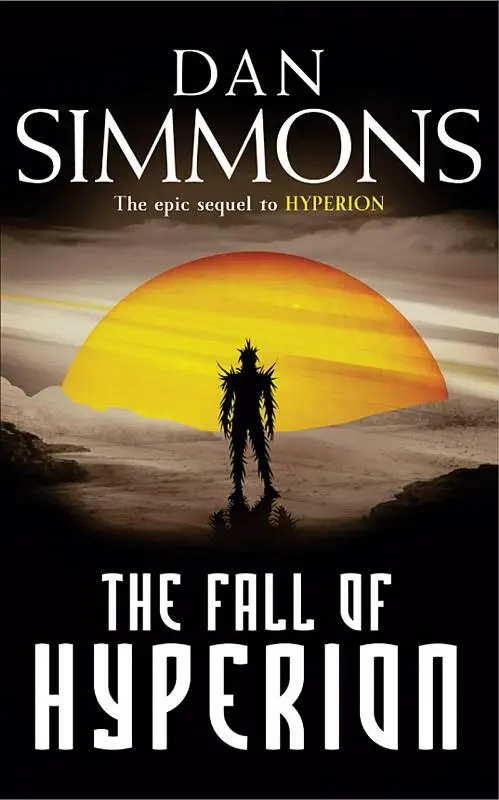
- Название:The Fall of Hyperion
- Автор:
- Издательство:Orion Publishing Group
- Жанр:
- Год:2006
- Город:London
- ISBN:9780575076389
- Рейтинг книги:5 / 5. Голосов: 1
-
Избранное:Добавить в избранное
- Отзывы:
-
Ваша оценка:
The Fall of Hyperion: краткое содержание, описание и аннотация
Предлагаем к чтению аннотацию, описание, краткое содержание или предисловие (зависит от того, что написал сам автор книги «The Fall of Hyperion»). Если вы не нашли необходимую информацию о книге — напишите в комментариях, мы постараемся отыскать её.
The Fall of Hyperion — читать онлайн бесплатно полную книгу (весь текст) целиком
Ниже представлен текст книги, разбитый по страницам. Система сохранения места последней прочитанной страницы, позволяет с удобством читать онлайн бесплатно книгу «The Fall of Hyperion», без необходимости каждый раз заново искать на чём Вы остановились. Поставьте закладку, и сможете в любой момент перейти на страницу, на которой закончили чтение.
Интервал:
Закладка:
Fifty meters from the Monolith, and ribbons of light lance to his left and right, turning sand to glass with a touch, reaching for him with a speed nothing and no one can dodge. Killing lasers quit playing with him and lance home, stabbing at his helmet, heart, and groin with the heat of stars. His combat armor goes mirror bright, shifting frequencies in microseconds to match the changing colors of attack. A nimbus of superheated air surrounds him. Microcircuits shriek to overload and beyond as they release the heat and work to build a micrometer-thin field of force to keep it away from flesh and bone.
Kassad struggles the final twenty meters, using power assist to leap barriers of slagged crystal. Explosions erupt on all sides, knocking him down and then lifting him again. The suit is absolutely rigid; he is a doll thrown between flaming hands.
The bombardment stops. Kassad gets to his knees and then to his feet. He looks up at the face of the Crystal Monolith and sees the flames and fissures and little else. His visor is cracked and dead. Kassad lifts it, breathes in smoke and ionized air, and enters the tomb.
His implants tell him that the other pilgrims are paging him on all the comm channels. He shuts them off. Kassad removes his helmet and walks into darkness.
It is a single room, large and square and dark. A shaft has opened in the center and he looks up a hundred meters to a shattered skylight.
A figure is waiting on the tenth level, sixty meters above, silhouetted by flames.
Kassad drapes his weapon over one shoulder, tucks his helmet under his arm, finds the great spiral staircase in the center of the shaft, and begins to climb.
Fourteen
“Did you have your nap?” Leigh Hunt asked as we stepped onto the farcaster reception area of Treetops.
“Yes.”
“Pleasant dreams, I hope?” said Hunt, making no effort to hide either his sarcasm or his opinion of those who slept while the movers and shakers of government toiled.
“Not especially,” I said and looked around as we ascended the wide staircase toward the dining levels.
In a Web where every town in every province of every country on every continent seemed to brag of a four-star restaurant, where true gourmets numbered in the tens of millions and palates had been educated by exotic fare from two hundred worlds, even in a Web so jaded with culinary triumphs and restaurantic success, Treetops stood alone.
Set atop one of a dozen highest trees on a world of forest giants, Treetops occupied several acres of upper branches half a mile above the ground. The staircase Hunt and I ascended, four meters wide here, was lost amid the immensity of limbs the size of avenues, leaves the size of sails, and a main trunk—illuminated by spotlights and just glimpsed through gaps in the foliage—more sheer and massive than most mountain faces. Treetops held a score of dining platforms in its upper bowers, ascending in order of rank and privilege and wealth and power. Especially power. In a society where billionaires were almost commonplace, where a lunch at Treetops could cost a thousand marks and be within the reach of millions, the final arbiter of position and privilege was power—a currency that never went out of style.
The evening’s gathering was to be on the uppermost deck, a wide, curving platform of weirwood (since muirwood cannot be stepped upon), with views of a fading lemon sky, an infinity of lesser treetops stretching off to a distant horizon, and the soft orange lights of Templar treehomes and houses of worship glowing through far-off green and umber and amber walls of softly stirring foliage. There were about sixty people in the dinner party; I recognized Senator Kolchev, white hair shining under the Japanese lanterns, as well as Councilor Albedo, General Morpurgo, Admiral Singh, President Pro Tern Denzel-Hiat-Amin, All Thing Speaker Gibbons, another dozen senators from such powerful Web worlds as Sol Draconi Septem, Deneb Drei, Nordholm, Fuji, both the Renaissances, Metaxas, Maui-Covenant, Hebron, New Earth, and Ixion, as well as a bevy of lesser politicians. Spenser Reynolds, the action artist, was there, resplendent in a maroon velvet formal tunic, but I saw no other artists. I did see Tyrena Wingreen-Feif across the crowded deck; the publisher-turned-philanthropist still stood out in a crowd in her gown made of thousands of silk-thin leather petals, her blue-black hair rising high in a sculpted wave, but the gown was a Tedekai original, the makeup was dramatic but noninteractive, and her appearance was far more subdued than it would have been a mere five or six decades earlier. I moved in her direction across the crowded floor as guests milled about on the penultimate deck, making raids on the numerous bars and waiting for the call to dine.
“Joseph, dear,” cried Wingreen-Feif as I closed the last few yards, “how in the world did you get invited to such a dreary function?”
I smiled and offered her a glass of champagne. The dowager empress of literary fashion knew me only because of her week-long visit to the Esperance arts festival the previous year and my friendship with such Web-class names as Salmud Brevy III, Millon De Havre, and Rithmet Corber. Tyrena was a dinosaur who refused to become extinct—her wrists, palms, and neck would have glowed blue from repeated Poulsens if it had not been for makeup, and she spent decades on short-hop interstellar cruises or incredibly expensive cryogenic naps at spas too exclusive to have names; the upshot was that Tyrena Wingreen-Feif had held the social scene in an iron grip for more than three centuries and showed no signs of relinquishing it. With every twenty-year nap, her fortune expanded and her legend grew.
“Do you still live on that dreary little planet I visited last year?” she asked.
“Esperance,” I said, knowing that she knew precisely where each important artist on that unimportant world resided. “No, I appear to have moved my residence to TC 2for the present.”
M. Wingreen-Feif made a face. I was vaguely aware that there was a group of eight to ten hangers-on watching intently, wondering who this brash young man was who had moved into her inner orbit. “How dreadful for you,” said Tyrena, “to have to abide on a world of business people and government bureaucrats. I hope they allow you to escape soon!”
I raised my glass in a toast to her. “I wanted to ask you,” I said, “weren’t you Martin Silenus’s editor?”
The dowager empress lowered her glass and fixed me with a cold stare. For a second I imagined Meina Gladstone and this woman locked in a combat of wills; I shuddered and waited for her answer. “My darling boy,” she said, “that is such ancient history. Why would you bother your pretty young head about such prehistoric trivia?”
“I’m interested in Silenus,” I said. “In his poetry. I was just curious if you were still in touch with him.”
“Joseph, Joseph, Joseph,” rutted M. Wingreen-Feif, “no one has heard from poor Martin in decades. Why, the poor man would be ancient!”
I didn’t point out to Tyrena that when she was Silenus’s editor, the poet was much younger than she.
“It is odd that you mention him,” she continued. “My old firm, Transline, said recently that they were considering releasing some of Martin’s work. I don’t know if they ever contacted his estate.”
“His Dying Earth books?” I said, thinking of the Old Earth nostalgia volumes which had sold so well so long ago.
“No, oddly enough. I believe they were thinking of printing his Cantos,” said Tyrena. She laughed and held out a cannabis stick ensconced in a long, ebony cigarette holder. One of her retinue hurried to light it. “Such an odd choice,” she said, “considering that no one ever read the Cantos when poor Martin was alive. Well, nothing helps an artist’s career more than a little death and obscurity, I always say.”
Читать дальшеИнтервал:
Закладка:
Похожие книги на «The Fall of Hyperion»
Представляем Вашему вниманию похожие книги на «The Fall of Hyperion» списком для выбора. Мы отобрали схожую по названию и смыслу литературу в надежде предоставить читателям больше вариантов отыскать новые, интересные, ещё непрочитанные произведения.







Обсуждение, отзывы о книге «The Fall of Hyperion» и просто собственные мнения читателей. Оставьте ваши комментарии, напишите, что Вы думаете о произведении, его смысле или главных героях. Укажите что конкретно понравилось, а что нет, и почему Вы так считаете.