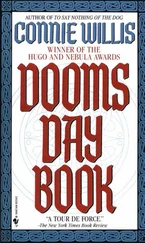
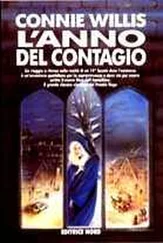
Connie Willis - Doomsday Book
Здесь есть возможность читать онлайн «Connie Willis - Doomsday Book» весь текст электронной книги совершенно бесплатно (целиком полную версию без сокращений). В некоторых случаях можно слушать аудио, скачать через торрент в формате fb2 и присутствует краткое содержание. Год выпуска: 1992, ISBN: 1992, Издательство: Bantam Books, Жанр: Фантастика и фэнтези, Социально-психологическая фантастика, на английском языке. Описание произведения, (предисловие) а так же отзывы посетителей доступны на портале библиотеки ЛибКат.
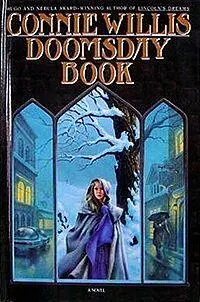
- Название:Doomsday Book
- Автор:
- Издательство:Bantam Books
- Жанр:
- Год:1992
- ISBN:ISBN 0-553-35167-2
- Рейтинг книги:3 / 5. Голосов: 1
-
Избранное:Добавить в избранное
- Отзывы:
-
Ваша оценка:
Doomsday Book: краткое содержание, описание и аннотация
Предлагаем к чтению аннотацию, описание, краткое содержание или предисловие (зависит от того, что написал сам автор книги «Doomsday Book»). Если вы не нашли необходимую информацию о книге — напишите в комментариях, мы постараемся отыскать её.
is an intelligent and satisfying blend of classic science fiction and historical reconstruction. Kivrin, a history student at Oxford in 2048, travels back in time to a 14th-century English village, despite a host of misgivings on the part of her unofficial tutor. When the technician responsible for the procedure falls prey to a 21st-century epidemic, he accidentally sends Kivrin back not to 1320 but to 1348 — right into the path of the Black Death. Unaware at first of the error, Kivrin becomes deeply involved in the life of the family that takes her in. But before long she learns the truth and comes face to face with the horrible, unending suffering of the plague that would wipe out half the population of Europe. Meanwhile, back in the future, modern science shows itself infinitely superior in its response to epidemics, but human nature evidences no similar evolution, and scapegoating is still alive and well in a campaign against "infected foreigners." This book finds villains and heroes in all ages, and love, too, which Kivrin hears in the revealing and quietly touching deathbed confession of a village priest. Won Nebula Award for Best Novel in 1992
Won Hugo Award for Best Novel in 1993
Doomsday Book — читать онлайн бесплатно полную книгу (весь текст) целиком
Ниже представлен текст книги, разбитый по страницам. Система сохранения места последней прочитанной страницы, позволяет с удобством читать онлайн бесплатно книгу «Doomsday Book», без необходимости каждый раз заново искать на чём Вы остановились. Поставьте закладку, и сможете в любой момент перейти на страницу, на которой закончили чтение.
Интервал:
Закладка:
He tore off a strip of tape and stuck the placard to the chalkboard. "I was just posting these at the Infirmary, and what do you think the Gallstone was doing?" he said, taking another placard out of the bundle. It read, "Wear Your Face Mask." He taped it to the wall above the cot Finch was making. "Reading the Bible to the patients." He pocketed the tape. "I hope I don't catch it." He tucked the rest of the placards under his arm and started out.
"Wear your face mask," Dunworthy said.
Colin grinned. "That's what the Gallstone said. And she said, the Lord would smite anyone who heeded not the words of the righteous." He pulled the gray plaid muffler out of his pocket. "I wear this instead of a face mask," he said, tying it over his mouth and nose highwayman fashion.
"Cloth cannot keep out microscopic viruses," Dunworthy said.
"I know. It's the color. It frightens them away." He darted out.
Dunworthy rang Mary to tell her the ward was ready but couldn't get through, so he went over to Infirmary. The rain had let up a little, and people, mostly wearing masks, were out again, coming back from the grocer's and queueing in front of the chemist's. But the streets seemed hushed, unnaturally silent.
Someone's turned the carillon off, Dunworthy thought. He almost regretted it.
Mary was in her office, staring at a screen. "The sequencing's arrived," she said before he could tell her about the ward.
"Have you told Gilchrist?" he said eagerly.
"No," she said. "It's not the Uruguay virus. Or the South Carolina."
"What is it?"
"It's an H9N2. Both the South Carolina and the Uruguay were H3's."
"Then where did it come from?"
"The WIC doesn't know. It's not a known virus. It's previously unsequenced." She handed him a printout. "It has a seven point mutation, which explains why it's killing people."
He looked at the printout. It was covered with columns of numbers, like Finch's list of changes, and as unintelligible. "It has to come from somewhere."
"Not necessarily. Approximately every ten years, there's a major antigenic shift with epidemic potential, so it may have originated with Badri." She took the printout back from him. "Does he live around livestock, do you know?"
"Livestock?" he said. "He lives in a flat in Headington."
"Mutant strains are sometimes produced by the intersection of an avian virus with a human strain. The WIC wants us to check possible avian contacts and exposure to radiation. Viral mutations have sometimes been caused by X-rays." She studied the printout as though it made sense. "It's an unusual mutation. There's no recombination of the hemagluttinin genes, only an extremely large point mutation."
No wonder she had not told Gilchrist. He had said he would open the laboratory when the sequencing arrived, but this news would only fuel his ridiculous theories.
"Is there a cure?"
"There will be as soon as an analogue can be manufactured. And a vaccine. They've already begun work on the prototype."
"How long?"
"Three to five days to produce a prototype, then at least another five to manufacture, if they don't run into any difficulty with duplicating the proteins. We should be able to begin inoculating by the tenth."
The tenth. And that was when they could begin giving immunizations. How long would it take to immunize the quarantine area? A week? Two? Before Gilchrist and the idiot protesters considered it safe to open the laboratory?
"That's too long," Dunworthy said.
"I know," Mary said, and sighed. "God knows how many cases we'll have by then. There have been five new ones already this morning."
"Do you think it's a mutant strain?" Dunworthy asked.
She thought about it. "No. I think it's much more likely that Badri caught it from someone at that dance in Headington. There may have been New Hindus there, or Earthers, or someone else who doesn't believe in antivirals or modern medicine. The Canadian goose flu of 2010, if you'll remember, was traced back to a Christian Science commune. There's a source. We'll find it."
"And what about Kivrin in the meantime? What if you don't find the source by the rendezvous? Kivrin's supposed to come back on the sixth of January. Will you have it sourced by then?"
"I don't know," she said wearily. "She may not want to come back to a century that's rapidly becoming a ten. She may want to stay in 1320."
If she's in 1320, he thought, and went up to see Badri. He had not mentioned rats since Christmas night. He was back to the afternoon at Balliol when he had come looking for Dunworthy. "Laboratory?" he murmured when he saw Dunworthy. He tried feebly to hand him a note, and then seemed to sink into sleep, exhausted by the effort.
He stayed only a few minutes and then went to see Gilchrist.
It was raining hard again by the time he reached Brasenose. The gaggle of picketers were huddling underneath their banner, shivering.
The porter was standing at the lodge desk, taking the decorations off the little Christmas tree. He glanced up at Dunworthy and looked suddenly alarmed. Dunworthy walked past him and through the gate.
"You can't go in there, Mr. Dunworthy," the porter called after him. "The college is restricted."
Dunworthy walked into the quad. Gilchrist's rooms were in the building behind the laboratory. He hurried toward them, expecting the porter to catch up to him and try to stop him.
The laboratory had a large yellow sign on it that read "No Admittance Without Authorization," and an electronic alarm attached to the jamb.
"Mr. Dunworthy," Gilchrist said, striding toward him through the rain. The porter must have phoned him. "The laboratory is off-limits."
"I came to see you," Dunworthy said.
The porter came up, trailing a tinsel garland. "Shall I phone for the University police?" he asked.
"That won't be necessary. Come up to my rooms," he said to Dunworthy. "I have something I want you to see."
He led Dunworthy into his office, sat down at his cluttered desk, and put on an elaborate mask with some sort of filters.
"I've just spoken to the WIC," he said. His voice sounded hollow, as if it were coming from a great distance. "The virus is a previously unsequenced virus whose source is unknown."
"It's been sequenced now," Dunowrthy said, "and the analogue and vaccine are due to arrive in a few days. Dr. Ahrens has arranged for Brasenose to be given immunization priority, and I'm attempting to locate a tech who can read the fix as soon as immunization has been completed."
"I'm afraid that's impossible," Gilchrist said hollowly. "I've been conducting research into the incidence of influenza in the 1300's. There are clear indications that a series of influenza epidemics in the first half of the fourteenth century severely weakened the populace, thereby lowering their resistance to the Black Death."
He picked up an ancient-looking book. I have found six separate references to outbreaks between October of 1318 and February of 1321." He held up a book and began to read. "'After the harvest there came upon all of Dorset a fever so fierce as to leave many dead. This fever began with an aching in the head and confusion in all the parts. The doctors bled them, but many died in despite.'"
A fever. In an age of fevers — typhoid and cholera and measles, all of them producing "aching of the head and confusion in all the parts."
"1319. The Bath Assizes for the previous year were cancelled," Gilchrist said, holding up another book. "'A malady of the chest that fell upon the court so that none, nor judge nor jury, were left to hear the cases,'" Gilchrist said. He looked at Dunworthy over the mask. "You stated that the public's fears over the net were hysterical and unfounded. It would seem, however, that they are based in solid historical fact."
Читать дальшеИнтервал:
Закладка:
Похожие книги на «Doomsday Book»
Представляем Вашему вниманию похожие книги на «Doomsday Book» списком для выбора. Мы отобрали схожую по названию и смыслу литературу в надежде предоставить читателям больше вариантов отыскать новые, интересные, ещё непрочитанные произведения.




Обсуждение, отзывы о книге «Doomsday Book» и просто собственные мнения читателей. Оставьте ваши комментарии, напишите, что Вы думаете о произведении, его смысле или главных героях. Укажите что конкретно понравилось, а что нет, и почему Вы так считаете.