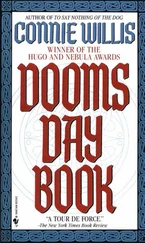
Connie Willis - Doomsday Book
Здесь есть возможность читать онлайн «Connie Willis - Doomsday Book» весь текст электронной книги совершенно бесплатно (целиком полную версию без сокращений). В некоторых случаях можно слушать аудио, скачать через торрент в формате fb2 и присутствует краткое содержание. Год выпуска: 1992, ISBN: 1992, Издательство: Bantam Books, Жанр: Фантастика и фэнтези, Социально-психологическая фантастика, на английском языке. Описание произведения, (предисловие) а так же отзывы посетителей доступны на портале библиотеки ЛибКат.
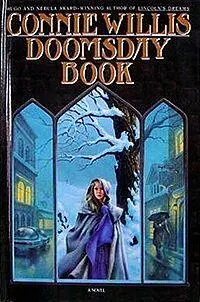
- Название:Doomsday Book
- Автор:
- Издательство:Bantam Books
- Жанр:
- Год:1992
- ISBN:ISBN 0-553-35167-2
- Рейтинг книги:3 / 5. Голосов: 1
-
Избранное:Добавить в избранное
- Отзывы:
-
Ваша оценка:
Doomsday Book: краткое содержание, описание и аннотация
Предлагаем к чтению аннотацию, описание, краткое содержание или предисловие (зависит от того, что написал сам автор книги «Doomsday Book»). Если вы не нашли необходимую информацию о книге — напишите в комментариях, мы постараемся отыскать её.
is an intelligent and satisfying blend of classic science fiction and historical reconstruction. Kivrin, a history student at Oxford in 2048, travels back in time to a 14th-century English village, despite a host of misgivings on the part of her unofficial tutor. When the technician responsible for the procedure falls prey to a 21st-century epidemic, he accidentally sends Kivrin back not to 1320 but to 1348 — right into the path of the Black Death. Unaware at first of the error, Kivrin becomes deeply involved in the life of the family that takes her in. But before long she learns the truth and comes face to face with the horrible, unending suffering of the plague that would wipe out half the population of Europe. Meanwhile, back in the future, modern science shows itself infinitely superior in its response to epidemics, but human nature evidences no similar evolution, and scapegoating is still alive and well in a campaign against "infected foreigners." This book finds villains and heroes in all ages, and love, too, which Kivrin hears in the revealing and quietly touching deathbed confession of a village priest. Won Nebula Award for Best Novel in 1992
Won Hugo Award for Best Novel in 1993
Doomsday Book — читать онлайн бесплатно полную книгу (весь текст) целиком
Ниже представлен текст книги, разбитый по страницам. Система сохранения места последней прочитанной страницы, позволяет с удобством читать онлайн бесплатно книгу «Doomsday Book», без необходимости каждый раз заново искать на чём Вы остановились. Поставьте закладку, и сможете в любой момент перейти на страницу, на которой закончили чтение.
Интервал:
Закладка:
Please don't let Rosemund die. Please don't let Agnes get it. Send Gawyn back.
CHAPTER TWENTY-EIGHT
The boy who had run from Kivrin the day she tried to find the drop came down with the plague in the night. His mother was standing waiting for Father Roche when he went to matins. The boy had a bubo on his back, and Kivrin lanced it while Roche and the mother held him.
She didn't want to do it. The scurvy had left him already weak, and Kivrin had no idea whether there were any arteries below the shoulder blades. Rosemund did not seem at all improved, though Roche claimed her pulse was stronger. She was so white, as if she had been utterly drained of blood, and so still. And the boy didn't look as if he could stand to lose any blood.
But he bled hardly at all, and the color was already coming back in his cheeks before Kivrin finished washing the knife.
"Give him tea made from rose hips," Kivrin said, thinking that at least that would help the scurvy. "And willow bark." She held the blade of the knife over the fire. It was no bigger than the day she had sat by it, too weak to find the drop. It would never keep the boy warm, and if she told the woman to go gather firewood, she might expose someone else. "We will bring you some wood," she said, and then wondered how.
There was still food left over from the Christmas feast, but they were fast running out of everything else. They had used most of the wood that was already cut trying to keep Rosemund and the clerk warm, and there was no one to ask to chop the logs that lay piled against the kitchen. The reeve was ill, the steward was tending his wife and son.
Kivrin gathered up an armful of the already-split wood and some pieces of loose bark for kindling and took it back to the hut, wishing she could move the boy into the manor house, but Eliwys had the clerk and Rosemund to tend, and she looked ready to collapse herself.
Eliwys had sat with Rosemund all night, giving her sips of willow tea and rebandaging the wound. They had run out of cloths, and she had taken off her coif and torn it into strips. She sat where she could see the screens, and every few minutes she had stood up and gone over to the door, as if she heard someone coming. With her dark hair down over her shoulders, she looked no older than Rosemund.
Kivrin took the firewood to the woman, dumping it on the dirt floor next to the rat cage. The rat was gone, killed, no doubt, and not even guilty. "The Lord blesses us," she woman said to her. She knelt by the fire and began carefully adding the wood to it.
Kivrin checked the boy again. His bubo was still draining a clear watery fluid, which was good. Rosemund's had bled half the night and then begun to swell and grow hard again. And I can't lance it again, Kivrin thought. She can't lose any more blood.
She started back to the hall, wondering if she should relieve Eliwys or try to chop some wood. Roche, coming out of the steward's house, met her with the news that two more of the steward's children were ill.
It was the two youngest boys, and it was clearly the pneumonic. Both were coughing, and the mother intermittently retched a watery sputum. The Lord blesses us.
Kivrin went back to the hall. It was still hazy from the sulfur, and the clerk's arms looked almost black in the yellowish light. The fire was no better than the one in the woman's hut. Kivrin brought in the last of the cut wood and then told Eliwys to lie down, that she would tend Rosemund.
"Nay," Eliwys said, glancing toward the door. She added, almost to herself, "He has been three days on the road."
It was seventy kilometers to Bath, a day and a half at least on horseback and the same amount of time back, if he had been able to get a fresh horse in Bath. He might be back today, if he had found Lord Guillaume immediately. If he comes back, Kivrin thought.
Eliwys glanced at the door again, as if she heard something, but the only sound was Agnes, crooning softly to her cart. She had put a blanket over it and was spooning make-believe food into it. "He has the blue sickness," she told Kivrin.
Kivrin spent the rest of the day doing household chores — bringing in water, making broth from the roast joint, emptying the chamberpots. The steward's cow, its udders swollen in spite of Kivrin's orders, came lowing into the courtyard and followed her, nudging her with its horns till Kivrin gave up and milked it. Roche chopped wood in between visits to the steward and the boy, and Kivrin, wishing she had learned how to split wood, hacked clumsily at the big logs.
The steward came to fetch them again just before dark to his younger daughter. That's eight cases so far, Kivrin thought. There were only forty people in the village. The Black Death was supposed to have had a mortality rate of one-third to one-half, and Mr. Gilchrist thought that was exaggerated. One third would be thirteen cases, only five more. Even at fifty per cent, only twelve more would get it, and the steward's children had all already been exposed.
She looked at them, the older daughter stocky and dark like her father, the youngest boy sharp-faced like his mother, the scrawny baby. You'll all get it, she thought, and that will leave eight.
She couldn't seem to feel anything, even when the baby began to cry and the girl took it on her knee and stuck her filthy finger in its mouth. Thirteen, she prayed. Twenty at the most.
She couldn't feel anything for the clerk either, even though it was clear he could not last the night. His lips and tongue were covered with a brown slime, and he was coughing up a watery spittle that was streaked with blood. She tended him automatically, without feeling.
It's the lack of sleep, she thought, it's making us all numb. She lay down by the fire and tried to sleep, but she seemed beyond sleep, beyond tiredness. Eight more people, she thought, adding them up in her mind. The mother will catch it, and the reeve's wife and children. That leaves four. Don't let one of them be Agnes or Eliwys. Or Roche.
In the morning Roche found the cook lying in the snow in front of her hut, half-frozen and coughing blood. Nine, Kivrin thought.
The cook was a widow, with no one to take care of her, so they brought her into the hall and laid her next to the clerk, who was, amazingly, horribly, still alive. The hemorrhaging had spread all over his body now, his chest criss-crossed with bluish-purple marks, his arms and legs nearly solid black. His cheeks were covered with a black stubble that seemed somehow a symptom, too, and under it his face was darkening.
Rosemund still lay white and silent, balanced between life and death, and Eliwys tended her quietly, carefully, as if the slightest movement, the slightest sound, might tip her into death. Kivrin tiptoed among the pallets, and Agnes, sensing the need for silence, fell completely apart.
She whined, she hung on the barricade, she asked Kivrin half a dozen times to take her to see her hound, her pony, to get her something to eat, to finish telling her the story of the naughty girl in the woods.
"How does it end?" she whined in a tone that set Kivrin's teeth on edge. "Do the wolves eat the girl?"
"I don't know," Kivrin snapped after the fourth time. "Go and sit by your grandmother."
Agnes looked contemptuously at Lady Imeyne, who still knelt in the corner, her back to all of them. She had been there all night. "Grandmother will not play with me."
"Well, then, play with Maisry."
She did, for five minutes, pestering her so mercilessly she retaliated and Agnes came screaming back, shrieking that Maisry had pinched her.
"I don't blame her," Kivrin said, and sent both of them to the loft.
She went to check on the boy, who was so improved he was sitting up, and when she came back, Maisry was hunched in the high seat, sound asleep.
Читать дальшеИнтервал:
Закладка:
Похожие книги на «Doomsday Book»
Представляем Вашему вниманию похожие книги на «Doomsday Book» списком для выбора. Мы отобрали схожую по названию и смыслу литературу в надежде предоставить читателям больше вариантов отыскать новые, интересные, ещё непрочитанные произведения.


Обсуждение, отзывы о книге «Doomsday Book» и просто собственные мнения читателей. Оставьте ваши комментарии, напишите, что Вы думаете о произведении, его смысле или главных героях. Укажите что конкретно понравилось, а что нет, и почему Вы так считаете.