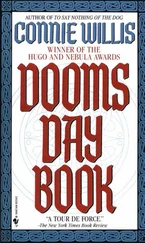
Connie Willis - Doomsday Book
Здесь есть возможность читать онлайн «Connie Willis - Doomsday Book» весь текст электронной книги совершенно бесплатно (целиком полную версию без сокращений). В некоторых случаях можно слушать аудио, скачать через торрент в формате fb2 и присутствует краткое содержание. Год выпуска: 1992, ISBN: 1992, Издательство: Bantam Books, Жанр: Фантастика и фэнтези, Социально-психологическая фантастика, на английском языке. Описание произведения, (предисловие) а так же отзывы посетителей доступны на портале библиотеки ЛибКат.
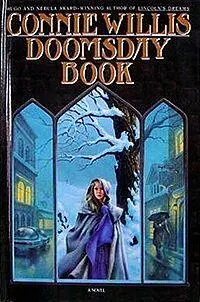
- Название:Doomsday Book
- Автор:
- Издательство:Bantam Books
- Жанр:
- Год:1992
- ISBN:ISBN 0-553-35167-2
- Рейтинг книги:3 / 5. Голосов: 1
-
Избранное:Добавить в избранное
- Отзывы:
-
Ваша оценка:
Doomsday Book: краткое содержание, описание и аннотация
Предлагаем к чтению аннотацию, описание, краткое содержание или предисловие (зависит от того, что написал сам автор книги «Doomsday Book»). Если вы не нашли необходимую информацию о книге — напишите в комментариях, мы постараемся отыскать её.
is an intelligent and satisfying blend of classic science fiction and historical reconstruction. Kivrin, a history student at Oxford in 2048, travels back in time to a 14th-century English village, despite a host of misgivings on the part of her unofficial tutor. When the technician responsible for the procedure falls prey to a 21st-century epidemic, he accidentally sends Kivrin back not to 1320 but to 1348 — right into the path of the Black Death. Unaware at first of the error, Kivrin becomes deeply involved in the life of the family that takes her in. But before long she learns the truth and comes face to face with the horrible, unending suffering of the plague that would wipe out half the population of Europe. Meanwhile, back in the future, modern science shows itself infinitely superior in its response to epidemics, but human nature evidences no similar evolution, and scapegoating is still alive and well in a campaign against "infected foreigners." This book finds villains and heroes in all ages, and love, too, which Kivrin hears in the revealing and quietly touching deathbed confession of a village priest. Won Nebula Award for Best Novel in 1992
Won Hugo Award for Best Novel in 1993
Doomsday Book — читать онлайн бесплатно полную книгу (весь текст) целиком
Ниже представлен текст книги, разбитый по страницам. Система сохранения места последней прочитанной страницы, позволяет с удобством читать онлайн бесплатно книгу «Doomsday Book», без необходимости каждый раз заново искать на чём Вы остановились. Поставьте закладку, и сможете в любой момент перейти на страницу, на которой закончили чтение.
Интервал:
Закладка:
Roche came into the courtyard. "Ulric, Hal's son," he said, walking with her into the house, "and one of the steward's sons, the eldest, Walthef." He stumbled the into bench nearest the door.
"You're exhausted," Kivirn said. "You should lie down and rest."
On the other side of the hall, Imeyne stood up, getting awkwardly to her feet, as though her legs had fallen asleep, and started across the hall toward them.
"I cannot stay. I came to fetch a knife to cut the willows," Roche said, but he sat down by the fire and stared blankly into it.
"Rest a minute at least," Kivrin said. "I will fetch you some ale." She pushed the bench to the side and started out.
"You have brought this sickness," Lady Imeyne said.
Kivrin turned. The old lady was standing in the middle of the hall, glaring at Roche. She held her book to her chest with both hands. Her reliquary dangled from them. "It is your sins have brought the sickness here."
She turned to Kivrin. "He said the litany for Martinmas on St. Eusebius' Day. His alb is dirty." She sounded as she had when she was complaining to Sir Bloet's sister, and her hands fumbled with the reliquary, counting off his sins on the links of the chain. "He did not shut the church door after vespers last Wednesday."
Kivrin watched her, thinking, she's trying to justify her own guilt. She wrote the bishop asking for a new chaplain, she told him where they were. She can't bear the knowledge that she helped bring the plague here, Kivrin thought, but she couldn't summon up any pity. You have no right to blame Roche, she thought, he has done everything he can. And you've sat in a corner and prayed.
"God has not sent this plague as a punishment," she told Imeyne coldly. "It's a disease."
"He forgot the Confiteor Deo," Imeyne said, but she hobbled back to her corner and lowered herself to her knees. "He put the altar candles on the rood screen."
Kivrin went over to Roche. "No one is to blame," she said.
He was staring into the fire. "If God does punish us," he said, "it must be for some terrible sin."
"No sin," she said. "It is not a punishment."
"Dominus!" the clerk cried, trying to sit up. He coughed again, a racking, terrible cough that sounded like it would tear his chest apart, though nothing came up. The sound woke Rosemund and she began to whimper, and if it isn't a punishment, Kivrin thought, it certainly looks like one.
Rosemund's sleep had not helped her at all. Her temp was back up again, and her eyes had begun to look sunken. She jerked as if flogged at the slightest movement.
It's killing her, Kivrin thought. I have to do something.
When Roche came in again, she went up to the bower and brought down Imeyne's casket of medicines. Imeyne watched, her lips moving soundlessly, but when Kivrin set it in front of her and asked her what was in the linen bags, she put her folded hand up to her face and closed her eyes.
Kivrin recognized some of them. Mr. Dunworthy had made her study medicinal herbs, and she recognized comfrey and lungwort and the crushed leaves of tansy. There was a little pouch of powdered mercury sulfide, which no one in their right mind would give anyone, and a packet of foxglove, which was almost as bad.
She boiled water and poured in every herb she recognized and steeped it. The fragrance was wonderful, like a breath of summer, and it tasted no worse than the willow-bark tea, but it didn't help either. By nightfall, the clerk was coughing continuously, and red blotches had begun to appear on Rosemund's stomach and arms. Her bubo was the size of an egg and as hard. When Kivrin touched it, she screamed with pain.
During the Black Death the doctors had put poultices on the buboes or lanced them. They had also bled people and dosed them with arsenic, she thought, though the clerk had seemed better after his buboes broke, and he was still alive. But lancing it might spread the infection or, worse, take it into the bloodstream.
She heated water and wet rags to lay on the bubo, but even though the water was lukewarm, Rosemund screamed at the first touch. Kivrin had to go back to cold water, which did no good. None of it's doing any good, she thought, holding the wet cold cloth against Rosemund's armpit. None of it.
I must find the drop, she thought. But the woods stretched on for miles, with hundreds of oak trees, dozens of clearings. She would never find it. And she couldn't leave Rosemund.
Perhaps Gawyn would turn back. They had closed the gates of some cities — perhaps he would not be able to get in, or perhaps he would talk to people on the roads and realize Lord Guillaume must be dead. Come back, she willed him, hurry. Come back.
Kivrin went through Imeyne's bag again, tasting the contents of the pouches. The yellow powder was sulfur. Doctors had used that during epidemics, too, burning it to fumigate the air, and she remembered learning in History of Meds that sulfur killed certain bacteria, though whether that was only in the sulfa compounds she couldn't remember. It was safer than cutting the bubo open, though.
She sprinkled a little on the fire to test it, and it billowed into a yellow cloud that burned Kivrin's throat even through her mask. The clerk gasped for breath, and Imeyne, over in her corner, set up a continuous hacking.
Kivrin had expected the smell of bad eggs to disperse in a few minutes, but the yellow smoke hung in the air like a pall, burning their eyes. Maisry ran outside, coughing into her apron, and Eliwys took Imeyne and Agnes up to the loft to escape it.
Kivrin propped the manor door open and fanned the air with one of the kitchen cloths, and after awhile the air cleared a little, though her throat still felt parched. The clerk continued to cough, but Rosemund stopped, and her pulse slowed till Kivrin could scarcely feel it.
"I don't know what to do," Kivrin said, holding her hot, dry wrist. "I've tried everything.
Roche came in, coughing.
"It is the sulfur," she said. "Rosemund is worse."
He looked at her and felt her pulse and then went out again, and Kivrin took that as a good sign. He would not have left if she were truly bad.
He came back in a few minutes, wearing his vestments and carrying the oil and viaticum of the last rites.
"What is it?" Kivrin said. "Has the steward's wife died then?"
"Nay," he said, and looked past her at Rosemund.
"No," Kivrin said. She scrambled to her feet to stand between him and Rosemund. "I won't let you."
"She must not die unshriven," he said, still looking at Rosemund.
"Rosemund isn't dying," Kivrin said, and followed his gaze.
She looked already dead, her chapped lips half-open and her eyes blind and unblinking. Her skin had taken on a yellowish cast and was stretched tautly over her narrow face. No, Kivrin thought desperately. I must do something to stop this. She's twelve years old.
Roche moved forward with the chalice, and Rosemund raised her arm, as if in supplication, and then let it fall.
"We must open the plague-boil," Kivrin said. "We must let the poison out."
She thought he was going to refuse, to insist on hearing Rosemund's confession first, but he did not. He set the chrism and chalice down on the stone floor and went to fetch a knife.
"A sharp one," Kivrin called after him, "and bring wine." She set the pot of water on the fire again. When he came back with the knife, she washed it off with water from the bucket, scrubbing the encrusted dirt near the hilt with her fingernails. She held it in the fire, the hilt wrapped in the tail of her surcote, and then poured boiling water over it and then wine and then the water again.
They moved Rosemund closer to the fire, the side with the bubo facing it so they could have as much light as possible, and Roche knelt at Rosemund's head. Kivrin slipped her arm gently out of her shift and bunched the fabric under her for a pillow. Roche took hold of her arm, turning it so the swelling was exposed.
Читать дальшеИнтервал:
Закладка:
Похожие книги на «Doomsday Book»
Представляем Вашему вниманию похожие книги на «Doomsday Book» списком для выбора. Мы отобрали схожую по названию и смыслу литературу в надежде предоставить читателям больше вариантов отыскать новые, интересные, ещё непрочитанные произведения.



Обсуждение, отзывы о книге «Doomsday Book» и просто собственные мнения читателей. Оставьте ваши комментарии, напишите, что Вы думаете о произведении, его смысле или главных героях. Укажите что конкретно понравилось, а что нет, и почему Вы так считаете.