Robert Sawyer - Frameshift
Здесь есть возможность читать онлайн «Robert Sawyer - Frameshift» весь текст электронной книги совершенно бесплатно (целиком полную версию без сокращений). В некоторых случаях можно слушать аудио, скачать через торрент в формате fb2 и присутствует краткое содержание. Год выпуска: 1998, ISBN: 1998, Издательство: Tor Science Fiction, Жанр: Фантастика и фэнтези, на английском языке. Описание произведения, (предисловие) а так же отзывы посетителей доступны на портале библиотеки ЛибКат.
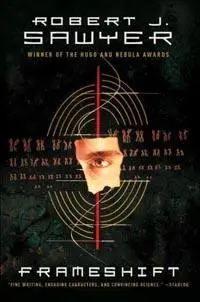
- Название:Frameshift
- Автор:
- Издательство:Tor Science Fiction
- Жанр:
- Год:1998
- ISBN:0-812-57108-8
- Рейтинг книги:4 / 5. Голосов: 1
-
Избранное:Добавить в избранное
- Отзывы:
-
Ваша оценка:
Frameshift: краткое содержание, описание и аннотация
Предлагаем к чтению аннотацию, описание, краткое содержание или предисловие (зависит от того, что написал сам автор книги «Frameshift»). Если вы не нашли необходимую информацию о книге — напишите в комментариях, мы постараемся отыскать её.
Frameshift — читать онлайн бесплатно полную книгу (весь текст) целиком
Ниже представлен текст книги, разбитый по страницам. Система сохранения места последней прочитанной страницы, позволяет с удобством читать онлайн бесплатно книгу «Frameshift», без необходимости каждый раз заново искать на чём Вы остановились. Поставьте закладку, и сможете в любой момент перейти на страницу, на которой закончили чтение.
Интервал:
Закладка:
The man was moving slowly toward them, but the boy was still blocking the entrance with his body. “You’re wasting your time,” said the boy. “He’s blind.”
Avi felt his heart sinking. Not again! Damn it, why hadn’t he thought to check on this before leaving the States? How was he going to explain this one to his boss? “Yes, sir, that’s right, I spent three thousand dollars flying halfway across the world to show some pictures to a bunch of blind old men.”
The old fellow was still working his way down the corridor. “I — I’m sorry to have disturbed you,” Avi said, turning to go.
“What do you two want?” asked Malamud, his voice as dry as the desert.
“Nothing,” said Avi, and then, almost at once, thinking for a second that his Hebrew had failed him, “Did you say ‘you two?” Tischler hadn’t uttered a word since they’d arrived.
“Speak up, young man. I can hardly hear you.”
Avi wheeled on the teenager. “Is he blind, or isn’t he?”
“ ‘Course he is,” said the boy. “Well, legally blind.”
“Mr. Malamud, how much vision do you have left?”
“Not much.”
“If I show you a series of photographs, could you tell them apart?”
“Maybe.”
“Can we come in?”
The old man thought for a long time. “I guess,” he said at last.
The teenager, looking quite miffed at having had an end run done around him, reluctantly moved aside. Avi and Tischler followed Malamud as he moved at a snail’s pace down to the kitchen. He found a chair — whether he could actually see it, or simply knew where it would be, Avi couldn’t tell. After he’d sat down, he waved for Avi and Tischler to do the same. Avi opened up his briefcase and took out a small cassette recorder, thumbed it on, then placed it on the table near Malamud. He then took out the photo spread, unfolding it at its central masking-tape hinge and placing it in front of Malamud. The spread consisted of three rows of eight photos, twenty-four in all.
“These are modern pictures,” said Avi. “They all show men in their eighties or nineties. But we’re trying to identify someone you might have known in your youth — someone you would have known in the early 1940s.”
The old man looked up, his eyes full of hope. “You’ve found Saul?”
Avi looked at the teenager. “Who is Saul?”
“His brother,” said the boy. “He disappeared in the war. My grandfather was taken to Treblinka; Saul was taken to Chelm.”
“I’ve been looking for him ever since,” said Malamud. “And now you’ve found him!”
Avi knew this was ideal: if Malamud thought he was looking for someone else and still spotted Ivan Grozny, the identification would be very hard to discredit in court. But Avi couldn’t bear to use the man like that. “No,” he said. “No, I’m so sorry, but this has nothing to do with your brother.”
The man’s face visibly sank. “Then what?”
“If you can just look at these pictures…”
Malamud took a moment to compose himself, then fumbled for a pair of glasses in his breast pocket. They had enormously thick lenses. He balanced them on his large, pitted nose, and peered at the pictures for a few moments. “Still can’t see them very well,” he said.
Avi sighed. But then Malamud continued, “Ezra, go and get my lens.”
The boy, now somewhat intrigued by the proceedings, seemed reluctant to leave, but, after a moment’s hesitation, he disappeared into another room and then returned brandishing a magnifying glass worthy of Sherlock Holmes. The old man removed his glasses, held out his hand, let Ezra place the lens within it, and then bent over the photo spread again.
“No,” he said, looking at the first photo, and “No,” again, after peering at the second.
“Remember,” said Avi, knowing he should keep quiet, but unable to do so, “you’re looking for someone from fifty-odd years ago. Try to imagine them as young men.”
The man grunted, as if to say there was no need to remind him of that — he might be old, but he wasn’t stupid. He moved from face to face, his own eye only inches above the snapshots. “No. No. Not him, either.
No — oh, my! Oh, heaven — oh, heaven.” His finger was on the Danielson photo. “It’s him! After all these years, you’ve found him!”
Avi felt his pulse racing. “Who?” he said, trying to keep his voice under control. “Who is it?”
“That monster from Treblinka.” The man’s face had gone completely white and his hand was shaking so much it looked like he was going to drop the magnifying glass. Ezra reached over and took it gently from his grandfather.
“Who is he?” asked Avi. “What’s his name?”
“Ivan,” said the old man, practically spitting the word. “Ivan Grozny.”
“Are you sure?” said Avi. “Do you have any doubt?”
“Those eyes. That mouth. No — no doubt. It’s him, the very devil himself.”
Avi closed his eyes. “Thank you,” he said. “If we draw up a statement to that effect, will you sign it?”
The old man turned to face Avi. “Where is he? Have you got him?”
“He’s in the United States.”
“You’ll bring him here? To stand trial?”
“Yes.”
The old man was silent for a long time, then: “Yes, I’ll sign a statement.
You’re afraid I’ll die before the trial, aren’t you? Afraid I won’t live to identify him in court?”
Avi said nothing.
“I’ll live,” said the old man simply. “You’ve given me something to live for.” He reached out, trying to find Avi’s hand. They connected, Avi feeling the rough, loose skin. As he reached out, Malamud’s sleeve rode up his forearm, revealing his serial-number tattoo. “Thank you,” said Malamud.
“Thank you for bringing him to justice.” He paused. “What did you say your name was again?”
“Meyer, sir. Agent Avi Meyer, of the United States Department of Justice.”
“I knew someone named Meyer, at Treblinka. Jubas Meyer. He was my partner in removing bodies.”
Avi felt his eyes stinging. “That was my father.”
“A good man, Jubas.”
“He died before I was born,” said Avi. “What — what was he like?”
“Sit down,” said Malamud, “and I’ll tell you.”
Avi looked at Tischler, his eyes asking for the Israeli cop’s indulgence.
“Go ahead,” said Tischler gently. “Family is important.”
Avi took a seat, his heart pounding.
Malamud told him stories about Jubas, and Avi listened, rapt. When the old man had recounted all he could remember, Avi shook his hand again. “Thank you,” he said. “Thank you so very much.”
Malamud shook his head, “No, son — thank you . Thank you for both of us, both me and your father. He’d be very proud of you today.”
Avi smiled, blinking away tears.
Pierre had done tests on various types of primate DNA collected from the zoo, determining not just the degree of genetic divergence but also specific ways in which key segments of their chromosome thirteens varied.
Pierre and Shari were now immersed in designing a computer simulation.
They integrated all the cytosine-methylation data they had, all the patterns they’d detected in the human and nonhuman introns, all the ideas they had about the significance of codon synonyms.
It was a massive project, with a huge database. The simulation was far too complex for them to run in any reasonable amount of time on their lab’s PC. But LBNL had a Cray supercomputer, a machine that could crunch all the numbers six ways from Sunday in the blink of an eye. Pierre had long ago put in a request for some CPU time on the Cray, and he’d slowly been moving up the queue. His time was scheduled for two weeks from now.
Читать дальшеИнтервал:
Закладка:
Похожие книги на «Frameshift»
Представляем Вашему вниманию похожие книги на «Frameshift» списком для выбора. Мы отобрали схожую по названию и смыслу литературу в надежде предоставить читателям больше вариантов отыскать новые, интересные, ещё непрочитанные произведения.


Обсуждение, отзывы о книге «Frameshift» и просто собственные мнения читателей. Оставьте ваши комментарии, напишите, что Вы думаете о произведении, его смысле или главных героях. Укажите что конкретно понравилось, а что нет, и почему Вы так считаете.