Robert Sawyer - Frameshift
Здесь есть возможность читать онлайн «Robert Sawyer - Frameshift» весь текст электронной книги совершенно бесплатно (целиком полную версию без сокращений). В некоторых случаях можно слушать аудио, скачать через торрент в формате fb2 и присутствует краткое содержание. Год выпуска: 1998, ISBN: 1998, Издательство: Tor Science Fiction, Жанр: Фантастика и фэнтези, на английском языке. Описание произведения, (предисловие) а так же отзывы посетителей доступны на портале библиотеки ЛибКат.
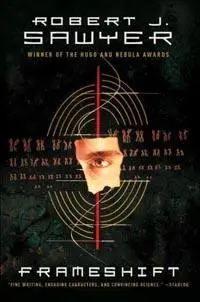
- Название:Frameshift
- Автор:
- Издательство:Tor Science Fiction
- Жанр:
- Год:1998
- ISBN:0-812-57108-8
- Рейтинг книги:4 / 5. Голосов: 1
-
Избранное:Добавить в избранное
- Отзывы:
-
Ваша оценка:
Frameshift: краткое содержание, описание и аннотация
Предлагаем к чтению аннотацию, описание, краткое содержание или предисловие (зависит от того, что написал сам автор книги «Frameshift»). Если вы не нашли необходимую информацию о книге — напишите в комментариях, мы постараемся отыскать её.
Frameshift — читать онлайн бесплатно полную книгу (весь текст) целиком
Ниже представлен текст книги, разбитый по страницам. Система сохранения места последней прочитанной страницы, позволяет с удобством читать онлайн бесплатно книгу «Frameshift», без необходимости каждый раз заново искать на чём Вы остановились. Поставьте закладку, и сможете в любой момент перейти на страницу, на которой закончили чтение.
Интервал:
Закладка:
“That’s the same thing.”
“Not necessarily. It’s only the same thing if his mother had never been married before.”
“But — oh, shit. Shit, shit, shit.”
“You see? What was Demjanjuk’s mother’s first name?”
“Olga. She died in 1970.”
“If Olga had been born Olga Tabachuk, but had married a man named Marchenko and then later divorced him before marrying John Demjanjuk’s father—”
“—Nikolai Demjanjuk—”
“—then when asked his mother’s maiden name, and interpreting it as meaning his mother’s previous name, John Demjanjuk would have answered ‘Marchenko.’ And if Olga had had one son named Ivan in 1911 by this elder Marchenko, and another son named Ivan nine years later by Nikolai Demjanjuk, then—”
“Then Ivan Marchenko and Ivan Demjanjuk would be half brothers!” said Avi.
“Exactly! Half brothers, having about twenty-five percent of their DNA in common. In fact, it even makes sense that they’re both bald. The gene for male-pattern baldness is inherited from the mother; it resides on the X chromosome. And it explains why they look so much alike — why witness after witness mistook one for the other.”
“But wait — wait. That doesn’t work. Nikolai and Olga Tabachuk were married January twenty-fourth, 1910, and Ivan Marchenko was born after that — on March second, 1911. That means he would have been conceived in the summer of 1910 — after Olga had already ended up with the legal last name of Demjanjuk.”
Pierre frowned for a moment, but then, thinking briefly of his own mother and Henry Spade, he exclaimed, “A triangle!”
Avi looked at him. “What?”
“A triangle — don’t you see? Think about John Demjanjuk’s own marriage from 1947. I remember reading that he’d been fooling around with another man’s wife while that man was away.” Pierre paused. “You know, we sometimes sum up the geneticist’s creed as ‘like father, like son’ — but ‘like mother, like son’ is just as valid for many things. My wife the behaviorist doesn’t like to admit it, but particular kinds of infidelity do run in families. Let’s say Olga Tabachuk married the senior Marchenko, divorced him, and then married Nikolai Demjanjuk.”
Avi nodded. “Okay.”
“But Nikolai leaves their village and heads out to — what town was Demjanjuk born in?”
“Dub Macharenzi.”
“To Dub-whatever. He goes there, looking for work or something like that, saying he’ll send for his wife once he’s got a place. Well, while the cat’s away… Olga goes back to sleeping with her ex, Marchenko. She gets pregnant and gives birth to Marchenko’s child, a child they name Ivan.
But then Nikolai sends word for her to come join him in Dub-thingie. Olga abandons baby Ivan, leaving him with the elder Marchenko. In fact — well, here’s one my wife would like: Ivan Marchenko grew up to have a predilection for slicing off women’s nipples. Call that his revenge for having been abandoned by his mother.”
Avi was nodding slowly. “You know, it makes sense. If Olga really did abandon the baby Ivan Marchenko, and if her second husband, Nikolai Demjanjuk, never knew about that incident, when she finally had a son of her own by Nikolai, that could explain why she decided to name him Ivan, too — so that she could never give herself away by accidentally referring to her legitimate son by the bastard child’s name.” Avi looked down at the autorads. “So — so one of these was made from the tissue specimen I sent you that we’d taken from John Demjanjuk, right?”
Pierre nodded, and touched the one on the left. “This one, to be precise.”
“And the other one — not Abraham Danielson?”
“Yes, indeed.”
“How’d you manage to get a tissue sample from him? I thought you’d only seen him from a distance.”
“I had a little device built.” He slowly got up from his stool and, holding on to the rounded lip of the countertop for support, made his way over to a shelf and picked up a small object from it. He returned to where Avi was sitting and extended his shaking hand so that Avi could see what he was holding. It was impossible to get a good look at it the way Pierre’s arm kept moving; Avi reached in and plucked the small device from Pierre’s palm. It looked like a tiny beige thumbtack, with a very short, very narrow spike.
“I call it a joy buzzer,” said Pierre, sitting down again. “It sticks to the palm of your hand with a minuscule drop of cyanoacrylate glue, and when you shake hands with someone, it takes a sample of a few skin cells. The pressure of the handshake is enough to distract from the minute pricking sensation.” He held up a hand. “I can’t take full credit for it — I got the idea from a special pen Condor Health uses; it seemed poetic justice to employ a similar device. A fellow I know, a newspaper reporter — same one who took the photo I originally faxed you of Abraham Danielson — wore it going into a meeting with Danielson, and shook his hand in greeting.”
Avi nodded, impressed. “Can I have copies of these… these — what do you call them?”
“Autorads.”
“These autorads?”
“Sure. Why?”
“When we’re through, I want to send them to Demjanjuk’s lawyer in Cleveland. Maybe they’ll help him get his U.S. citizenship back.” He looked at Pierre, then shrugged a little. “It’s the least I can do.”
Pierre nodded. “So where do we stand?”
“We’ve got two eyewitness identifications, both positive. But, well, the witnesses are old, and one of them is legally blind. I wish we had more.
Still, this half brother stuff to some degree rehabilitates the positive identifications made during Demjanjuk’s denaturalization and his trial in Israel.”
“So have you got enough to move against Marchenko?”
Avi sighed. “I don’t know. Danielson wasn’t even suspected of being a Nazi. He’s done a great job of covering his tracks.”
“He’s doubtless been able to pay off people over the last few years — make any records he wants disappear.”
“More than likely.” Avi shook his head. “The Israelis are going to be very wary about taking him on, especially after what happened last time.”
“So what else would you need to make the case?”
Avi shrugged. “In the best of all possible worlds? A confession.”
Pierre frowned. Of course, Molly could confirm Danielson’s guilt easily enough, but there was no way Pierre wanted her to have to testify in court.
“I could meet with him while wired for sound.”
“What makes you think he’ll agree to see you?” The way Avi said “you” grated a little — it was almost as if Avi were saying, “What makes you think he’ll see someone in your condition?”
Pierre gritted his teeth. “We’ll find a way.”
“Even if he is willing to see you,” said Avi, spreading his arms, “what makes you think he’ll confess to you?”
“He doesn’t have to confess then and there. He just has to say something incriminating enough to justify you arresting him. Then you can interrogate him properly.”
“I suppose. It would take some paperwork.”
“Do it. Set it up.”
“I don’t know, Pierre. You’re a civilian, and—”
“I’m a volunteer. You want to see that bastard go free?”
Avi frowned, considering. “All right,” he said at last. “Let’s give it a try.”
Chapter 41
“Abraham Danielson’s office,” said a woman’s voice.
“May I speak to him, please?”
“Who’s calling?”
“Dr. Pierre Tardivel.”
“One moment.”
Silence.
“I’m sorry, Dr. Tardivel, Mr. Danielson is unable to take your call just now. Would you like to leave a message?”
Читать дальшеИнтервал:
Закладка:
Похожие книги на «Frameshift»
Представляем Вашему вниманию похожие книги на «Frameshift» списком для выбора. Мы отобрали схожую по названию и смыслу литературу в надежде предоставить читателям больше вариантов отыскать новые, интересные, ещё непрочитанные произведения.




Обсуждение, отзывы о книге «Frameshift» и просто собственные мнения читателей. Оставьте ваши комментарии, напишите, что Вы думаете о произведении, его смысле или главных героях. Укажите что конкретно понравилось, а что нет, и почему Вы так считаете.