Robert Sawyer - Frameshift
Здесь есть возможность читать онлайн «Robert Sawyer - Frameshift» весь текст электронной книги совершенно бесплатно (целиком полную версию без сокращений). В некоторых случаях можно слушать аудио, скачать через торрент в формате fb2 и присутствует краткое содержание. Год выпуска: 1998, ISBN: 1998, Издательство: Tor Science Fiction, Жанр: Фантастика и фэнтези, на английском языке. Описание произведения, (предисловие) а так же отзывы посетителей доступны на портале библиотеки ЛибКат.
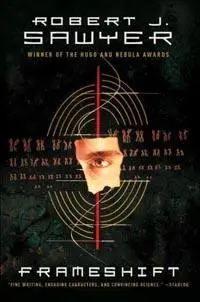
- Название:Frameshift
- Автор:
- Издательство:Tor Science Fiction
- Жанр:
- Год:1998
- ISBN:0-812-57108-8
- Рейтинг книги:4 / 5. Голосов: 1
-
Избранное:Добавить в избранное
- Отзывы:
-
Ваша оценка:
Frameshift: краткое содержание, описание и аннотация
Предлагаем к чтению аннотацию, описание, краткое содержание или предисловие (зависит от того, что написал сам автор книги «Frameshift»). Если вы не нашли необходимую информацию о книге — напишите в комментариях, мы постараемся отыскать её.
Frameshift — читать онлайн бесплатно полную книгу (весь текст) целиком
Ниже представлен текст книги, разбитый по страницам. Система сохранения места последней прочитанной страницы, позволяет с удобством читать онлайн бесплатно книгу «Frameshift», без необходимости каждый раз заново искать на чём Вы остановились. Поставьте закладку, и сможете в любой момент перейти на страницу, на которой закончили чтение.
Интервал:
Закладка:
“This is it,” said Tischler, checking the number on the house against an address he had written down on a Post-it note in his hand, folded in half so that the adhesive strip was covered over. The door was set back only a meter from the road. Weeds grew out of the cracks in the stone walk, but the beauty of the ceramic mezuzah on the doorpost caught Avi’s eye. He knocked. After about half a minute, a middle-aged woman appeared.
“ Shalom,” said Avi. “My name is Avi Meyer, and this is Detective Tischler, of the Israeli State Police. Is Casimir Landowski home?”
“He’s upstairs. What’s this all about?”
“May we speak to him?”
“About what?”
“We just need him to identify some photos.”
The middle-aged woman looked from one man to the other. “You’ve found Ivan Grozny,” she said flatly.
Avi cringed. “It’s important that the identification not be prejudiced. Is Casimir Landowski your father?”
“Yes. My husband and I have looked after him since his wife died.”
“Your father can’t know in advance who we’re asking him to identify. If he knows, the defense lawyers will be able to get the identification ruled ineligible. Please, don’t say a word to him.”
“He won’t be able to help you.”
“Why not?”
“Because he’s blind, that’s why not. Complications from diabetes.”
“Oh,” said Avi, his heart sinking. “I’m sorry.”
“Even if he could see,” said the woman, “I’m not sure I’d let you speak to him.”
“Why?”
“We watched the trial of John Demjanjuk on TV. What was that, ten or more years ago? He could see then — and he knew you had the wrong guy.
They’d shown him pictures of Demjanjuk, and he’d said it wasn’t Ivan.”
“I know. That’s why he’d have made a great witness this time.”
“But it tore him up, watching that trial. All that testimony about Treblinka. He’d never spoken about it — my whole life, he’d never said a word to me. But he sat there, transfixed, day in and day out, listening to the testimony. He knew some of those who were testifying. Hearing them recount the things that butcher did — murder and rape and torture. He thought if he never spoke about it, somehow he could separate it from his life, keep it isolated from everything else. To have to live through it all again, even from the comfort of his living room, almost killed him. To ask him to do that once more — such a thing I’d never do. He’s ninety-three; he’d never survive it.”
“I’m sorry,” said Avi. He looked at the woman, trying to size her up. It occurred to him that perhaps the man wasn’t really blind. Maybe she was just trying to shelter him. “I, ah, I’d like to speak to your father anyway, if I may. You know, just to shake his hand. I’ve come all the way from the United States.”
“You don’t believe me,” she said, in the same blunt tone she’d used before. But then she shrugged. “I’ll let you talk to him, but you can’t say a word about why you’re here. I won’t have you upsetting him.”
“I promise.”
“Come in, then.” She headed upstairs, Avi and Tischler following. The man was sitting in a chair in front of a television set. Avi thought he’d caught the woman in a lie, but it soon became apparent that he wasn’t watching the TV. Rather, he was just listening to it. A talk show in Hebrew was on. The interviewer, a young woman, was asking her guests about their first sexual experiences. The man was listening intently. In the corner of the room, a white cane leaned against a wall.
“ Abba,” said the woman, “I’d like you to meet two people. They’re just passing through town. Old friends of mine.”
The man rose slowly, painfully, to his feet. As soon as he was standing, Avi saw his eyes. They were completely clouded over. “It’s a great pleasure to meet you,” said Avi, taking the man’s gnarled hand. “A great pleasure.”
“Your accent — you’re American?”
“Yes.”
“What brings you to Israel?” asked the man, his voice low.
“Just the sights,” said Avi. “You know — the history.”
“Oh, yes,” said the old man. “We’ve got lots of that.”
The phone in Pierre’s lab rang. He hobbled over to answer it. “Hello?”
“Pierre?”
“Hi, Avi. What’s the score?”
“Forces of good, zero. Forces of evil, two.”
“No IDs?”
“Not yet. The second guy is blind. Complications of diabetes, his daughter said.”
Pierre snorted.
“What’s so funny?”
“It’s not funny, really. Just ironic. The first guy had Alzheimer’s and this one has diabetes. Those are both genetically related. As Danielson, Marchenko discriminates against people who have those same diseases, and now those diseases are saving him.”
“Yeah,” said Avi. “Well, let’s hope things go better. We’ve only got two shots left.”
“Keep me posted.”
“Right. Bye.”
Pierre went back to the light table, hunching over the two autorads. He kept at it for hours, but when he was done, he leaned back and nodded to himself in satisfaction. It was exactly what he’d expected.
When Avi got back to the States, Pierre would have one hell of a surprise for him.
Avi and Detective Tischler drove down to Jerusalem for their next attempt. All the buildings were made of stone — there was an ordinance that required it; at sunset, the light reflecting from the stone transformed Jerusalem into the fabled City of Gold. They found the ancient house they were looking for and knocked on the door. After a few moments a young man, perhaps thirteen years old, appeared, wearing a yarmulke and a
Melrose Place T-shirt. Avi shook his head slightly. He was always surprised at how pervasive American pop culture was no matter where he traveled.
“Yes?” said the boy in Hebrew.
Avi smiled. “ Shalom ,” he said. He knew his Hebrew was rough, but he’d told Tischler that he wanted to do all the talking. He couldn’t risk the Israeli police officer saying anything that might contaminate the identification. “My name is Avi Meyer. I’m looking for Shlomo Malamud.”
“He’s my zayde ,” said the boy. But then his eyes immediately narrowed.
“What do you want?”
“Just to speak to him, just for a moment.”
“About what?”
Avi sighed. “I’m an American—”
“No shit,” said the boy, making it clear that this had been obvious from the first syllable Avi had uttered.
“—and this man is an Israeli police officer. Show him,” said Avi, turning to Tischler. Tischler pulled out his ID and held it up for the boy to see.
The boy shook his head. “My zayde is very old,” he said, “and almost never leaves the house. He hasn’t done anything.”
“We know that. We just need to talk to him for a moment.”
“Maybe you should come back when my father is home,” said the boy.
“When will that be?”
“Friday, for Shabbat. He’s on business right now, in Haifa.”
“What we want will only take a moment.” Through the doorway, Avi could see that an ancient man had appeared, oblivious of their presence, hunched over, shuffling toward the kitchen.
“Is that him?” asked Avi.
The boy didn’t have to look back. “He’s very old,” he said.
“Shlomo Malamud!” shouted Avi.
The man slowly turned around, a look of surprise on his deeply wrinkled, sun-battered face.
“Mar Malamud!” Avi shouted again. The man began to shuffle toward them.
“It’s all right,” said the boy, trying to stop his grandfather from coming nearer. “I’m taking care of everything.”
“Mar Malamud,” said Avi over the boy. “I’ve come a long way to ask you just one question, sir. I need you to look at some photographs and tell me if you recognize anyone.”
Читать дальшеИнтервал:
Закладка:
Похожие книги на «Frameshift»
Представляем Вашему вниманию похожие книги на «Frameshift» списком для выбора. Мы отобрали схожую по названию и смыслу литературу в надежде предоставить читателям больше вариантов отыскать новые, интересные, ещё непрочитанные произведения.


Обсуждение, отзывы о книге «Frameshift» и просто собственные мнения читателей. Оставьте ваши комментарии, напишите, что Вы думаете о произведении, его смысле или главных героях. Укажите что конкретно понравилось, а что нет, и почему Вы так считаете.