Robert Sawyer - Frameshift
Здесь есть возможность читать онлайн «Robert Sawyer - Frameshift» весь текст электронной книги совершенно бесплатно (целиком полную версию без сокращений). В некоторых случаях можно слушать аудио, скачать через торрент в формате fb2 и присутствует краткое содержание. Год выпуска: 1998, ISBN: 1998, Издательство: Tor Science Fiction, Жанр: Фантастика и фэнтези, на английском языке. Описание произведения, (предисловие) а так же отзывы посетителей доступны на портале библиотеки ЛибКат.
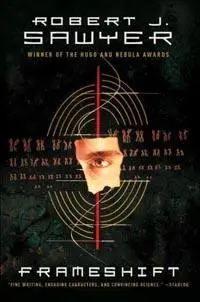
- Название:Frameshift
- Автор:
- Издательство:Tor Science Fiction
- Жанр:
- Год:1998
- ISBN:0-812-57108-8
- Рейтинг книги:4 / 5. Голосов: 1
-
Избранное:Добавить в избранное
- Отзывы:
-
Ваша оценка:
Frameshift: краткое содержание, описание и аннотация
Предлагаем к чтению аннотацию, описание, краткое содержание или предисловие (зависит от того, что написал сам автор книги «Frameshift»). Если вы не нашли необходимую информацию о книге — напишите в комментариях, мы постараемся отыскать её.
Frameshift — читать онлайн бесплатно полную книгу (весь текст) целиком
Ниже представлен текст книги, разбитый по страницам. Система сохранения места последней прочитанной страницы, позволяет с удобством читать онлайн бесплатно книгу «Frameshift», без необходимости каждый раз заново искать на чём Вы остановились. Поставьте закладку, и сможете в любой момент перейти на страницу, на которой закончили чтение.
Интервал:
Закладка:
Yes, he still ached at not being able to communicate with her the way he’d like to, but he was coming to realize how important that special relationship between Molly and Amanda was. Amanda seemed totally comfortable with Molly’s ability to reach into her mind and hear her thoughts; it was almost a relief to the girl that she could communicate without effort with another human being. And Molly’s bond with her daughter went beyond even the normal closeness of mother and child; she could touch Amanda’s very mind.
Pierre still thought mostly in French, and he knew, given that he virtually always spoke English, that he was doing this on some subconscious level as a defense against having his thoughts read. But Amanda had accepted her mother’s ability from the beginning, and she erected no barriers between herself and Molly; they had a closeness that was transcendental — and Pierre was, at last, glad of it. His wife was no longer tortured by her gift; rather, she was now grateful for it. And Pierre knew that after he was gone, Molly and Amanda would need that special closeness to support each other, to go on and face whatever the future might bring them together, almost as one.
“Try again,” Molly, her back to Pierre, said to Amanda. “You can do it.”
Pierre stepped fully into the room. “What are you two conspiring about?” he said lightly.
Molly looked up, startled. “Nothing,” she said too quickly. “Nothing.”
She looked embarrassed. Amanda’s brown eyes went wide, the way they did when she’d been caught doing something bad.
“You look like the cat who swallowed the canary,” Pierre said to Molly, a bemused smile on his face. “What are—”
The phone rang.
Molly leaped to her feet. “I’ll get it,” she said, bounding into the kitchen.
A moment later, she called out, “Pierre! It’s for you.”
Pierre made his way ponderously into the kitchen. The noise from the dishwasher was irritating, but it would take him several minutes to hobble down to the den or up to the bedroom to use a different phone.
“Hello?” said Pierre after taking the handset from his wife.
“Pierre? It’s Avi.”
Molly headed back to the living room; Pierre could barely hear her as she went back to talking to Amanda in conspiratorial tones.
“We’ve dug up Abraham Danielson’s immigration records,” continued Avi. “You’re right that that’s not his real name. Nothing unusual about that, though; lots of immigrants changed their names when they came here after the war. According to his visa application, his real name is Avrom Danylchenko. Born 1911, the same year as Ivan Marchenko — but, then again, so was Klimus, so that’s hardly compelling evidence. He was living in Rijeka at the time he applied to come to the States.”
“Okay.”
“We can’t find anything prior to 1945 about Avrom Danylchenko.
Again, that doesn’t prove spit. Lots of records were lost during the war, and there’s tons of stuff from the old Soviet Union that no one has sifted through yet. Still, it is interesting that the last record we have of Ivan Marchenko is Nikolai Shelaiev’s statement that he saw him in Fiume in 1944, and the first record of Avrom Danylchenko is his visa application the following year in Rijeka.”
“How far is Rijeka from Fiume?”
“I wondered that myself — couldn’t find Fiume in my atlas at first. It turns out — get this — that Fiume and Rijeka are the same place. Fiume is the old Italian name for the city.”
“Jesus. So what happens now?”
“I’m going to show the photo to the remaining Treblinka survivors. I’m flying out to New Mexico tomorrow to see one of them, and I’m off to Israel after that.”
“Surely you could just fax the photo to the police there,” said Pierre.
“No, I want to be on hand. I want to see the witnesses at the moment they first look at the photo. We were fucked over on the Demjanjuk case because the identifications weren’t handled properly. Yoram Sheftel — that’s Demjanjuk’s Israeli lawyer — says in all his years in the business, he’s never once seen the Israeli police conduct a proper photo-spread ID. In the Demjanjuk case, they used a photo spread that had Demjanjuk’s photo mixed in with seven others. But some of the photos were bigger or clearer than the others, and most of them didn’t bear even a passing resemblance to the man the witnesses had described.
This time I’m going to supervise it all, every step of the way. There aren’t going to be any fuckups.” A pause. “Anyway, I’ve got to get going.”
“Wait — one more thing.”
“What are you, Columbo?”
Pierre was taken aback. At least it was an improvement over everyone assuming he was a salesman. “When you have somebody in custody, what kind of identification records do you keep?”
“How do you mean?” said Avi.
“I mean you must keep records, right? The whole idea behind Nazi hunting is proving identity. Surely if you have someone in custody, you must take pains to make sure you can identify the same person again years later if need be.”
“Sure. We take fingerprints, even some retinal scans—”
“Do you take tissue samples? For DNA fingerprinting?”
“That sort of routine testing is not legal.”
“That’s not a direct answer. Do you do it? It’s easy enough, after all. All you need is a few cells. Do you do it?”
“Off the record, yes.”
“Were you doing that as far back as the 1980s?”
“Yes.”
“Would you have a tissue sample from John Demjanjuk still on file?”
“I imagine so. Why?”
“Get it. Have it sent to my lab by FedEx.”
“Why?”
“Just do it. If I’m right — if I’m right, I can clear up the mystery of exactly what went wrong at the Ivan the Terrible trial in Jerusalem all those years ago.”
Chapter 39
The phone rang again the next day. This time Pierre was down in the den, and he got it there. “Hello?”
“Pierre, it’s Avi. I’m calling you from O’Hare. I saw Zalmon Chudzik this morning; he’s one of the Treblinka survivors who now lives in the States.”
“And?”
“And the poor bastard’s got Alzheimer’s disease.”
“Merde.”
“Exactly. But, you know — this may sound cruel — but in this one case, maybe it’s a blessing.”
“Huh?”
“His daughter says he’s forgotten everything about Treblinka. For the first time in over fifty years, he’s managing to sleep through the night.”
Pierre didn’t know how to reply. After a few moments, he said, “When do you leave for Israel?”
“About three hours.”
“I hope you have better luck there.”
Avi’s voice was weary. “Me, too. There were only fifty Treblinka survivors, and over thirty-five of them have passed on in the intervening years. There are only four left who hadn’t previously misidentified Demjanjuk as Ivan — and Chudzik was one of those four.”
“What happens to our case if we don’t get a positive ID?”
“It evaporates. Look at all the evidence they had against O. J.
Simpson — made no difference to the jury. Without eyewitnesses, we’re sunk. And I do mean eyewitnesses, plural. The Israelis aren’t going to pay attention unless we get at least two independent IDs.”
“Good Christ,” said Pierre softly.
“At this stage,” said Avi, “I’d even take his help.”
Avi Meyer had spent the last few days wrangling back and forth over jurisdictional issues with Izzy Tischler, a plainclothes detective with the Nazi Crimes Investigation Division of the Israeli State Police. They were now ready to attempt their first ID. Tischler, a tall, thin, red-haired fellow of forty, wore a yarmulke; Avi was wearing a large canvas hat, trying to ward off the brutal sun. They walked down the narrow street, beside buildings of yellow brick with narrow balconies, packed one right up against the next. Two Orthodox Jewish men walked down the lane, and an Arab headed up the other way. They didn’t look at each other as they passed.
Читать дальшеИнтервал:
Закладка:
Похожие книги на «Frameshift»
Представляем Вашему вниманию похожие книги на «Frameshift» списком для выбора. Мы отобрали схожую по названию и смыслу литературу в надежде предоставить читателям больше вариантов отыскать новые, интересные, ещё непрочитанные произведения.






Обсуждение, отзывы о книге «Frameshift» и просто собственные мнения читателей. Оставьте ваши комментарии, напишите, что Вы думаете о произведении, его смысле или главных героях. Укажите что конкретно понравилось, а что нет, и почему Вы так считаете.