Robert Sawyer - Frameshift
Здесь есть возможность читать онлайн «Robert Sawyer - Frameshift» весь текст электронной книги совершенно бесплатно (целиком полную версию без сокращений). В некоторых случаях можно слушать аудио, скачать через торрент в формате fb2 и присутствует краткое содержание. Год выпуска: 1998, ISBN: 1998, Издательство: Tor Science Fiction, Жанр: Фантастика и фэнтези, на английском языке. Описание произведения, (предисловие) а так же отзывы посетителей доступны на портале библиотеки ЛибКат.
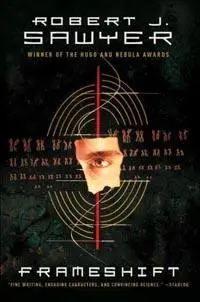
- Название:Frameshift
- Автор:
- Издательство:Tor Science Fiction
- Жанр:
- Год:1998
- ISBN:0-812-57108-8
- Рейтинг книги:4 / 5. Голосов: 1
-
Избранное:Добавить в избранное
- Отзывы:
-
Ваша оценка:
Frameshift: краткое содержание, описание и аннотация
Предлагаем к чтению аннотацию, описание, краткое содержание или предисловие (зависит от того, что написал сам автор книги «Frameshift»). Если вы не нашли необходимую информацию о книге — напишите в комментариях, мы постараемся отыскать её.
Frameshift — читать онлайн бесплатно полную книгу (весь текст) целиком
Ниже представлен текст книги, разбитый по страницам. Система сохранения места последней прочитанной страницы, позволяет с удобством читать онлайн бесплатно книгу «Frameshift», без необходимости каждый раз заново искать на чём Вы остановились. Поставьте закладку, и сможете в любой момент перейти на страницу, на которой закончили чтение.
Интервал:
Закладка:
“So,” said Klimus awkwardly. “How are your friends the Lagerkvists?”
“They’re fine,” said Molly. “Ingrid’s talking about going into private practice.”
“Ah,” said Klimus. “Would she stay in Berkeley?”
“If the Lagerkvists have any plans to move,” said Molly, “they’re keeping it a secret.” She paused for a beat. “Secrets are always interesting, aren’t they?” She looked right at the old man. “I mean, we’ve all got secrets. I do, Pierre does, even little Amanda does, I’m sure. What about you, Burian?
What’s your secret?”
What’s she on about ? thought Klimus.
“You know — something down deep, something hidden…”
She’s crazy if she thinks I’m going to talk about my private life.
“I don’t know what you expect me to say, Molly.”
“Oh, nothing really. I’m just rambling. Just wondering what makes a man like you tick. You know I’m a psychologist. You’ve got to forgive me for being intrigued by the mind of a genius.”
That’s more like it , though Klimus. A little respect .
“I mean,” said Molly, “normal people have all kinds of secrets — sexual things…”
Christ, I can’t remember the last time I had sex…
“Financial secrets — maybe a little cheating on the old income tax…”
No more than anyone else…
“Or secrets related to their jobs…”
Best damned job in the world, university professor. Travel, respect, d ecent money, power…
“Secrets related to your research…”
Not lately…
“To your earlier research…”
The prize should have been mine, anyway…
“To — to your Nobel Prize, maybe?”
Secrets Tottenham took to the grave…
Molly looked him directly in the eyes. “Who is Tottenham?”
Klimus’s parchment skin showed a little color. “Tottenham—”
“Yes, who is he?”
She.
“Or she?”
Christ, what is — “I don’t know anyone named—”
Amanda was playing with Pierre’s fingers. He spoke up.
“Tottenham — not Myra Tottenham?”
Molly looked at her husband. “You know that name?”
Pierre frowned, thinking. Where had he heard it before? “A biochemist at Stanford during the sixties. I read an old paper of hers recently on missense mutations.”
Molly’s eyes narrowed. She’d gone over Klimus’s bio in Who’s Who in preparation for today. “Weren’t you at Stanford in the sixties?” she said.
“Whatever happened to Myra Tottenham?”
“Oh, that Tottenham,” said Klimus. He shrugged. “She died in 1969, I think. Leukemia.” The frigid bitch .
Molly frowned. “Myra Tottenham. Pretty name. Did you work together?”
Tried to . “No.”
“It’s sad when somebody dies like that.”
Not for me . “People die all the time, Molly.” He rose to his feet. “Now, really, I must be going.”
“But the coffee—” said Pierre.
“No. No, I’m leaving now.” He made his way to the front door.
“Good-bye.”
Molly followed him to the door. Once he was gone she came back into the living room and clapped her hands together. Still in her father’s lap, Amanda turned to look at her, surprised by the sound. “Well?” said Pierre.
“I know I’ll never get you off hockey,” she said, “but fishing is my favorite sport.”
“How far is Stanford?” asked Pierre.
Molly shrugged. “Not far. Forty miles.”
Pierre kissed his daughter on the cheek and spoke to her in a soothing voice: “Soon you won’t have to see that mean old man anymore.”
Pierre couldn’t do the work himself; it required much too steady a hand. But LBNL did have a comprehensive machine shop: there was a wide variety of work done at Lawrence Berkeley, and custom-designed tools and parts had to be built all the time. Pierre had Shari sketch a design for him from his verbal description, and then he took the shuttle bus down to UCB, where he visited Stanley Hall, home of the university’s virus lab. He’d guessed right: that lab had the narrowest-gauge syringes he’d ever seen. He got several of them and headed back up to the machine shop.
The shop master, a mechanical engineer named Jesus DiMarco, looked over Pierre’s rough sketch and suggested three or four refinements, then went to write up the work order. LBNL was a government lab, and everything generated paperwork — although not nearly as much as a bureaucracy-crazy Canadian facility would have. “What do you call this gizmo?” asked DiMarco.
Pierre frowned, thinking. Then: “A joy-buzzer.”
DiMarco chuckled. “Pretty cute,” he said.
“Just call me koo ,” said Pierre.
“What?”
“You know—” He whistled the James Bond theme.
DiMarco laughed. “You mean Q.” He looked up at the wall clock. “Come back anytime after three. It’ll be ready.”
“Newsroom,” said the male voice.
“Barnaby Lincoln,” said Pierre into the phone. “He’s a business reporter.”
“He’s out right now, and — oh, wait. Here he comes.” The voice shouted into the phone; Pierre hated people who didn’t cover the mouthpiece when shouting. “Barney! Call for you!” The phone was dropped on a hard surface.
A few moments later it was picked up.
“Lincoln,” said the voice.
“Barnaby, it’s Pierre Tardivel at LBNL.”
“Pierre! Good to hear from you. Have you given some thought to what we talked about?”
“I’m intrigued, yes. But that’s not why I’m calling. First, though, thanks for the pictures of Danielson. They were terrific.”
“That’s why they pay me the big bucks,” said Lincoln, deadpan.
“I need you to do one more thing for me, though.”
“Yeah?”
“Are you going to be interviewing Abraham Danielson soon?”
“Geez, I haven’t interviewed the old man for — hell, must be six years now.”
“Would he see you if you called?”
“I guess, sure.”
“Can you arrange that? Can you get in to see him? Even for five minutes?”
“Sure, but why?”
“Set it up. But come by my lab on the way. I’ll explain everything when you get here.”
Lincoln thought this over for a moment. “This better be a good story,” he said at last.
“Can you say ‘Pulitzer’?” said Pierre.
The receptionist escorted Barnaby Lincoln into Abraham Danielson’s office.
“Barney,” said Abraham, rising from his leather chair.
Lincoln surged forward, hand extended. “Thanks for seeing me on such short notice.”
Abraham looked at Lincoln’s outstretched hand. Lincoln left it extended. The old man finally took it. They shook firmly.
Pierre had been working in the den at home — it was awkward getting into LBNL these days, since Molly had to drive him. He decided to head up to the living room to replenish his Diet Pepsi. Coffee was too dangerous a way to get his morning caffeine; he overturned his drink at least once a week now, and didn’t want to scald himself. And regular Pepsi contained all that sugar — it would ruin his keyboard or computer if he spilled it in there. But aspartame wasn’t conductive; it might make a mess, but it wouldn’t wreck electronics if spilled on them… Of course Pierre made a fair bit of noise going up the stairs, but the dishwasher was going, producing enough racket to drown out the sound. As he entered the living room, he saw Molly sitting with Amanda on the couch. Molly was saying something to Amanda that Pierre couldn’t quite make out, and Amanda seemed to be concentrating very, very hard.
He watched them for a moment — and was pleased that, to some degree, at least, his jealousy of his wife’s closeness to their daughter had passed.
Читать дальшеИнтервал:
Закладка:
Похожие книги на «Frameshift»
Представляем Вашему вниманию похожие книги на «Frameshift» списком для выбора. Мы отобрали схожую по названию и смыслу литературу в надежде предоставить читателям больше вариантов отыскать новые, интересные, ещё непрочитанные произведения.





Обсуждение, отзывы о книге «Frameshift» и просто собственные мнения читателей. Оставьте ваши комментарии, напишите, что Вы думаете о произведении, его смысле или главных героях. Укажите что конкретно понравилось, а что нет, и почему Вы так считаете.