Robert Sawyer - Frameshift
Здесь есть возможность читать онлайн «Robert Sawyer - Frameshift» весь текст электронной книги совершенно бесплатно (целиком полную версию без сокращений). В некоторых случаях можно слушать аудио, скачать через торрент в формате fb2 и присутствует краткое содержание. Год выпуска: 1998, ISBN: 1998, Издательство: Tor Science Fiction, Жанр: Фантастика и фэнтези, на английском языке. Описание произведения, (предисловие) а так же отзывы посетителей доступны на портале библиотеки ЛибКат.
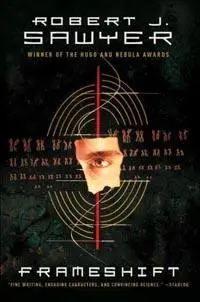
- Название:Frameshift
- Автор:
- Издательство:Tor Science Fiction
- Жанр:
- Год:1998
- ISBN:0-812-57108-8
- Рейтинг книги:4 / 5. Голосов: 1
-
Избранное:Добавить в избранное
- Отзывы:
-
Ваша оценка:
Frameshift: краткое содержание, описание и аннотация
Предлагаем к чтению аннотацию, описание, краткое содержание или предисловие (зависит от того, что написал сам автор книги «Frameshift»). Если вы не нашли необходимую информацию о книге — напишите в комментариях, мы постараемся отыскать её.
Frameshift — читать онлайн бесплатно полную книгу (весь текст) целиком
Ниже представлен текст книги, разбитый по страницам. Система сохранения места последней прочитанной страницы, позволяет с удобством читать онлайн бесплатно книгу «Frameshift», без необходимости каждый раз заново искать на чём Вы остановились. Поставьте закладку, и сможете в любой момент перейти на страницу, на которой закончили чтение.
Интервал:
Закладка:
But it’s not — it’s a wonderful thing. I come from Canada, where we believe that the right to health care is as inalienable as the right to free speech.
Senator Johnston’s law recognizes that none of us can control our genetic makeup.”
He paused to catch his breath — his diaphragm spasmed occasionally.
He noticed two security guards had appeared at the side of the theater; both had gun holsters. “I work on the Human Genome Project. We’re sequencing every bit of DNA that makes up a human being. We already know the location of the gene for Huntington’s disease — which is what I have — as well as the locations of the genes for some forms of Alzheimer’s and breast cancer and heart disease. But eventually we’ll know where e very gene is, what every gene does. We may very well have that knowledge in the lifetime of many people in this room. Today, there’s only a handful of things we can test genetically for, but tomorrow, we’ll be able to tell who will become obese, who will develop high cholesterol, who will get colon cancer. Then, if it weren’t for laws like Senator Johnston’s, it could be you or your already-born children or grandchildren who would have the safety net pulled out from beneath them, all in the name of profit.” His natural instinct at this moment was to spread his arms imploringly, but he couldn’t do that without losing his balance. “We shouldn’t be fighting to keep other states from adopting laws like the one here in California. Rather, we should be helping them all adopt such principles. We should—”
Craig Bullen spoke firmly into his own microphone. “Insurance is a business, Dr. Tardivel.”
Pierre started at the use of his name. The cat was clearly out of the bag.
“Yes, but—”
“And these good people” — he spread his arms, and Pierre wondered for a moment if Bullen was mocking the gesture he’d been unable to make himself — “have rights, too. The right to see their hard-earned money work for them. The right to profit from the sweat of their brows. They invest their money here, in this company, to give themselves financial security — the security to retire comfortably, the security to weather uncertain times. You identified yourself as a geneticist, correct?”
“Yes.”
“But why don’t you also tell these good people that you’re also a policyholder? Why don’t you tell them that you applied for insurance on the day after Senator Johnston’s bill became law? Why don’t you tell them about the thousands of dollars in claims you’ve already submitted to this company, for everything from drugs to help contain your chorea, to the cost of that cane you’re holding? You are a burden, sir — a burden on every person in this room. Providing coverage for you represents state-imposed charity on our part.”
“But I’m—”
“And there is a place for charity, I certainly agree. Doubtless it would surprise you, Dr. Tardivel, to know that I personally, from my own pocket, donated ten thousand dollars last year to an AIDS hospice here in San Francisco. But our largesse must know reasonable bounds. Medical services cost money. Your vaunted Canadian socialized health-care system may well collapse as costs spiral ever upward.”
“That’s not—”
“Now please, sir, you’ve had your say. Please sit down.”
“But you’re trying to—”
A deep-voiced man shouted from the rear: “Sit down, Frenchie!”
“Go back home if you don’t like it here,” yelled a woman.
“ Une minute! ” said Pierre.
“Cancel your policy!” shouted another man. “Stop sucking us dry!”
“You people don’t understand,” said Pierre. “It’s—”
One fellow began to boo. He was soon joined by several more. Someone tossed a wadded-up copy of the agenda at Pierre. Bullen motioned with two crooked fingers at his security men, who started to move forward.
Pierre exhaled noisily and made his slow, painful way back to his seat.
Molly patted him on the arm as he sat down.
“You got a lot of nerve, buddy,” said a fellow with a comb-over in the row behind them, leaning forward.
Molly, who had been detecting some thoughts from this man and his wife throughout the evening, wheeled around and snapped, “And you’re having an affair with your secretary Rebecca.”
The man’s mouth dropped open and he began to splutter. His wife immediately laid into him.
Molly turned back to Pierre. “Let’s go, honey. There’s no point in staying any longer.”
Pierre nodded and began the slow process of getting to his feet again.
Bullen pressed on with the meeting. “My apologies for that unfortunate display. Now, ladies and gentlemen, as we do every year, we’ll close with a few words from the company’s founder, Mr. Abraham Danielson.”
Pierre was halfway out into the aisle now. Onstage, a completely bald octogenarian rose from the long mahogany table and began his own slow journey across the stage to the podium. Molly was gathering up her purse.
She looked up, and—
Oh my God!
That face — those cruel, dark eyes…
He’d been wearing a watch cap when she’d last seen him, his ears pressed flat against his head, his baldness concealed, but that was him, no doubt about it—
“Pierre, wait!” Her husband turned to look at her. Molly’s jaw was hanging open.
“I founded this company forty-eight years ago,” said Abraham Danielson, his reedy voice tinged by an Eastern European accent. “At that time—”
“It’s him,” said Molly in a low voice to Pierre, who was now lowering himself back into his seat. “It’s him — it’s the man I saw torturing the dying cat!”
“Are you sure?” whispered Pierre.
Molly nodded vigorously. “It’s him!”
Pierre squinted to see the guy better: thick necked, bald. Sure, all old geezers looked somewhat alike, but this guy bore more than a passing resemblance to Burian Klimus, although Klimus didn’t have flapping ears like that. In fact, who he really looked like was—
Jesus, he was the spitting image of John Demjanjuk.
“Holy God,” said Pierre. He sagged back in his chair, as if someone had knocked the wind out of him. “Holy God,” he said again. “Molly — it’s Ivan Marchenko!”
“But — but when I saw him that morning in San Francisco, he swore at me in Russian, not Ukrainian.”
“Lots of people speak Russian in the Ukraine,” said Pierre. He shook his head back and forth. It all made sense. What better job for an out-of-work Nazi than being an actuary? He’d spent the war years dividing people into good and bad classes — Aryan, Jew; master, slave — and now he’d found a way to continue doing that. And the murders, conducted by neo-Nazis led by a man they called Grozny. How many people needed to be eliminated to ensure Condor’s obscene profits? Whatever the figure, it was chump change compared to the number Marchenko had killed half a century before.
If only he had a camera — if only he could show Avi Meyer what this fucking goddamned son-of-a-bitch asshole looked like—
They got up to leave again, Pierre moving as fast as he possibly could.
They made it to the elevator lobby. Molly pressed the call button. As they waited, a large black man in a tweed jacket came out after them. “Wait!” he called. He had a big leather bag hanging from his shoulder.
Molly looked up at the row of illuminated digits above each of the four doors. The closest elevator was still eight floors away.
“Wait!” said the man again, jogging up to close the distance. “Dr. Tardivel, I want to have a word with you.”
Molly moved close to her husband. “He said everything he had to say back there.”
Читать дальшеИнтервал:
Закладка:
Похожие книги на «Frameshift»
Представляем Вашему вниманию похожие книги на «Frameshift» списком для выбора. Мы отобрали схожую по названию и смыслу литературу в надежде предоставить читателям больше вариантов отыскать новые, интересные, ещё непрочитанные произведения.





Обсуждение, отзывы о книге «Frameshift» и просто собственные мнения читателей. Оставьте ваши комментарии, напишите, что Вы думаете о произведении, его смысле или главных героях. Укажите что конкретно понравилось, а что нет, и почему Вы так считаете.