Robert Sawyer - Frameshift
Здесь есть возможность читать онлайн «Robert Sawyer - Frameshift» весь текст электронной книги совершенно бесплатно (целиком полную версию без сокращений). В некоторых случаях можно слушать аудио, скачать через торрент в формате fb2 и присутствует краткое содержание. Год выпуска: 1998, ISBN: 1998, Издательство: Tor Science Fiction, Жанр: Фантастика и фэнтези, на английском языке. Описание произведения, (предисловие) а так же отзывы посетителей доступны на портале библиотеки ЛибКат.
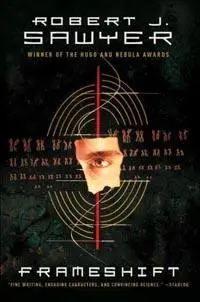
- Название:Frameshift
- Автор:
- Издательство:Tor Science Fiction
- Жанр:
- Год:1998
- ISBN:0-812-57108-8
- Рейтинг книги:4 / 5. Голосов: 1
-
Избранное:Добавить в избранное
- Отзывы:
-
Ваша оценка:
Frameshift: краткое содержание, описание и аннотация
Предлагаем к чтению аннотацию, описание, краткое содержание или предисловие (зависит от того, что написал сам автор книги «Frameshift»). Если вы не нашли необходимую информацию о книге — напишите в комментариях, мы постараемся отыскать её.
Frameshift — читать онлайн бесплатно полную книгу (весь текст) целиком
Ниже представлен текст книги, разбитый по страницам. Система сохранения места последней прочитанной страницы, позволяет с удобством читать онлайн бесплатно книгу «Frameshift», без необходимости каждый раз заново искать на чём Вы остановились. Поставьте закладку, и сможете в любой момент перейти на страницу, на которой закончили чтение.
Интервал:
Закладка:
Munroe’s one long eyebrow knotted together in the middle. “How would you know that?”
“I’m a Ph.D. in molecular biology; I know how long it takes for blood to turn that dark.”
“All just coincidence, is that right?”
“Yes. Yes.”
“You say you worked together?”
“That’s right. At the Human Genome Center, Lawrence Berkeley National Laboratory.”
“Someone tried to kill you, and now, four months later, someone does kill her. Is that it?”
“I guess.”
Munroe looked unconvinced. “You’ll have to hold tight until the coroner arrives; then we’ll head downtown.”
Pierre was sitting on a wooden chair in a small interrogation room at Berkeley police headquarters. The room smelled of sweat; Pierre could also smell Officer Munroe’s coffee. The lights overhead were fluorescents, and one of the tubes was strobing a bit, giving Pierre a headache.
The metal door had a small window in it. Pierre saw a flash of blond hair through it, then the door opened, and—
“Molly!”
“Pierre, I—”
“Hello, Mrs. Tardivel,” said Officer Munroe, moving between them.
“Thank you for coming down.” He nodded at the sergeant who had escorted Molly to the room.
It was a sign of how upset she was that Molly didn’t reflexively correct Munroe about her name. “What’s going on?” she asked.
“Were you with your husband last night between five and seven?” The coroner’s initial analysis suggested that Joan Dawson’s death had occurred between those hours.
Molly was wearing an orange sweatshirt and blue jeans. “Yes,” she said.
“We’d gone out to dinner together.”
“Where?”
“Chez Panisse.”
Munroe’s eyebrow climbed his forehead at the mention of the expensive restaurant. “What was the occasion?”
“We’d just found out that we’re going to have a baby. Look, what’s—”
“And you were there from five o’clock on?”
“Yes. We had to go that early to get in without a reservation. Dozens of people saw us there.”
Munroe pursed his lips, thinking. “All right, all right. Let me make a phone call.” He stepped out of the room. Molly surged toward Pierre, hugging him. “What the hell’s going on?” she said.
“I went by Joan Dawson’s house this morning. She’d been murdered—”
“Murdered!” Molly’s eyes were wide.
Pierre nodded.
“Murdered…” repeated Molly, as if the word were as foreign as the occasional French phrases that passed Pierre’s lips. “And they suspect you? That’s crazy.”
“I know, but…” Pierre shrugged.
“What were you doing at Joan’s place, anyway?”
He told her the story.
“God, that’s horrible,” said Molly. “She was—”
Just then, Munroe reentered the room. “Okay,” he said. “Good thing you got that accent, Mr. Tardivel. Everybody at Chez Panisse remembered you. You’re free to go, but…”
Pierre made an exasperated sound. “But what? If I’m free—”
Munroe held up his beefy hand. “No, no. You’re cleared. But, well, I was going to say watch your back. Maybe it is all coincidence, but…”
Pierre nodded grimly. “Yeah. Thanks.”
Molly and Pierre left the station; Molly had taken a taxi over. They got into Pierre’s Toyota, which was stiflingly hot, having sat for two hours now in direct sunlight in the police parking lot. As they drove back to the university, Pierre asked her which of the campus’s libraries might have People or Time .
“Doe, probably — on the fourth floor. Why?”
“You’ll see.”
They headed there. Pierre refused to tell Molly what he was looking for, and he was careful to keep thinking in French, lest she pluck it from his mind. A librarian got the back issues Pierre wanted. He quickly leafed through them, nodded at what he found, then spread a copy of People out on a worktable and took some pieces of paper — flyers about the library’s overdue-fines policy — and used them to mask everything except a small photograph: a 1942 picture of John Demjanjuk.
“All right,” said Pierre, pointing at the table. “Go have a look at that photo and tell me if you recognize the person in it.”
Molly leaned in and stared at the photo. “I don’t—”
“It’s an old photo, from 1942. Is it anyone you know?”
“That’s a long time ago, and— oh, I see. Sure, it’s Burian Klimus, isn’t it?
Gee, he must have had his ears fixed.”
Pierre sighed. “Let’s go for a walk. There’s something we have to talk about.”
“Shouldn’t you go tell them at the lab about Joan’s murder?”
“Later. This can’t wait.”
“That photo wasn’t of Burian Klimus,” said Pierre as they walked out of Doe Library and headed south. It was a beautiful early autumn afternoon, the sun sliding down toward the horizon. “It’s of a man called John Demjanjuk.”
They passed by a group of students heading the other way. “That name’s vaguely familiar,” said Molly.
Pierre nodded. “He’s been in the news a fair bit over the years. The Israelis tried him for being Ivan the Terrible, the gas chamber operator at the Treblinka death camp in Poland.”
“Right, right. But he was innocent, wasn’t he?”
“That’s right. It was a case of mistaken identity. Someone else who looked a lot like Demjanjuk was the real Ivan the Terrible. And he’s still at large.”
“Oh,” said Molly. And then, “ Oh .”
“Exactly: Burian Klimus looks like Demjanjuk — at least somewhat.”
“Still, that’s hardly reason enough to suspect him of being a war criminal.”
Pierre looked up. An airplane contrail had split the cloudless sky into two equal halves. “Remember I told you a federal agent came to see me after Chuck Hanratty attacked me? Well, I found out today that he’s with the part of the Department of Justice that’s devoted to tracking down Nazis.”
“I find it hard to believe that a man who won a Nobel Prize could be that evil.”
“Well, Klimus didn’t win the Nobel Peace Prize, after all. Anyway, the man who operated the gas chambers — Ivan Marchenko — he’d been a prisoner of war himself before volunteering for service to the Nazis. Who knows what he did before or after the war? Who knows what level of education he had?”
“But a Nobel laureate—”
“You know who William Shockley was?” asked Pierre.
“Umm, the inventeur of the transistor?”
Pierre smiled. “You’re cheating.”
Molly blushed a little.
“But, anyway, yeah, Shockley invented the transistor, and he won a Nobel Prize for that in 1956. He was also a raving, out-and-out racist. He claimed that blacks were genetically inferior to whites, and that the only smart blacks were smart because they had some white blood in them. He advocated sterilization of the poor, as well as anyone with a below-average IQ. Believe me, I’ve read enough biographies of Nobel laureates to know that not all of them were good people.”
“But even if Burian is this Ivan Marchenko—”
“If he’s Marchenko, then, well—” He looked down at Molly’s stomach.
“Then the baby is Marchenko’s, too.”
“Oh, shit — I hadn’t even thought about that.” She lowered her eyes. “I keep thinking of it as your baby…”
Pierre smiled. “Me, too. But, well, if it is the child of Ivan the Terrible, then… then maybe we don’t want to continue with the pregnancy.”
They’d come to the plaza just inside Sather Gate. Pierre motioned for them to rest on one of the benches placed against the low retaining wall.
Molly sat down, and Pierre sat next to her, placing an arm over her shoulders.
Читать дальшеИнтервал:
Закладка:
Похожие книги на «Frameshift»
Представляем Вашему вниманию похожие книги на «Frameshift» списком для выбора. Мы отобрали схожую по названию и смыслу литературу в надежде предоставить читателям больше вариантов отыскать новые, интересные, ещё непрочитанные произведения.



Обсуждение, отзывы о книге «Frameshift» и просто собственные мнения читателей. Оставьте ваши комментарии, напишите, что Вы думаете о произведении, его смысле или главных героях. Укажите что конкретно понравилось, а что нет, и почему Вы так считаете.