Robert Sawyer - Frameshift
Здесь есть возможность читать онлайн «Robert Sawyer - Frameshift» весь текст электронной книги совершенно бесплатно (целиком полную версию без сокращений). В некоторых случаях можно слушать аудио, скачать через торрент в формате fb2 и присутствует краткое содержание. Год выпуска: 1998, ISBN: 1998, Издательство: Tor Science Fiction, Жанр: Фантастика и фэнтези, на английском языке. Описание произведения, (предисловие) а так же отзывы посетителей доступны на портале библиотеки ЛибКат.
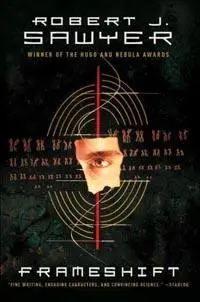
- Название:Frameshift
- Автор:
- Издательство:Tor Science Fiction
- Жанр:
- Год:1998
- ISBN:0-812-57108-8
- Рейтинг книги:4 / 5. Голосов: 1
-
Избранное:Добавить в избранное
- Отзывы:
-
Ваша оценка:
Frameshift: краткое содержание, описание и аннотация
Предлагаем к чтению аннотацию, описание, краткое содержание или предисловие (зависит от того, что написал сам автор книги «Frameshift»). Если вы не нашли необходимую информацию о книге — напишите в комментариях, мы постараемся отыскать её.
Frameshift — читать онлайн бесплатно полную книгу (весь текст) целиком
Ниже представлен текст книги, разбитый по страницам. Система сохранения места последней прочитанной страницы, позволяет с удобством читать онлайн бесплатно книгу «Frameshift», без необходимости каждый раз заново искать на чём Вы остановились. Поставьте закладку, и сможете в любой момент перейти на страницу, на которой закончили чтение.
Интервал:
Закладка:
Pierre sat in front of his UNIX workstation. The monitor was on, but he wasn’t reading its display; rather, he was leafing through the Daily Californian , the UCB student newspaper. News about the campus football team; big debates about UCB’s elimination of racial quotas for students; a letter to the editor complaining about Felix Sousa.
Pierre’s mind wandered back to the last time he’d spoken to somebody about Sousa. He’d been talking to that strange bull-doglike fellow who had blustered into this very room over three months ago. Ari something. No, no — not Ari. Avi . Avi — Avi Meyer , that was it.
Pierre never had figured out what that had all been about. He closed the newspaper and turned to his computer, opening a window on the governmental telephone database CD-ROM, accessible through the LAN.
Avi Meyer had said he worked for the Department of Justice. The database didn’t contain individual agent listings, but Pierre did find a general-inquiry number in Washington. He highlighted the number, pressed the key for his telephone program, ticked the personal-call option in the dialogue box that popped up, and let his modem dial the call for him while he held his telephone handset to his ear.
“Justice,” said a female voice at the other end. All that was missing, thought Pierre, were Truth and the American Way.
“Hello,” he said. “Do you have someone there named Avi Meyer?”
Keyclicks. “Yes. He’s out of town right now, but I can put you through to his voice mail, or let you speak to a receptionist at OSI.”
“OSI?” said Pierre.
“The Office of Special Investigations,” said the voice.
“Oh, of course,” said Pierre. “Well, if you say he’s not in, I’ll just try again another time. Thanks.” He hung up, then clicked on his CompuServe icon and logged on to Magazine Database Plus, which had become one of Pierre’s favorite research tools since he’d discovered it a couple of months ago. It contained the full text of all the articles in over two hundred general-interest and specialty magazines — including such publications as
Science and Nature — going back as far as 1986. He typed in two search strings, “Special Investigations” and “OSI,” and selected whole-words-only, so that the latter wouldn’t result in a deluge of matches on “deposits” or “Bela Lugosi.”
The first hit was in an article from People magazine about Lee Majors.
In his 1970s TV series The Six Million Dollar Man , he’d worked for a fictitious government agency called the OSI. Pierre continued his search.
The second hit was right on target: an article in the New Republic from 1993. The highlighted sentence began: “Then there is the conduct of Demjanjuk’s major enemy in this country, the Office of Special Investigations, which set the wheels of injustice moving against him…”
Pierre read on, fascinated. The OSI was indeed part of the Department of Justice — a division founded in 1979, devoted to exposing Nazi war criminals and collaborators in the United States.
The case against this Demjanjuk fellow — a retired auto-worker from Cleveland, a simple man with just a fourth-grade education — had started out as the OSI’s first big success. Demjanjuk had been accused of being Ivan the Terrible, a guard at the Treblinka death camp. He’d been extradited to Israel, where he was found guilty in 1988, the second of two war-crimes trials ever held there. As in the first trial, that of Adolf Eichmann, Demjanjuk was sentenced to death.
But the OSI’s reputation was blackened when, on appeal, the Israeli supreme court overturned the conviction of John Demjanjuk. In an inquest into the whole mess, U.S. federal judge Thomas Wiseman found that the OSI had failed to meet even “the bare minimum standards of professional conduct” in its proceedings against Demjanjuk, presuming him to be guilty and ignoring all evidence to the contrary.
Pierre continued reading. The OSI had known that the real name of the man they’d wanted was Marchenko, not Demjanjuk. Now, yes, John Demjanjuk had listed his mother’s maiden name incorrectly as Marchenko on his application for refugee status, but he’d later claimed he’d simply forgotten her real name, and so had just filled in a common Ukrainian one.
Pierre skimmed other articles about the Demjanjuk affair, from Time, Maclean’s , the Economist, National Review, People , and elsewhere. He found part of Demjanjuk’s life story interesting because of the rocky marriage of his own parents, Elisabeth and Alain Tardivel. Demjanjuk had married a woman named Vera in a displaced-persons camp on September 1,1947. Nothing remarkable about that — except that when Vera and Demjanjuk had met, she was already married to another DP, Eugene Sakowski. Sakowski went to Belgium for three weeks, and, while he was gone, John Demjanjuk had taken up with Vera; when Sakowski returned, Vera divorced him and married John.
Pierre let his breath escape in a long sigh. Triangles were everywhere, it seemed. He wondered what his own life would have been like if his mother had ignored the church and divorced Alain Tardivel so that she could have married Pierre’s real father, Henry Spade. Things would have been so—
A sentence on the screen caught his eye: a description of Demjanjuk.
Magazine Database Plus contained text only — no photographs — but a picture nonetheless formed in Pierre’s mind: a Ukrainian, bald, sturdy, thick necked, with thin lips, almond eyes, and protruding ears.
Shit…
It couldn’t be.
It could not be.
The man had won a Nobel Prize, after all.
Yeah — and fucking Kurt Waldheim had ended up as United Nations secretary-general.
Bald, protruding ears. Ukrainian.
Demjanjuk had been identified based on those features. But Demjanjuk had not been Ivan the Terrible.
Meaning somebody else had been.
Someone the articles called Ivan Marchenko.
Somebody who might very well still be at large.
Burian Klimus was Ukrainian, and by his own recent statement had been bald since youth. He had large ears — not unusual for a man his age — but Pierre had never thought of them as protruding. Still, a little plastic surgery could have corrected that years ago.
And Avi Meyer was a Nazi hunter.
A Nazi hunter who had been sniffing around the Lawrence Berkeley Lab—
Meyer had asked about several geneticists, but he hadn’t really been interested in all of them. He’d consistently referred to Donna Yamashita as Donna Yamasaki, for instance — there’s no way he wouldn’t have known the correct name of someone he was actually investigating.
And, anyway, neither Yamashita nor Toby Sinclair — the other geneticist Meyer had asked about — was old enough to be a war criminal.
But Burian Klimus was.
Pierre shook his head.
God.
If he was right, if Meyer was right—
Then Molly was carrying within her the child of a monster.
Chapter 23
Pierre knew where to find any biology journal on campus, but he had no idea which of UCB’s libraries would have things like Time and National Review . He wanted to see the pictures of Demjanjuk, both as he appeared today and, more importantly, the old photos from which he’d been misidentified as Ivan. Joan Dawson seemed to know just about everything there was to know about the university; she’d doubtless know where he could find those magazines. Pierre left his lab and headed down to the HGC general office.
He stopped short on the threshold. Burian Klimus was in there, getting his mail out of the cubbyhole with his name on it just inside the door.
Читать дальшеИнтервал:
Закладка:
Похожие книги на «Frameshift»
Представляем Вашему вниманию похожие книги на «Frameshift» списком для выбора. Мы отобрали схожую по названию и смыслу литературу в надежде предоставить читателям больше вариантов отыскать новые, интересные, ещё непрочитанные произведения.


Обсуждение, отзывы о книге «Frameshift» и просто собственные мнения читателей. Оставьте ваши комментарии, напишите, что Вы думаете о произведении, его смысле или главных героях. Укажите что конкретно понравилось, а что нет, и почему Вы так считаете.