Robert Sawyer - Frameshift
Здесь есть возможность читать онлайн «Robert Sawyer - Frameshift» весь текст электронной книги совершенно бесплатно (целиком полную версию без сокращений). В некоторых случаях можно слушать аудио, скачать через торрент в формате fb2 и присутствует краткое содержание. Год выпуска: 1998, ISBN: 1998, Издательство: Tor Science Fiction, Жанр: Фантастика и фэнтези, на английском языке. Описание произведения, (предисловие) а так же отзывы посетителей доступны на портале библиотеки ЛибКат.
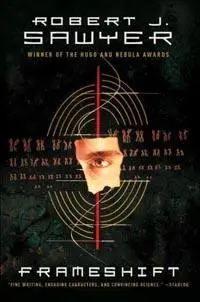
- Название:Frameshift
- Автор:
- Издательство:Tor Science Fiction
- Жанр:
- Год:1998
- ISBN:0-812-57108-8
- Рейтинг книги:4 / 5. Голосов: 1
-
Избранное:Добавить в избранное
- Отзывы:
-
Ваша оценка:
Frameshift: краткое содержание, описание и аннотация
Предлагаем к чтению аннотацию, описание, краткое содержание или предисловие (зависит от того, что написал сам автор книги «Frameshift»). Если вы не нашли необходимую информацию о книге — напишите в комментариях, мы постараемся отыскать её.
Frameshift — читать онлайн бесплатно полную книгу (весь текст) целиком
Ниже представлен текст книги, разбитый по страницам. Система сохранения места последней прочитанной страницы, позволяет с удобством читать онлайн бесплатно книгу «Frameshift», без необходимости каждый раз заново искать на чём Вы остановились. Поставьте закладку, и сможете в любой момент перейти на страницу, на которой закончили чтение.
Интервал:
Закладка:
“I suppose. But what if he was after your husband, rather than his tools?”
“What on earth for?”
“Well, I don’t know. I’m just wondering if he and I had anything in common. Hanratty was a member of a neo-Nazi group. It’s possible he didn’t like me because I’m a foreigner, for instance.”
“My Bryan was born right here in the good old U.S. of A. In Lincoln, Nebraska, to be exact.”
“What about his politics?”
“Republican — although sometimes he couldn’t bother getting off his duff to vote.”
“And his religion?”
“Presbyterian.”
“Did he go to university?”
“Bryan?” She laughed. “He’s an eighth-grade dropout.” She held up a hand. “Doesn’t mean he was stupid, mind you. He was a good man, and he could fix just about anything. But he didn’t have a lot of school.”
“And he was older than me, wasn’t he?”
“Depends. You as young as you look?”
“I’m thirty-three.”
“Well, my Bryan was forty-nine.” She grew a bit wistful at the mention of the age. “There’s nothing worse than dying young, is there?”
Pierre nodded. Nothing worse.
Pierre looked over the counter in the lab. Ever since he’d been a little boy, he’d hated cleaning up after himself. It just wasn’t nearly as much fun putting things away as it was taking them out. But it had to be done. He’d spread beakers and retort stands all across the countertop. And some of the labware had to be carefully washed; a molecular-biology lab was a perfect breeding ground for germs, after all.
He dismantled the retort stand and put it away in one of the cupboards.
He then picked up a beaker and took it over to the sink, rinsing it out under cold water, then placing it in a rack to dry. Next, he got his petri dishes and put them in a special bag for disposal. He returned to the table and reached out for a large flask, picked it up, and watched it fall from his trembling hand. Shards of glass went everywhere and the flask’s liquid contents made a yellowish splash across the tiled floor.
Pierre swore in French. Just tired, he told himself. Long day. Still a bit distracted from the meeting with Bryan Proctor’s widow. Need a good night’s sleep.
He went to get the broom and dustpan, and began sweeping up the broken glass.
Tired. Nothing more than that.
And yet—
God, would he have to go through this every time he dropped something? Every time he took a misstep? Every time he bumped into a wall?
Damn it — he — was — just — tired! Tired, that’s all.
Unless—
Unless it was fucking goddamn Huntington’s disease, at last rearing its monstrous head.
No. It was nothing.
Nothing.
He carried the dustpan over to the garbage pail and emptied it.
Tomorrow, everything would be fine.
Surely, it would be fine.
Chapter 22
Pierre and Molly stood in their bathroom early in the morning and looked at the test strip together. A blue plus sign blossomed into existence on its white surface.
“ Oui? ” said Pierre.
“Wow,” said Molly. “Wow.”
Pierre kissed his wife. “Congratulations.”
“We’re going to be parents,” said Molly dreamily.
Pierre stroked her hair. “I never thought this could happen. Not for me.”
“It’s going to be wonderful.”
“You’ll make a terrific mother.”
“And you’ll make a great daddy.”
Pierre smiled at the thought. “Do you want a boy or a girl?”
“You know, we probably could have asked Burian. He could have sorted his sperm, if we’d told him. There’s a difference between male-producing sperm and female-producing, isn’t there?” Pierre nodded. Molly paused, considering his question. “I don’t know. I suppose a girl, but that’s only because of my family life, I’m sure. My mother and sister and I were alone for a long time before Paul showed up. I’m not sure how I’d be with a little boy.”
“You’d do fine.”
“Do you have a preference?”
“Me? No, I guess not. I mean, I know that every man is supposed to want a son he can play catch with, but…” He trailed off, deciding not to complete the thought. “Maybe having a girl would be simpler,” he said.
Molly had missed, or was choosing to ignore, the undercurrent. “I really don’t care which it is,” she said at last, her voice still dreamy. “Just as long as it’s healthy.”
After a long day at the Human Genome Center, Joan Dawson was pleased to be approaching home. She was walking from the BART station; the walk was almost a mile, but she did it every night. At her age, she wasn’t up to any more-strenuous exercise, but she did spend all day at her secretarial desk, and diabetics had to be particular about their weight.
There was hardly anyone around; she lived in a quiet neighborhood.
When she and her husband had bought here in 1959, there had been lots of young families. The neighborhood had grown up with them, but although these had qualified as starter homes all those years ago, they were out of the reach of today’s young couples. Now this area was home mostly to elderly people — the lucky ones still husband and wife, but many of the others, like Joan, having lost their spouses over the years. Her Bud had passed on in 1987.
Joan came up the walk to the front of her house, opened the lid on the mailbox, scooped up the bills, smiled when she saw her copy of Ellery Queen’s had arrived, fumbled for her keys, and let herself in. She turned on the porch light, made her way up to her living room, and —
“Joan Dawson?”
Her heart practically shot out of her chest, it was beating so hard. She turned around. A young white man with a shaven head and tattoos of skulls on his forearms was looking at her with pale blue eyes.
Joan was still holding her purse. She thrust it at him. “Take it! Take it!
You can have my money.”
The man was wearing a black Megadeath T-shirt with a denim vest over it, jeans with artful slashes in them, and gray Adidas. He shook his head.
“It’s not your money I’m after.”
Joan started backing away, still holding the purse in front of her, but now as if it were a shield. “No,” she said. “No — there’s jewelry upstairs.
Lots of jewelry. You can have it all.”
The punk started walking toward her. “I don’t want your jewelry, either.”
Joan had backed into the glass-topped coffee table. She tumbled backward over it, and the glass cracked with a sound like a rifle going off.
She scrambled to her feet. Pain stabbed at her from her ankle; she’d wrenched it badly going down. “Please,” she said, whimpering now.
“Please, not that.”
The skinhead stopped approaching for a moment, a look of revulsion on his face. “Fuck, woman, don’t be disgusting. You’re old enough to be my grandmother.”
Joan felt a surge of hope fighting to the surface against all the terror.
“Thank you,” she said. “Thank you, thank you, thank you.” She’d backed against the rough brick of the fireplace now.
The man pulled his vest open. He had a long single-edged hunting knife with a black handle in a sheath under his arm. He pulled out the weapon and amused himself for a second by sending a glint of light playing down Joan’s horrified face.
Joan fumbled for the fireplace poker, found it, raised it in front of her.
“Stay back!” she said. “What do you want?”
The man grinned, showing tobacco-stained teeth. “I want,” he said, “for you to be dead.”
Joan inhaled deeply, prelude to a scream, but before she could get it out, the man flipped the knife out of his hand, and it landed smack-dab in the middle of her chest, burying itself halfway to the hilt. She slumped to the tiled area just in front of the fireplace, her mouth still in the perfect O of the stillborn scream.
Читать дальшеИнтервал:
Закладка:
Похожие книги на «Frameshift»
Представляем Вашему вниманию похожие книги на «Frameshift» списком для выбора. Мы отобрали схожую по названию и смыслу литературу в надежде предоставить читателям больше вариантов отыскать новые, интересные, ещё непрочитанные произведения.







Обсуждение, отзывы о книге «Frameshift» и просто собственные мнения читателей. Оставьте ваши комментарии, напишите, что Вы думаете о произведении, его смысле или главных героях. Укажите что конкретно понравилось, а что нет, и почему Вы так считаете.