Robert Sawyer - Frameshift
Здесь есть возможность читать онлайн «Robert Sawyer - Frameshift» весь текст электронной книги совершенно бесплатно (целиком полную версию без сокращений). В некоторых случаях можно слушать аудио, скачать через торрент в формате fb2 и присутствует краткое содержание. Год выпуска: 1998, ISBN: 1998, Издательство: Tor Science Fiction, Жанр: Фантастика и фэнтези, на английском языке. Описание произведения, (предисловие) а так же отзывы посетителей доступны на портале библиотеки ЛибКат.
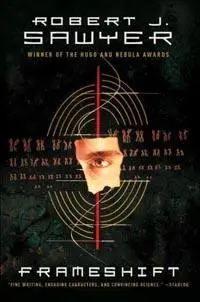
- Название:Frameshift
- Автор:
- Издательство:Tor Science Fiction
- Жанр:
- Год:1998
- ISBN:0-812-57108-8
- Рейтинг книги:4 / 5. Голосов: 1
-
Избранное:Добавить в избранное
- Отзывы:
-
Ваша оценка:
Frameshift: краткое содержание, описание и аннотация
Предлагаем к чтению аннотацию, описание, краткое содержание или предисловие (зависит от того, что написал сам автор книги «Frameshift»). Если вы не нашли необходимую информацию о книге — напишите в комментариях, мы постараемся отыскать её.
Frameshift — читать онлайн бесплатно полную книгу (весь текст) целиком
Ниже представлен текст книги, разбитый по страницам. Система сохранения места последней прочитанной страницы, позволяет с удобством читать онлайн бесплатно книгу «Frameshift», без необходимости каждый раз заново искать на чём Вы остановились. Поставьте закладку, и сможете в любой момент перейти на страницу, на которой закончили чтение.
Интервал:
Закладка:
She looked at him. “I know we’ve only known for sure that I’m pregnant for a day, but, well, I’ve felt pregnant ever since the implantation was done. And I’ve wanted this so long…”
Pierre stroked her arm. “We could try again. Go to a regular clinic.”
Molly closed her eyes. “It’s so much money. And we were so lucky to get an implantation on the first attempt this time.”
“But if it is Marchenko’s child…”
Molly looked around the plaza. People were walking in all directions.
Some pigeons were waddling by a few feet away from them. She turned back to Pierre. “You know I love you, Pierre, and I admire the work you do is a geneticist. And I know geneticists believe in ‘like father, like son.’ But, well, you know my speciality: behavioral psychology, just like good old B.
F. Skinner taught. I honestly believe it doesn’t matter who the biological parents are, so long as the child is brought up by a caring mother and a loving father.”
Pierre thought about this. They’d argued nature-versus-nurture once or twice before on their long evening walks, but he’d never expected it to be anything more than an academic debate. But now…
“You could find out for sure,” said Pierre. “You could read Klimus’s mind.”
Molly shrugged. “I’ll try, but you know I can’t dig into his mind. He has to be thinking — in English, in articulated thoughts — directly about the topic. That’s all I can read, remember. We can try to maneuver the conversation in such a way that his thoughts might turn to his Nazi past, but unless he actually formulates a sentence on that topic, I won’t be able to read it.” She took Pierre’s hand and placed it on her flat stomach. “But, regardless, even if he is a monster, the child in here is ours .”
It was late afternoon on the West Coast, and therefore early evening in Washington. Pierre struggled through the DOJ voice-mail system to get to the appropriate mailbox: “This is Agent Avi Meyer. I’m in Lexington, Kentucky, until Monday, October eighth, but am checking my voice mail frequently. Please leave a message at the tone.”
Beep!
“Mr. Meyer, this is Dr. Pierre Tardivel at the Lawrence Berkeley National Laboratory — remember me? Look, one of our staff members was killed last night. I need to talk to you. Call me either here or at home. The number here is…”
Chapter 24
Joan Dawson’s funeral was held two days later in an Episcopalian church. Pierre and Molly both attended. While waiting for the service to begin, Pierre found himself fighting back tears; Joan had been so kind, so friendly, so helpful…
Burian Klimus arrived. It seemed wrong to take advantage of such a solemn occasion, but opportunities for Molly to actually see Klimus were few and far between. When the old man sat down in a pew at the back, Molly and Pierre got up and moved over to sit next to him, Molly right beside him.
“It’s such a shame,” said Molly, in a low voice.
Klimus nodded.
“Still,” said Molly, “what a lifetime to have lived through. Somebody said Joan had been born in 1929. I can’t imagine how frightening it must have been for a ten-year-old girl to see the world go to war.”
“It was no easier for a twenty-eight-year-old man,” said Klimus dryly.
“I’m sorry,” said Molly. “Where were you during the war?”
“The Ukraine, mostly.” And Poland .
“Spend any time in Poland?” said Molly. Klimus looked at her. “My, ah, father’s family was there.”
“Yes, for a short time.”
“There was a camp there — Treblinka.”
“There were several camps,” said Klimus.
“Terrible places,” said Molly. She tried a different tack. ‘“Burian’ — is that the Ukrainian equivalent of ‘John? Every language seems to have its own version of John: ’Jean‘ in French, ’Ivan‘ in Russian.”
“No, it’s not. In Ukrainian, ‘John’ is also ‘Ivan.’” He looked embarrassed for a moment. “‘Burian’ actually means ‘dwells near the weeds.’”
“Oh. Still, I love Ukrainian names. They’re so musical. Klimus, Marcynuk, Toronchuk, Mymryk… Marchenko .”
Ivan Marchenko , thought Klimus, the names falling together naturally in his mind. “Yes, I suppose they are,” he said.
“The war must have been terrible, and—”
“I don’t like to think of it,” Klimus said, “and — oh, excuse me. There’s Dean Cowles; I should really say hello.” Klimus rose and walked away from them.
As Pierre drove himself and Molly to the cemetery, he turned to look at his wife. “Well? Any luck?”
Molly shrugged. “It’s hard to tell. He certainly didn’t think anything along the lines of, Gee, my secret identity is Ivan the Terrible and I killed hundreds of thousands of people. Of course, that’s not surprising — most people who have done terrible things in their pasts have built up psychological defense mechanisms to keep the memories from coming to mind. Still, he does know the name ‘Ivan Marchenko’ — he put those two names together at once in his head.”
Pierre frowned. “Well, I’m seeing Avi Meyer this afternoon. Maybe he’ll have concrete answers about Klimus’s past.”
Avi Meyer flew directly to San Francisco from Kentucky, where he’d been investigating some octogenarian KKK members. He and Pierre had arranged to meet privately at Skates, on Berkeley’s Seawall Drive at the Marina. The restaurant jutted out over the Bay, supported by pillars that didn’t seem nearly strong enough to hold it up. Seagulls perched on the edge of its gently sloping roof, trying to hold on in a rising wind. It was midafternoon, with a leaden sky. They got a table by one of the huge windows, looking out across the water to San Francisco.
“All right, Agent Meyer,” said Pierre as soon as he sat down, “I know you’re some kind of Nazi hunter. I also know that I was attacked, and my friend Joan Dawson is dead. Tell me the connection — tell me why you are poking around LBNL.”
Avi sipped his coffee. He looked past the hanging plants and out the window. An aircraft carrier was moving along the Bay, heading for Alameda. “We routinely monitor university and corporate genetics labs.”
Pierre tilted his head. “What?”
“We also keep an eye on physics departments, political science, and several other areas.”
“What on earth for?”
“They’re natural places for Nazis to end up. I don’t need to tell you that there’s always been a whiff of controversy about genetics research.
Creating a master race, discrimination based on genetic makeup—”
“Oh, come on!”
“You yourself mentioned Felix Sousa—”
“He’s not part of HGC; he’s just a biochem prof at the university, and besides—”
“—and there’s Philippe Rushton, up in your native Canada, giving a whole new meaning to ‘Great White North’—”
“Rushton and Sousa are too young to be Nazis.”
“The universities are lousy with people hiding from one thing or another; in Canada, half your profs are Vietnam draft dodgers.”
“So’s your president, for Pete’s sake.”
Avi shrugged. “You ever see The Stranger ? Orson Welles film? It’s about a Nazi who takes a job as an American college professor. I can name over one hundred actual cases of the same thing.”
“Which is why you think Burian Klimus is Ivan Marchenko.”
Avi’s small mouth dropped open. “You’re good,” he said at last.
“I need to know if it’s true.”
“Why should you care? I’ve gone over your files from McGill and U of T—”
“You’ve what?”
Читать дальшеИнтервал:
Закладка:
Похожие книги на «Frameshift»
Представляем Вашему вниманию похожие книги на «Frameshift» списком для выбора. Мы отобрали схожую по названию и смыслу литературу в надежде предоставить читателям больше вариантов отыскать новые, интересные, ещё непрочитанные произведения.



Обсуждение, отзывы о книге «Frameshift» и просто собственные мнения читателей. Оставьте ваши комментарии, напишите, что Вы думаете о произведении, его смысле или главных героях. Укажите что конкретно понравилось, а что нет, и почему Вы так считаете.