Robert Sawyer - Frameshift
Здесь есть возможность читать онлайн «Robert Sawyer - Frameshift» весь текст электронной книги совершенно бесплатно (целиком полную версию без сокращений). В некоторых случаях можно слушать аудио, скачать через торрент в формате fb2 и присутствует краткое содержание. Год выпуска: 1998, ISBN: 1998, Издательство: Tor Science Fiction, Жанр: Фантастика и фэнтези, на английском языке. Описание произведения, (предисловие) а так же отзывы посетителей доступны на портале библиотеки ЛибКат.
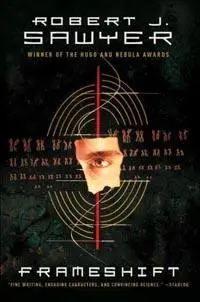
- Название:Frameshift
- Автор:
- Издательство:Tor Science Fiction
- Жанр:
- Год:1998
- ISBN:0-812-57108-8
- Рейтинг книги:4 / 5. Голосов: 1
-
Избранное:Добавить в избранное
- Отзывы:
-
Ваша оценка:
Frameshift: краткое содержание, описание и аннотация
Предлагаем к чтению аннотацию, описание, краткое содержание или предисловие (зависит от того, что написал сам автор книги «Frameshift»). Если вы не нашли необходимую информацию о книге — напишите в комментариях, мы постараемся отыскать её.
Frameshift — читать онлайн бесплатно полную книгу (весь текст) целиком
Ниже представлен текст книги, разбитый по страницам. Система сохранения места последней прочитанной страницы, позволяет с удобством читать онлайн бесплатно книгу «Frameshift», без необходимости каждый раз заново искать на чём Вы остановились. Поставьте закладку, и сможете в любой момент перейти на страницу, на которой закончили чтение.
Интервал:
Закладка:
“You weren’t a campus activist. Didn’t belong to any social-justice groups. Why should you care what Klimus might have done half a century ago? A French speaker from Montreal — why should someone like you care?”
“Damn it, I told you before I’m not an anti-Semite. Maybe there is a problem with that in Quebec, but I’m not part of it.” Pierre tried to calm himself. “Look, I’ve seen pictures of Demjanjuk. I know what he looked like as a young man, know he bore a resemblance to Klimus.”
A waitress appeared. “Sprite,” said Pierre. She nodded and left.
“Klimus looks even more like Marchenko than Demjanjuk did,” said Avi.
Pierre blinked. “You’ve got photos of Marchenko?” None of the Magazine Database Plus articles mentioned the existence of such things.
Avi nodded. “The Israelis have had Marchenko’s SS file since 1991.” He opened his briefcase, pulled out a manila envelope, and took two sheets from it. The first was a photostat of an old-looking form, with a small head-and-shoulders photograph attached to its upper-left corner. The second was a blowup of that photo. It showed a man of thirty, with a broad face (twisted here in a cruel frown), incipient baldness, and protruding ears.
Pierre’s eyebrows went up. “You can certainly see the resemblance to Demjanjuk.”
Avi frowned ruefully. “Tell me about it.”
Pierre looked at the photostats.
“So,” said Avi, tapping the enlarged photo, “is that Burian Klimus?”
Pierre exhaled. “The ears are different—”
“Klimus’s don’t protrude. But that’s an easy enough thing to have fixed.”
Pierre nodded, and looked at the blowup again. “Yeah. Yeah, it could be Klimus.”
“That’s what I thought when I saw Klimus’s picture in Time when he was named director of the Human Genome Center. If he is Marchenko, you have no idea what a monster that man was. He didn’t just gas people, he tortured them, raped them. He used to love to slice nipples off women’s breasts.”
Pierre winced at that. “But do you have any proof, besides his appearance, that Klimus might be Marchenko?”
“He’s a geneticist.”
Pierre’s tone was sharp. “That’s not a crime.”
“And he was born in the same Ukrainian town as Ivan Marchenko, and in the same year — 1911.”
“Really?”
“Uh-huh. And then there’s what happened to you. The attack on you was the first direct connection between the Nazi movement and the genetics work going on at Lawrence Berkeley.”
“But Chuck Hanratty was a neo-Nazi.”
“Sure. But a lot of neo-Nazi groups were started by real World War II
Nazis. Do you know the name of the leader of the Millennial Reich?”
“No.”
“In documents the SFPD has captured, he’s referred to by the code name Grozny.”
Pierre’s stomach fluttered. He’d been ordered to kill you , Molly had said, having read Chuck Hanratty’s mind as he died, by someone named Grozny .
“Grozny,” repeated Pierre. “What does that mean?”
“Ivan Grozny is Russian for Ivan the Terrible. It’s what the people at Treblinka called Ivan Marchenko.”
Pierre’s head was swimming. “But this is crazy. What could Klimus have against me?” The waitress appeared and deposited Pierre’s Sprite.
“That’s a very good question.”
“And what about Joan Dawson? What could Klimus have against her?”
Avi shook his head. “I have no idea. But if I were you, I’d watch my back.”
Pierre frowned and looked out at the roiling waters of the Bay. “You’re the second person to say that to me recently.” He took a sip of his drink.
“So what do we do now?”
“There’s nothing we can do, until some proof materializes. These cases don’t break overnight, after all; if Klimus is Marchenko, he’s eluded detection for fifty years now. But keep your eyes and ears open, and report anything you find to me.”
Chapter 25
Seven months later
“Thanks for letting me come,” said Pierre, keeping his hand steady by holding firmly on to the edge of a desk. Although he still felt as though he didn’t really belong here, Pierre could no longer deny the truth: he was clearly manifesting symptoms of Huntington’s disease. The support-group meeting was held in a high-school classroom in San Francisco’s Richmond district, halfway between the Presidio and Golden Gate Park.
Carl Berringer’s head jerked back and forth, and it was a few moments before he was able to reply. But when he did, his words were full of warmth. “We’re glad to have you. What’d you think of the speaker?”
Berringer was a white-haired man of about forty-five with pale skin and blue eyes. The guest speaker had spoken on coping with the juvenile form of Huntington’s.
“She was fine,” said Pierre, who had tuned out the talk and simply spent the meeting surreptitiously watching the others, most of whom were in much later stages of the disease. After all, besides his father, Henry Spade, Pierre had never really seen anyone else with advanced Huntington’s up close. He watched their pain, their suffering, the contorted faces, the inability to speak clearly, the torture of something as simple as trying to swallow, and the thought came to him that perhaps some of them would be better off dead. It was a horrible thing to think, he knew, but…
… but there, because there is no grace of God, go I . Pierre’s condition was getting steadily worse; he’d broken dozens of pieces of labware and drinking glasses by now. Still, only those who knew him well suspected anything serious was amiss. Just a tendency toward dancing hands, occasional facial tics, a slight slurring of speech…
“You work at LBL, don’t you?” asked Carl, his head still moving constantly.
Pierre nodded. “Actually, it’s LBNL now. They added the word ‘National’ to the lab’s name almost a year ago.”
“Well, we had a guy from your lab give a talk a couple of years ago. Big old bald guy. Can’t remember his name, but he won a Nobel Prize.”
Pierre’s eyebrows went up. “Not Burian Klimus?”
“That’s the guy. Boy, were we lucky to get him. All we can offer speakers is a Huntington’s Society coffee mug. But he had just been appointed to Lawrence Berkeley, and the university was sending him out to speaking engagements.” Carl’s hands had started moving, as if he were doing finger-flexing exercises. Pierre tried not to stare at him. “Anyway,” said Carl, “I’m glad you came. Hope you’ll become a regular. We can all use some support.”
Pierre nodded. He wasn’t sure he was any happier now that he’d finally relented and come here. It seemed an unnecessarily graphic reminder of what his future held. He looked around the room. Molly, hugely pregnant, was off in one corner sipping mineral water with a middle-aged white woman, apparently a caregiver. She was doubtless hearing what was in store for her.
The really bad cases weren’t even here; they would be bedridden at home or in a hospital. He looked around, counted eighteen people: seven obvious Huntington’s patients, seven more who were clearly their caregivers, and four whose status wasn’t easy to determine. They could have been recently diagnosed as having the Huntington’s gene, or they could have been caregivers for patients too ill to attend the meeting themselves. “Is this the normal turnout?” asked Pierre.
Berringer’s head was still jerking, and his right arm had started moving back and forth a bit, the way one’s arm does when walking. “These days, yes. We’ve lost five members in the last year.”
Pierre looked at the tiled floor. Huntington’s was terminal; that was the one unshakable reality. “I’m sorry,” he said.
Читать дальшеИнтервал:
Закладка:
Похожие книги на «Frameshift»
Представляем Вашему вниманию похожие книги на «Frameshift» списком для выбора. Мы отобрали схожую по названию и смыслу литературу в надежде предоставить читателям больше вариантов отыскать новые, интересные, ещё непрочитанные произведения.




Обсуждение, отзывы о книге «Frameshift» и просто собственные мнения читателей. Оставьте ваши комментарии, напишите, что Вы думаете о произведении, его смысле или главных героях. Укажите что конкретно понравилось, а что нет, и почему Вы так считаете.